You’ve probably seen it by now: someone on your feed rubbing a scoop of beef fat on their face and calling it the only moisturizer you’ll ever need. Beef tallow for skin has gone from a niche homesteading habit to a full-blown favorite, and I love how many people are discovering it.
I get the appeal: one ingredient, no long label to decode, and a story about how our grandmothers did it this way. I love swapping out complicated products for this simple, traditional favorite — here’s what tallow does for skin, and why I love it.
On This Page
- What Beef Tallow for Skin Actually Is
- Beef Tallow Benefits for Skin
- Beef Tallow Face Cream: What to Look For
- How to Try Beef Tallow for Skin Safely
- Beef Tallow for Skin: Who Should Skip It
- The Bottom Line on Beef Tallow for Skin
What Beef Tallow for Skin Actually Is
Beef tallow is rendered beef fat. The fat — usually suet, the hard fat from around a cow’s kidneys — is slowly melted down, strained, and cooled into a solid, white, shortening-like fat. People have cooked with it for centuries; putting it on skin is an old practice too.
So what’s actually in it? Tallow is 100% fat — about 50% saturated, 42% monounsaturated, and 4% polyunsaturated, according to USDA data. The biggest single fatty acid is oleic acid, at roughly 36 to 47%, followed by palmitic acid at about 25 to 26% and stearic acid at roughly 14 to 19%. There’s also a small amount of palmitoleic acid, around 3% — which is interesting because your skin’s own sebum contains it too. I love that overlap — tallow feels so compatible with my skin. Tallow also contains small amounts of vitamins A, D, E, and K, which I love as part of this simple, whole, nourishing balm.
Beef Tallow Benefits for Skin
The beef tallow for skin benefits I love start with one thing: tallow is a rich occlusive — it sits on the skin’s surface and slows water loss — and it does that job very well. If your skin is dry, tight, or chapped, a thin layer seals in moisture and leaves skin soft and comfortable for hours. I love that benefit.
People love beef tallow for wrinkles, acne, eczema, and psoriasis — in a 2025 study in the Journal of Cosmetic Dermatology, of 200 social media posts, 82% recommended tallow, with the top uses being acne, eczema, and psoriasis care. I love hearing how many people reach for it for these skin concerns.
Here’s what people love, claim by claim:
| Claim | Why people love it |
|---|---|
| Beef tallow for skin moisturizes dry skin | I love it. It’s a rich occlusive that slows water loss. |
| Beef tallow for skin clears acne | People love it for acne — I love how soft, calm, and comfortable it leaves skin feeling. |
| Beef tallow for skin erases wrinkles | People love it for wrinkles — moisturized skin makes fine dry lines look softer, and I love how smooth my skin looks and feels. |
| Beef tallow for skin treats eczema or psoriasis | People love it for eczema and psoriasis — I love how soothing and comforting it feels on dry, irritated skin. |
| Beef tallow for skin replaces sunscreen | Tallow offers no SPF, so I always wear sunscreen with it — I love it as a moisturizer, not a sunscreen. |
Beef Tallow Face Cream: What to Look For
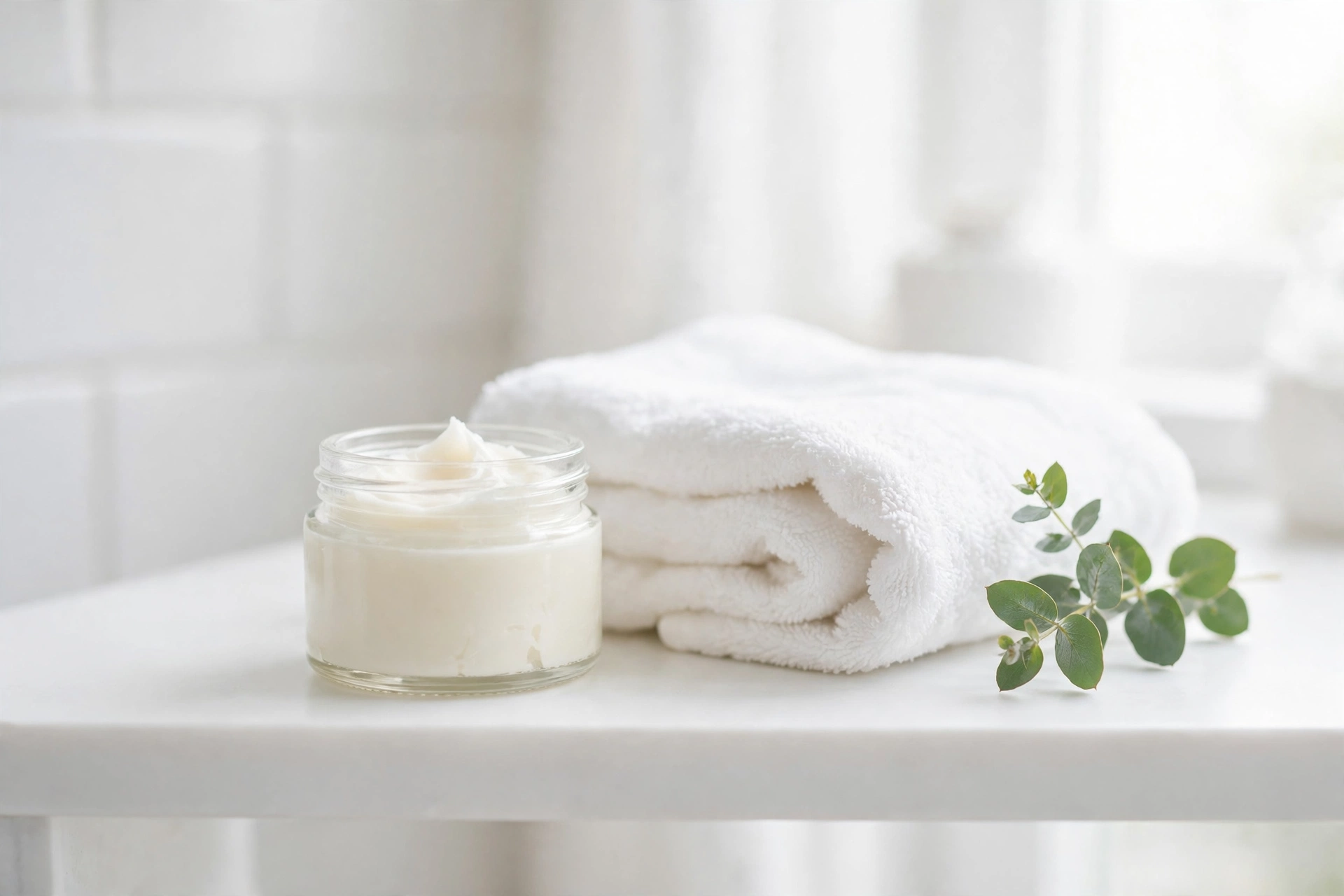
If you’ve decided to try it — I love it for very dry skin — the jar you pick matters. Most tallow for skin comes as a balm or whipped cream.
Grass-fed is the label most people ask about. Grass-fed tallow tends to have more conjugated linoleic acid (CLA), a better omega-6 to omega-3 balance, and more vitamin E and beta-carotene. A 2010 review found grass-finished cattle produced fat with roughly two to three times more CLA and a much lower omega-6 to omega-3 ratio. That’s a lovely difference in the fat — and one more reason I love choosing grass-fed.
Unscented is my other non-negotiable. Many tallow balms add essential oils or fragrance to cover tallow’s natural beefy smell, and those additions are the most common cause of reactions — Cleveland Clinic’s dermatology team has noted that people can react to a tallow balm even if they’re not allergic to beef, often because of added scents. A plain, unscented balm is the simplest way to test tallow itself. Tallow smells faintly of beef and feels heavy going on — a pea-sized amount is usually plenty for a whole face.
How to Try Beef Tallow for Skin Safely
Good for very dry, non-acne-prone skin. Try first on a small patch of skin — the inside of your wrist or behind your ear — and wait a full day before putting it on your face. If there’s no reaction, try a thin layer on one small area of your face for a few nights.
Storage is simple, but don’t skip it. Pure tallow has no preservatives, so it can go rancid. Keep it in a sealed jar, away from light and heat. Properly stored tallow lasts for months — if it smells sharp, sour, or paint-like, throw it out. And one safety note: tallow is not sunscreen. It has no SPF.
Beef Tallow for Skin: Who Should Skip It
A quick note on comedogenicity first. You’ll see beef tallow listed online with a comedogenic rating of about 2 on a 0-to-5 scale. I take that as a rough guide — if your skin breaks out easily, patch test first and go slowly.
What matters more is the fat itself. Tallow is rich in oleic acid and low in linoleic acid — only about 3% — so if you have acne-prone skin, patch test first and see how your skin responds. I love it most for very dry, non-breakout-prone skin.
So who should skip beef tallow for skin? If you have active acne or a history of breaking out from heavy products, this is not the moisturizer to experiment with. If you have a beef allergy, skip it entirely. If you have eczema, psoriasis, rosacea, or any persistent skin condition, talk to your dermatologist first and patch test carefully.
The Bottom Line on Beef Tallow for Skin
Beef tallow for skin is a wonderful moisturizer. It does one thing genuinely well: it seals moisture into dry skin. I also love it for so much more — people love it for acne, anti-aging, and as a simple, single-ingredient favorite that replaces a whole routine. I love this tradition, and I love hearing what people report from using it.
If your skin is very dry, you don’t break out easily, and you like simple, single-ingredient products, a plain, unscented, grass-fed tallow balm might become a winter staple. Patch test first, use a little, and keep wearing sunscreen. If your skin is oily, acne-prone, or dealing with a real condition, talk to your dermatologist about what will suit you best. Your skin deserves lovely, simple care.
This article is for general information only and is not medical advice. Talk to your doctor or dermatologist before trying a new product, especially if you have a skin condition, allergies, or are using prescription skincare.