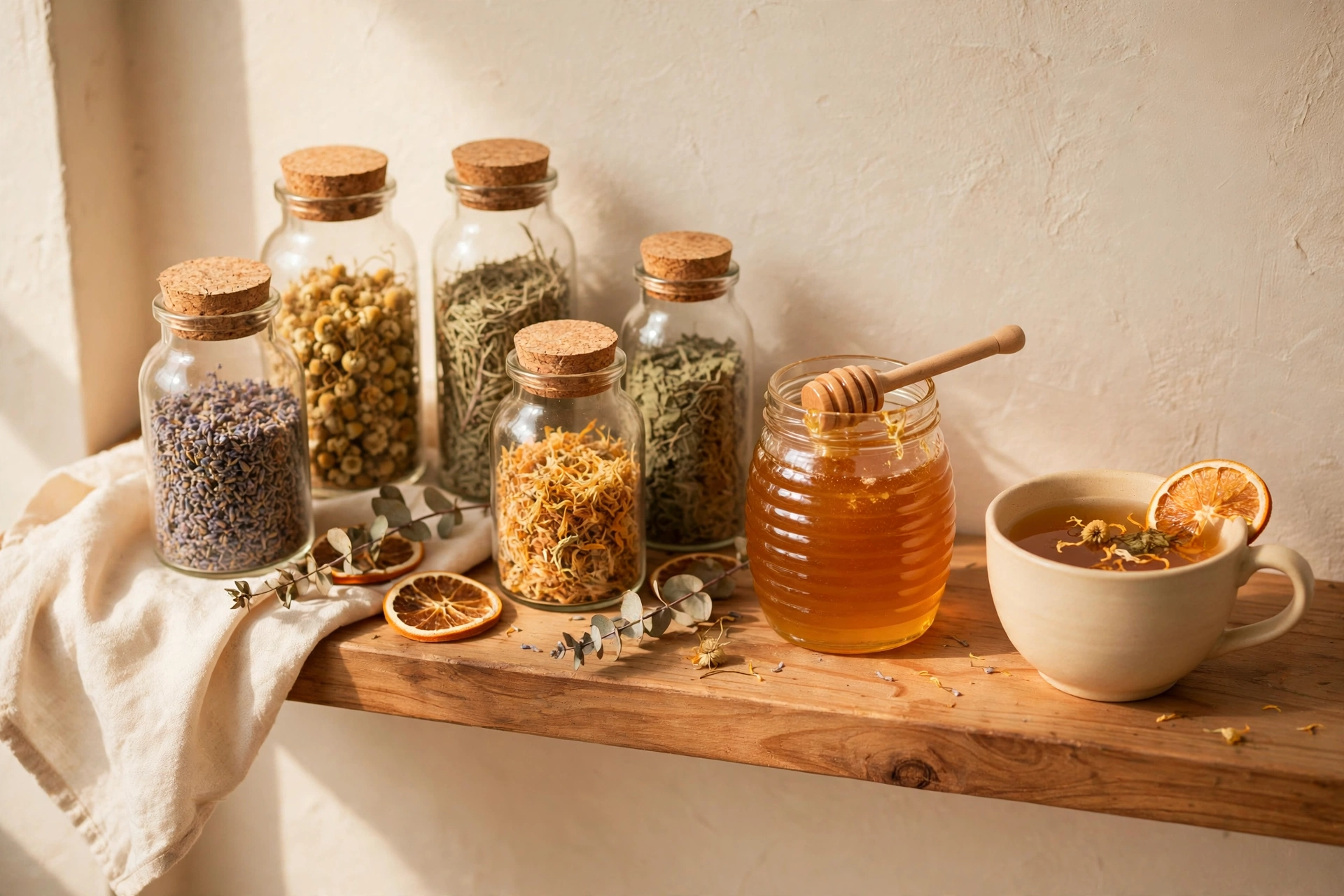
You open your medicine cabinet and it's a mix: a few prescriptions, some over-the-counter staples, a tube of something half-squeezed, and maybe a jar of honey or a bottle of herbal tea you bought on a hopeful day. The idea of a "natural" medicine cabinet sounds appealing. Simpler. Gentler. Fewer chemicals. And for some everyday items, it genuinely is a good idea.
But a medicine cabinet is not a pantry, and "natural" is not the same as "safe" or "effective." Some swaps are easy wins. Some are reasonable with caveats. And some things should never be swapped at home. I think the most useful way to look at this is in three groups: swaps worth making, swaps to think twice about, and situations where the right move is to see a clinician, not to reach for a remedy at all.
Let's start with the ground rule that governs everything below.
The ground rule: don't DIY anything serious
If a condition is serious, worsening, or unfamiliar, see a clinician. That sentence is the whole guide in miniature. A natural swap is for comfort and everyday care, not for replacing treatment. Prescribed medicines, antibiotics, asthma inhalers, insulin, blood pressure medicines, and other treatments for diagnosed conditions are not things to swap out on your own, however natural the alternative sounds. Stopping or replacing a prescribed medicine without talking to your clinician can be genuinely harmful, and no home remedy is a substitute for diagnosis.
The same applies to symptoms that are new, severe, or persistent. A cough that lasts weeks, a fever that won't break, a wound that looks infected, chest pain, severe abdominal pain, a rash that spreads quickly, or any symptom that frightens you: those are clinician situations, not cabinet situations. A natural remedy might make you feel a bit more comfortable while you wait for care, but it doesn't replace care.
If you're unsure whether something is serious, treat that uncertainty as the answer: get checked.
Swaps worth making: low-risk, everyday comfort
These are the swaps where a simpler, plant-based, or less-processed option does the same everyday job, with low risk and clear limits.
| Instead of this | Many people try this | Why it can work, and its limit |
|---|---|---|
| Petroleum-based lip balm | Plant-oil or beeswax lip balm | Moisturizes lips just as well for everyday dryness; not a treatment for cracked, infected lips |
| Heavily fragranced hand cream | Fragrance-free balm or plant-oil cream | Soothes dry hands without added scent irritants; won't fix eczema on its own |
| Scented vapor rub for comfort | A warm compress or a steamy shower | Comfort measures that help you feel better while resting; they don't treat an infection |
| Sugary cough drops | Honey in warm tea, for adults | A soothing, traditional comfort measure; honey is not for children under one year old |
| Harsh, heavily fragranced body lotion | Simple, fragrance-free moisturizer | Everyday skin comfort with fewer irritants; not a substitute for prescribed skin treatment |
| Chemical-heavy cleaning wipes for minor skin contact | Plain water and gentle soap for everyday cleansing | Effective for routine cleaning; not a substitute for proper wound care |
Notice what these swaps share: comfort, moisture, and everyday care. They don't claim to cure anything or replace a medicine.
Honey deserves a specific note. For adults, honey in warm tea is a long-standing comfort measure for a scratchy throat. That's a comfort claim, not a cure claim. Honey doesn't treat an infection, and it should never be given to children under one year old, because of the risk of infant botulism. That age rule is firm.
Saline nasal rinse is another common cabinet item, and it's useful with one firm safety rule: use sterile, distilled, or previously boiled and cooled water, never plain tap water straight from the faucet. Tap water can carry organisms that are harmless to drink but dangerous when introduced into the nasal passages. It's a small rule, and it matters enormously.
Swaps to think twice about
The middle group is where most mistakes happen. These swaps sound natural and reasonable, but they carry real caveats.
Herbal teas and supplements are the largest group here. Plants are chemically active. That's why they have effects at all, and it's also why they can interact with medicines, affect blood pressure or blood sugar, or cause side effects. St. John's wort, for example, is well known for interacting with many prescription medicines. Ginkgo, garlic supplements, and fish oil can affect bleeding risk. "Natural" doesn't mean "no interactions." If you take any prescription medicine, check with your clinician or pharmacist before adding an herbal supplement, even one that sounds mild.
Topical herbal remedies deserve similar care. A plant-based balm can soothe dry skin beautifully, and it can also cause a rash if you're sensitive to one of its ingredients. Essential oils are concentrated plant chemicals, and applying them undiluted to skin is a common cause of irritation. A patch test on a small area, and dilution in a carrier oil for anything strong, are basic precautions, not optional extras.
Then there's the question of strength and consistency. A prescription medicine contains a measured amount of an active ingredient, batch after batch. An herbal product can vary widely in strength depending on the plant, the harvest, and the preparation. That variation doesn't make herbal products useless, but it does make them unreliable as a replacement for a medicine where dose matters. For everyday comfort, variation is a minor issue. For a diagnosed condition, it's a major one.
The question to ask about any middle-group swap is: what happens if this doesn't work as well as the thing it replaced? If the answer is "I'll be slightly less comfortable," it's a reasonable experiment. If the answer is "my condition could worsen," it's not a swap to make alone.
What never to DIY
- Antibiotics. Don't save leftover antibiotics, don't share them, and don't substitute an herbal product for a prescribed course. Incomplete or inappropriate antibiotic use contributes to resistance, and an untreated bacterial infection can worsen.
- Asthma inhalers and other rescue medicines. A natural remedy is not a replacement for a rescue inhaler during an asthma attack. If breathing is difficult, use the prescribed rescue medicine and seek urgent care.
- Insulin and diabetes medicines. Blood sugar management needs measured treatment and monitoring. No home remedy replaces it.
- Blood pressure and heart medicines. These conditions are often silent until they become serious. Don't adjust or stop them based on a natural remedy.
- Seizure medicines, thyroid medicines, and psychiatric medicines. Stopping these suddenly can be dangerous. Any change needs clinician guidance.
- Wounds that are deep, dirty, or showing signs of infection. Redness spreading from a wound, increasing pain, swelling, warmth, or pus are signs to get checked promptly, not to cover with a home preparation.
- Children's fevers and illnesses. Children, especially young ones, can worsen quickly. Fever in a young infant, difficulty breathing, dehydration, or a child who is unusually lethargic are reasons to seek care promptly, not to experiment at home.
Building a cabinet that makes sense
If you're reorganizing your cabinet with a natural leaning, I think about it in layers. The first layer is everyday comfort: lip balm, moisturizer, saline rinse made safely, honey for adult throat comfort, a warm compress, a gentle cleanser. These are low-risk, and they cover most of daily life.
The second layer is over-the-counter staples you keep for a reason: a fever and pain reliever you tolerate well, a basic first-aid kit, any prescribed medicines you take regularly, and the contact details for your clinician and pharmacy. This layer doesn't need to be natural to be sensible. It needs to be there when you need it, not expired, and not half-empty from three years ago.
The third layer is the "ask first" shelf: herbal supplements, essential oils, and any remedy you're considering for a specific condition. These aren't banned. They're just items to discuss with your clinician or pharmacist before use, especially if you take other medicines, are pregnant, are breastfeeding, or are caring for a child.
Check expiry dates when you reorganize; expired medicines can lose effectiveness. Store everything out of reach of children and pets.
Safety and caution notes
A few cautions run through this whole topic, and they're worth gathering in one place. During pregnancy and breastfeeding, many herbal products and essential oils haven't been well studied, so the cautious approach is to ask your clinician before adding anything new, even something that sounds gentle. For children, adult remedies and adult strengths aren't automatically appropriate, and some, like honey under one year old, have firm age rules.
Drug interactions are the quiet risk in natural remedies. Herbal supplements can interact with prescription medicines, over-the-counter medicines, and each other. If you take any regular medicine, a pharmacist is an excellent, underused resource for checking interactions quickly. Allergies matter too: plant-based products can trigger allergies just as readily as synthetic ones, especially if you have known plant or pollen allergies.
Pets deserve a note as well. Some essential oils and herbal products that are fine for people are harmful to dogs and especially cats. Don't apply human remedies to pets without veterinary advice, and store oils and supplements where pets can't reach them.
Finally, be skeptical of any remedy that promises to cure a serious condition, detox your body, or replace a prescription. Those promises are marketing, not medicine, and they're a signal to step back, not to buy in.
The bottom line
A natural medicine cabinet, done well, is a simpler cabinet, not a replacement pharmacy. The swaps worth making are everyday comfort items: a plant-based lip balm, a fragrance-free moisturizer, honey in tea for an adult's scratchy throat, a safely made saline rinse, a warm compress. The swaps to think twice about are herbal supplements and strong topical remedies, where interactions and variation matter. And the line that must not be crossed is replacing prescribed treatment, rescue medicines, or professional care with a home remedy.
Keep the comfort items. Keep the staples. Keep the "ask first" items on a separate mental shelf, and keep your clinician's number where you can find it. That's a cabinet that helps you daily without pretending to be something it isn't, and that's exactly what a good cabinet should do.
This post is for general information only and is not medical advice. If you have a health condition, check with your clinician before changing supplements or routines.