How to Read a Cleaning Product Label (And What Ingredients to Avoid)
Quick Answer: Reading a cleaning product label means checking four key sections: directions, signal words, ingredients, and storage/disposal. To protect your family, avoid ingredients like ammonia, phthalates, synthetic “fragrance,” and ethoxylated surfactants (look for names ending in “-eth”). Third-party certifications like the EPA Safer Choice seal are your fastest shortcut to a safer product.
Key Takeaways 🌿
- Every cleaning label has four core sections: directions, caution/signal words, ingredients, and storage/disposal.
- Signal words — Danger, Warning, Caution — tell you exactly how hazardous a product is at a glance.
- Ingredients are listed by weight (heaviest first), so the first few ingredients matter most.
- Watch out for “fragrance” on the label — it’s a catch-all term that can hide dozens of undisclosed chemicals.
- Ingredients ending in “-eth” (like sodium laureth sulfate) may contain 1,4-dioxane, a likely carcinogen.
- Pictograms (skull, flame, exclamation point) give quick visual hazard clues — learn to read them.
- Third-party seals like EPA Safer Choice and Green Seal are more trustworthy than vague marketing claims.
- “Natural” and “eco-friendly” on the front label mean nothing without certification to back them up.
- Manufacturers are required to post each ingredient’s CAS Registry Number on their product website.
What Are the Four Main Sections of a Cleaning Product Label?
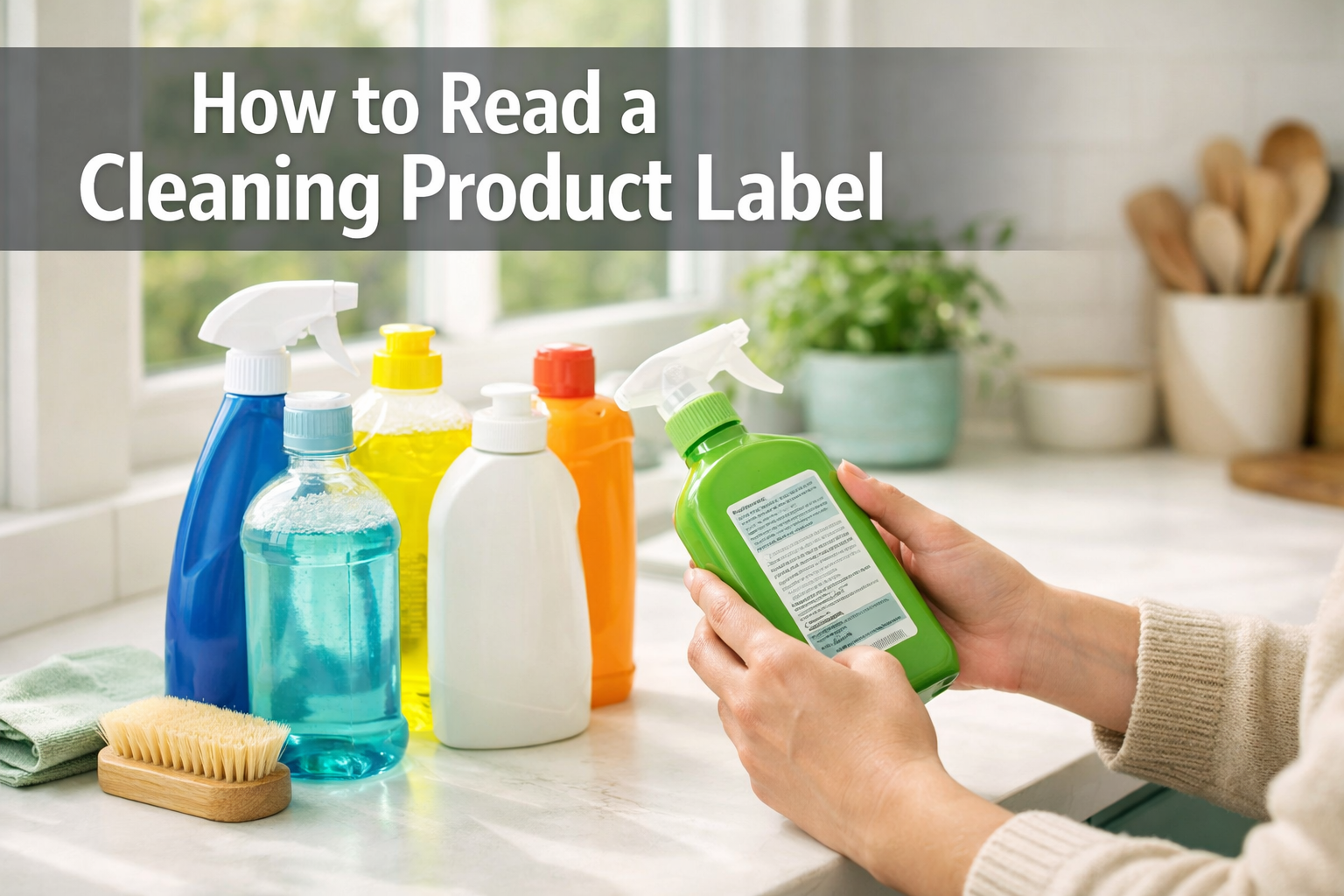
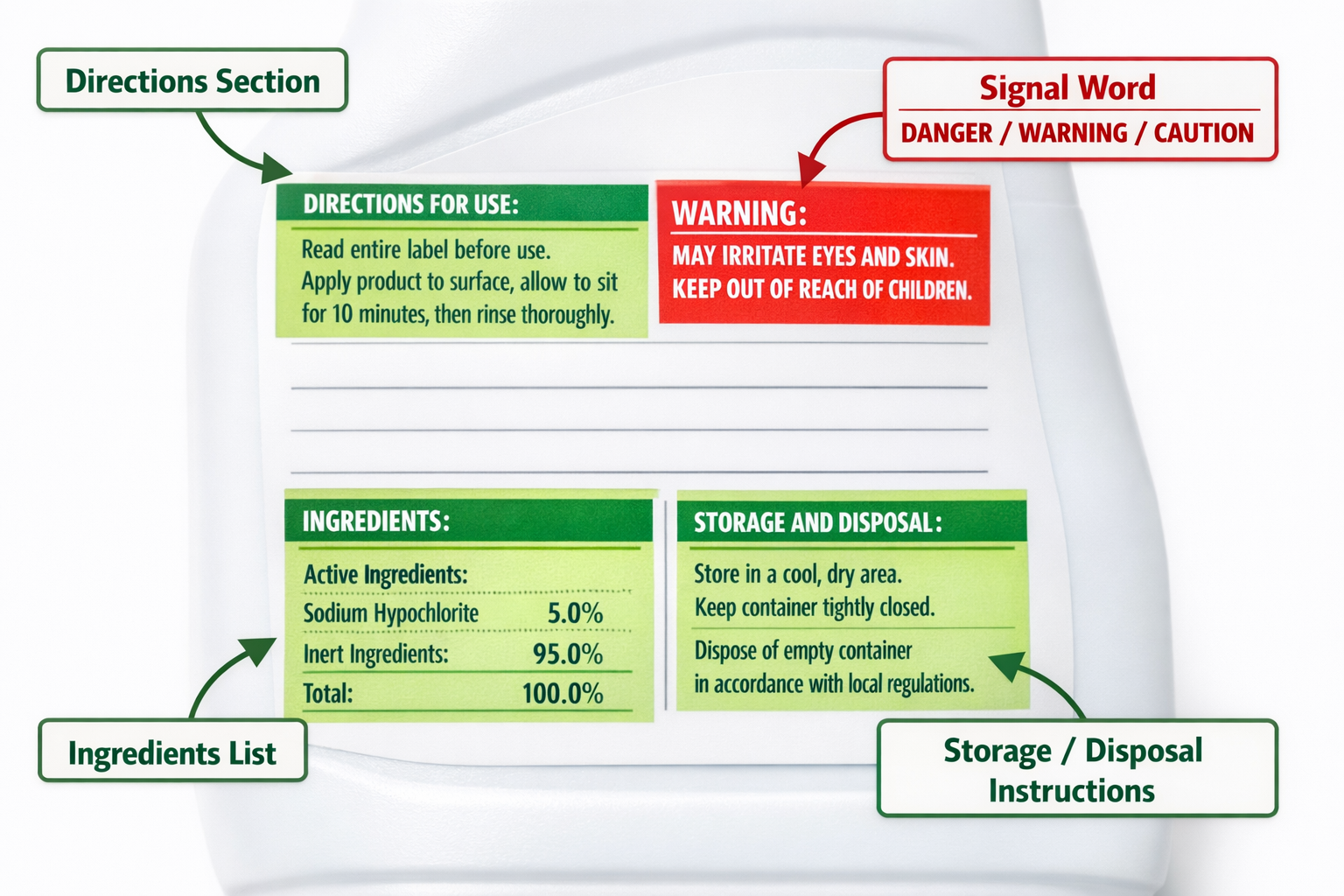
Every cleaning product label is built around four core sections. Knowing where to look saves time and helps spot red flags fast.
Here’s what each section covers:
| Section | What It Tells You |
|---|---|
| Directions | How to use the product safely and effectively |
| Signal Words / Warnings | How hazardous the product is (Danger, Warning, Caution) |
| Ingredients | What’s actually in the bottle |
| Storage & Disposal | How to store it safely and get rid of it properly |
The American Cleaning Institute recommends reviewing all four sections before using any new product. Most people only read the front label — which is exactly where brands put their best marketing spin.
💡 Quick tip: Flip the bottle over. The back and sides are where the real information lives.
How Do Signal Words and Pictograms Work?
Signal words are required by law and communicate hazard severity in plain terms. They appear prominently on the label and fall into three levels:
- DANGER — Most severe. Can cause serious injury, death, or irreversible harm.
- WARNING — Moderate hazard. Can cause harm if misused.
- CAUTION — Lowest hazard level. Still requires careful handling.
Alongside signal words, hazard pictograms give fast visual cues. Common ones include:
- 💀 Skull and crossbones — Toxic if swallowed, inhaled, or absorbed through skin
- 🔥 Flame — Flammable or combustible
- ❗ Exclamation mark — Irritant, may cause skin or eye irritation
- ☠️ Health hazard — May cause serious long-term health effects
Common mistake: Many people assume “Caution” means a product is safe. It still means handle with care, keep away from children, and follow directions exactly.
How to Read the Ingredients List on a Cleaning Label
Ingredients are listed in descending order by weight, so the first few ingredients make up the bulk of the product. Ingredients that make up less than 1% of the formula can appear in any order at the end of the list.
What this means for you:
- If water is first, the product is mostly water-based (usually a good sign).
- If a harsh solvent or surfactant is first, that chemical dominates the formula.
- Short ingredient lists are generally easier to evaluate.
Manufacturers are also required to publish each ingredient’s CAS Registry Number on their website, along with an explanation of why it’s included. If a brand doesn’t provide this, that’s worth noting.
What Ingredients Should Be Avoided in Cleaning Products?
Several common cleaning ingredients are linked to health concerns, especially for kids, pregnant women, and people with sensitivities. Here are the main ones to watch for:
🚫 Ingredients to Avoid
1. Synthetic Fragrance
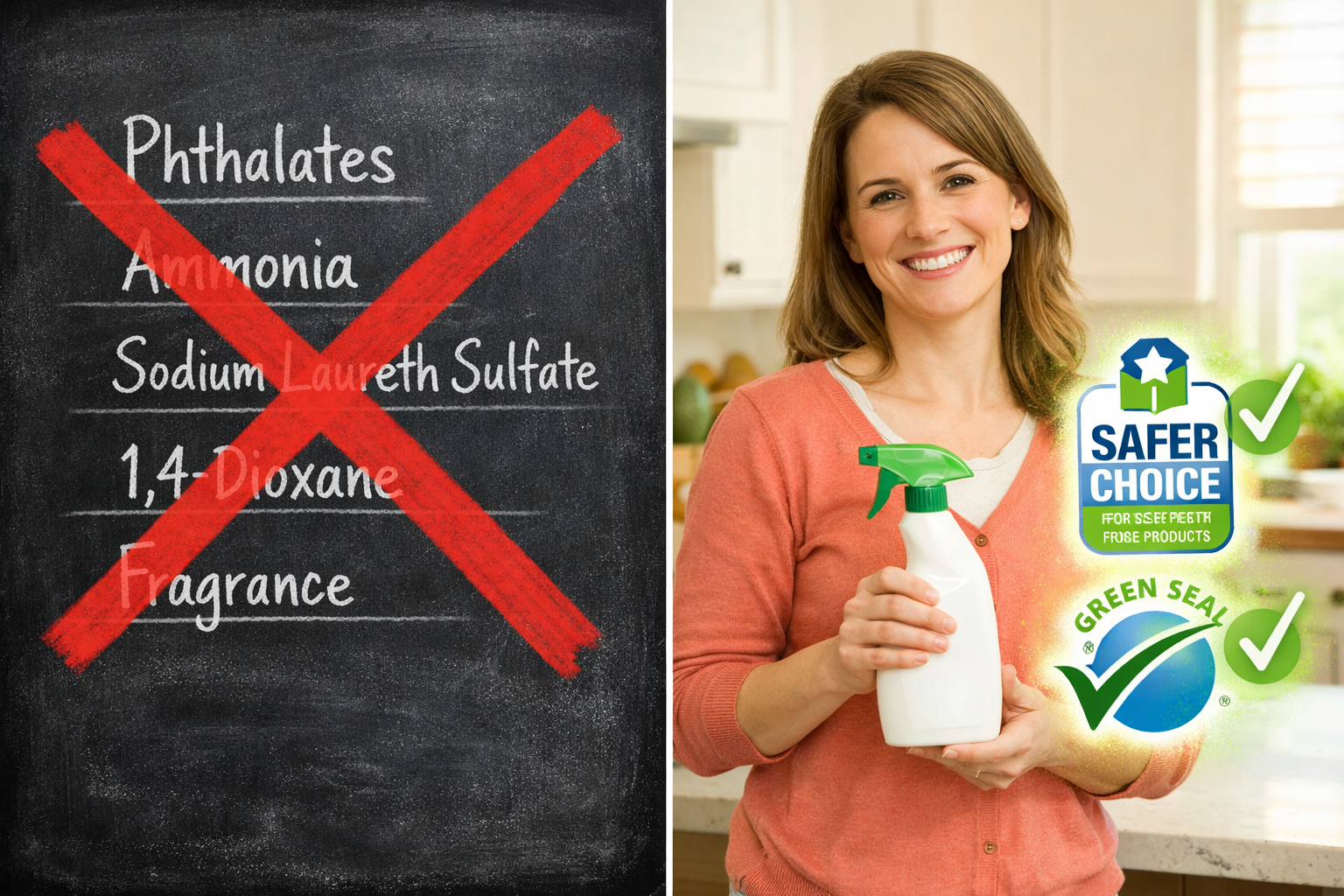
The word “fragrance” (or “parfum”) on a label is a legal loophole. It can represent a blend of dozens of undisclosed chemicals, some of which are known allergens or hormone disruptors. Choose products that list every scent ingredient individually or use essential oils.
2. Ethoxylated Surfactants (the “-eth” ingredients)
Look for names like sodium laureth sulfate (SLES) or laureth-6. These are created through a process that generates 1,4-dioxane as a byproduct — a likely carcinogen and neurotoxin. The tricky part: 1,4-dioxane itself doesn’t appear on the label because it’s a manufacturing byproduct, not an added ingredient.
3. Ammonia
A strong irritant to the eyes, skin, and lungs. Especially problematic for people with asthma. Never mix ammonia-based cleaners with bleach — the combination creates toxic chloramine gas.
4. Phthalates
Often hidden inside “fragrance.” Phthalates are endocrine disruptors linked to hormonal issues and are of particular concern for children and pregnant women.
5. Chlorine Bleach (Sodium Hypochlorite)
Effective at disinfecting, but harsh on airways and skin. Products certified USDA organic are prohibited from containing chlorine bleach.
6. Quaternary Ammonium Compounds (“Quats”)
Found in many disinfectant sprays. Associated with respiratory irritation and potential antibiotic resistance with long-term exposure.
How to Spot Greenwashing on a Cleaning Label
Greenwashing is when a product uses vague, feel-good language to appear safer or more eco-friendly than it actually is. It’s extremely common in the cleaning aisle.
Red flag phrases to be skeptical of:
- “Natural”
- “Green”
- “Plant-based” (without specifics)
- “Eco-friendly” (without certification)
- “Non-toxic” (self-declared, no standard definition)
What to trust instead:
Third-party certifications are far more reliable than marketing claims because an independent organization has actually reviewed the formula. Look for:
- EPA Safer Choice — Evaluates every ingredient for human health and environmental safety
- Green Seal — Requires low toxicity, limited VOCs, no carcinogens, and reduced carbon footprint
- USDA Organic — Prohibits synthetic chemicals including bleach and ammonia
“Third-party certifications from organizations like the EPA provide verification that products meet specific safety standards — helping consumers identify legitimate eco-friendly products versus greenwashing.”
Choose a certified product if: You want confidence without having to decode every ingredient yourself. Choose to read the full ingredient list if: the product makes bold claims but carries no certification.
Step-by-Step: How to Read a Cleaning Product Label Like a Pro
Here’s a simple process to use every time a new product comes into the house:
- Check the signal word first. If it says DANGER, decide whether the risk is worth it for your household.
- Look at the pictograms. Skull, flame, or health hazard symbols tell you what kind of risk you’re dealing with.
- Scan the first three ingredients. These make up the majority of the product.
- Search for red-flag terms: fragrance, any “-eth” ingredient, ammonia, bleach, quats.
- Check for third-party certification seals. EPA Safer Choice or Green Seal on the label is a strong positive signal.
- Read the directions. Proper dilution and ventilation matter even for safer products.
- Check storage and disposal. Some products require specific disposal methods to avoid environmental harm.
FAQ: Reading Cleaning Product Labels
Q: Is “fragrance-free” the same as “unscented”?
No. “Unscented” products may still contain masking fragrances to cover up chemical smells. “Fragrance-free” means no fragrance ingredients were added at all — the safer choice for sensitive households.
Q: Do cleaning products have to list all their ingredients?
In the U.S., full ingredient disclosure on the label itself isn’t always required, but manufacturers must post complete ingredient information including CAS numbers on their websites.
Q: What does “Danger” on a label actually mean?
It means the product poses a severe hazard — it could be highly toxic, corrosive, or flammable. Products labeled Danger should be stored locked away from children and used only with proper ventilation and protective gear.
Q: Can a product be “plant-based” and still contain harmful ingredients?
Yes. “Plant-based” describes the origin of certain ingredients, not the safety of the whole formula. A product can use plant-derived surfactants alongside synthetic fragrances or preservatives.
Q: Are EPA Safer Choice products completely non-toxic?
They’re formulated to minimize risk, but “safer” doesn’t mean zero risk. Always follow directions, even with certified products.
Q: What is 1,4-dioxane and why isn’t it on the label?
1,4-dioxane is a byproduct created during the manufacturing of ethoxylated surfactants. Because it’s not intentionally added, it doesn’t appear on ingredient lists. Avoiding “-eth” ingredients is the best way to reduce exposure.
Q: Is “biodegradable” a regulated term on cleaning labels?
No. “Biodegradable” has no standard legal definition in the U.S. for cleaning products, so it can be used loosely. Look for certified products instead.
Q: What’s the safest way to dispose of harsh cleaning products?
Check the disposal section of the label. Many products with DANGER or WARNING signals should not go down the drain or into regular trash — local hazardous waste collection programs are the right option.
Conclusion: Small Label Habits, Big Health Wins
Learning how to read a cleaning product label (and what ingredients to avoid) doesn’t require a chemistry degree. It just takes knowing where to look and what to look for.
Actionable next steps:
- This week: Pick up one cleaning product from under your sink and run through the 7-step label check above.
- This month: Swap out any products with “fragrance,” “-eth” ingredients, or ammonia for certified alternatives.
- Ongoing: Bookmark the EPA Safer Choice product search to find vetted options by category.
The front of the bottle is marketing. The back of the bottle is information. Once the habit of flipping the bottle clicks, making safer choices for the whole family becomes second nature. 🌱