If you’ve ever been curious about fasting but stopped at the idea of going days without food, Prolon is built for exactly that hesitation. It’s a 5-day program that mimics a fast — you still eat every day, but the food is so precisely formulated that your body stays in a fasting state. Here’s what it actually is, how the five days work, and whether it’s worth trying.
What Is Prolon?
Prolon is a fasting mimicking diet (FMD) created by Dr. Valter Longo, a biologist and researcher at the University of Southern California’s Longevity Institute, and sold by his company L-Nutra. The idea comes from decades of fasting research: prolonged fasting triggers useful processes in the body — fat burning, ketone production, and cellular clean-up called autophagy — but a water-only fast for five days is hard, unpleasant, and not recommended without medical supervision.
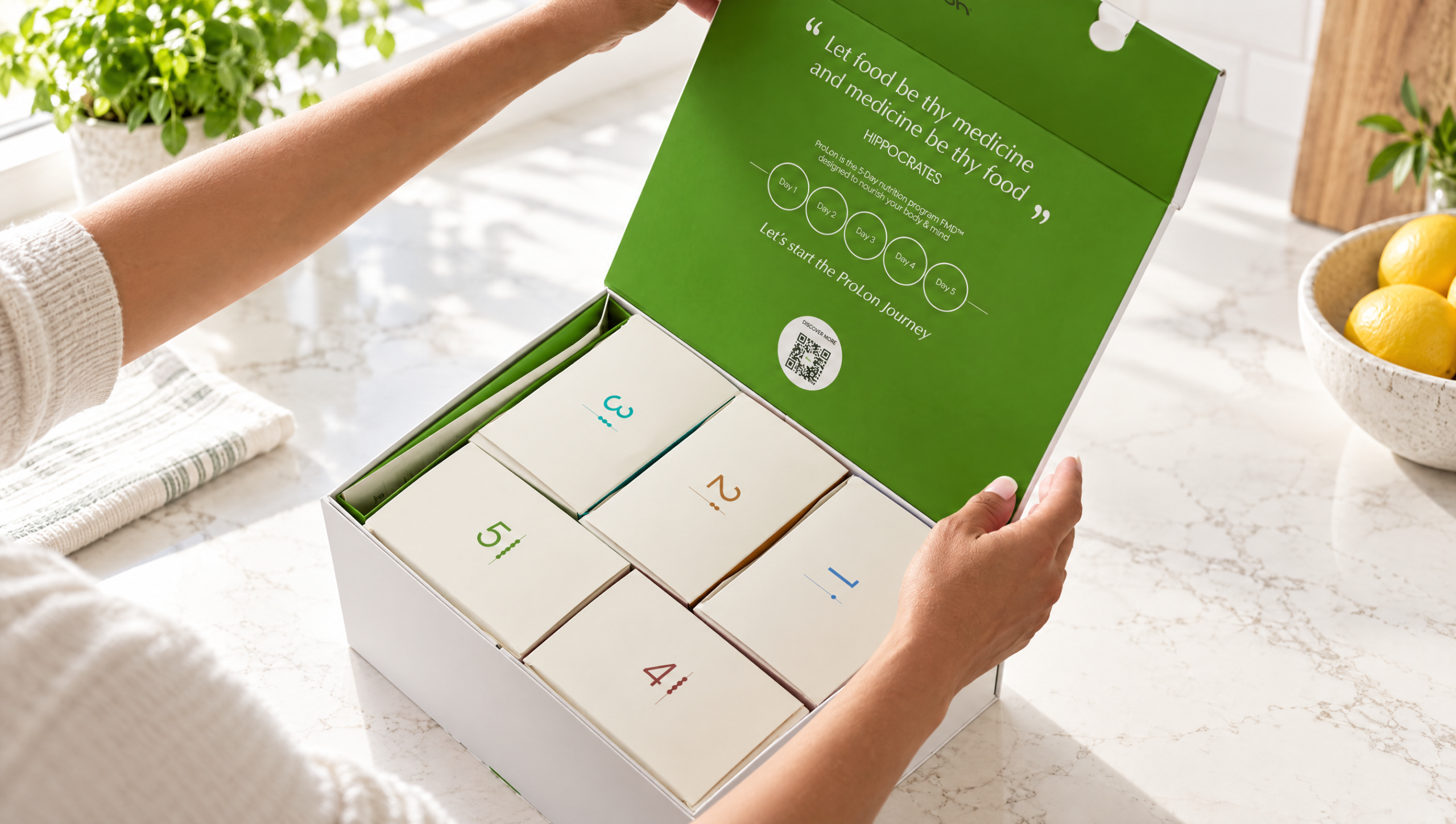
Prolon’s workaround is a box of pre-portioned, plant-based food for five days. The meals are low in calories and protein and relatively low in sugar, which keeps nutrient-sensing pathways quiet enough that your body behaves as if it’s fasting, even though you’re eating soups, bars, crackers, olives, and tea. Each day comes in its own numbered box, so there’s no measuring, no cooking decisions, and no guesswork — you open the day’s box and eat what’s in it.
What’s in the ProLon Box
Every day includes a combination of:
- Plant-based soups (the main meals)
- Nut-based bars
- Kale crackers
- Olives
- Herbal teas
- Snacks
- L-Drink, a glycerol-based drink supplied on days 2 through 5, designed to help protect muscle while calories are low
Day 1 runs around 1,100 calories. Days 2 through 5 drop to roughly 700 to 800 calories per day. Everything is plant-based, and the portions and order matter — you’re not meant to swap food between days, because the sequence is what keeps your body in a fasting state across the full five days.
What’s in the ProLon Box, in Detail
The post above covers the broad strokes, but the details matter when you’re deciding which kit to order.
First, there are three soup ranges to choose from. The Original set includes Vegetable, Minestrone, Minestrone Quinoa, Mushroom, and Tomato. The Gen3 set includes Red Bell Pepper & Onion, Green Pea & Chives, and Lentil Curry. It also includes Chickpea & Leeks and Carrot Ginger. Also, an Expanded variety adds extra-virgin olive oil, fasting bars, and a fasting shake.
The nut bars are cold-pressed, made with whole ingredients like almonds, macadamia nuts, and pecans. The kit also includes a daily supplement packet with multivitamins, amino acids, minerals, and omega-3. Finally, the L-Drink is a fruit-flavored glycerol drink for days 2 through 5. You mix it to your body weight, following the leaflet in the box.
Each day’s food comes in its own labeled box, with a meal card suggesting the order. You can eat that day’s items in any order. Still, nothing moves between days. Subscribers also get a free welcome kit with a water bottle and a Getting Started Guide.
How the ProLon 5 Days Work
Day 1: Transition. Your body starts shifting from its normal fed state into a fasting state and begins burning fat for fuel.
Day 2: Fat burning and ketogenesis. Fat burning ramps up and ketone production begins. By the end of day 2 (around 48 hours in), ketosis may start.
Day 3: Autophagy. This is the day most people are doing Prolon for — cellular clean-up, where the body breaks down and recycles damaged cell components. Fat burning and ketone use continue and increase.
Day 4: Cellular rejuvenation. Clean-up and renewal continue, and you’re in the final stretch.
Day 5: Renewal. The fast completes, and the brand notes that cellular renewal continues beyond day 5 as you return to normal eating.
After the five days, there’s a transition day back to regular food — you don’t jump straight from 700 calories to a full normal diet.
What the ProLon Research Actually Shows
Prolon is one of the few fasting products with real clinical studies behind it, which is a genuine point in its favor. In a clinical study of participants who completed a 5-day cycle once a month for three months, the average weight loss was about 5.7 pounds, mostly abdominal fat, while lean body mass was largely preserved. That’s a study result, not a guarantee — individual results vary, and some of the loss in any short program includes water weight.
The brand and its research team generally recommend cycles spaced out rather than back-to-back: an initial phase of once a month for a few months, then maintenance cycles every few months, with normal eating in between. Some sources cite 2 to 6 cycles per year as the typical range.
The Honest ProLon Downsides
Prolon is not for everyone, and the downsides are worth stating plainly:
- It’s a premium-priced program. This is a full 5-day kit, not a grocery run, and the cost is the most common complaint in reviews.
- The food gets repetitive. Five days of soups, bars, and crackers is a narrow menu, and some people find it boring by day 3.
- Day 2 is the hardest. Hunger and low energy peak early, and headaches are common as the body adjusts.
- Five days is a real commitment. You need a week where a strict, low-calorie program fits your life — not a travel week, not a celebration week.
- It’s not suitable for everyone. Anyone who is pregnant or nursing, underweight, has a history of eating disorders, or takes medication affected by fasting (including diabetes medication) should check with a clinician first. Fasting programs are not a substitute for medical care.
What to Know Before Buying ProLon
Before you order, I’d plan the week around it, not the other way around. The brand recommends picking a calm week: no travel, no celebrations, and no strenuous exercise. It also recommends drinking at least 2.5 liters of water a day.
During the five days, you eat only what’s in the kit, plus water. The brand’s UK guidance allows at most one small cup of black coffee a day. Add nothing to it, and only have one if you really need it.
Day 6 matters as much as the fast itself. The brand recommends a transition day of liquids and soft foods first. Start with smoothies. Then move to light meals like rice or pasta, with small portions of fish or legumes and vegetables. From day 7, return to a normal diet.
As for how often, the brand’s suggested rhythm is two cycles a year for healthy aging. Choose three if you also want weight loss. Or go monthly for three to four months, then quarterly, if you have a specific metabolic goal. So one box is a single cycle, not a one-off fix.
Prolon vs. DIY Fasting Mimicking
A lot of people search for a DIY fasting mimicking diet plan, and it’s a fair question: can you just eat low-calorie, plant-based food for five days yourself? In principle, yes — the concept isn’t secret. In practice, the hard part is matching the precise macronutrient ratios, micronutrient levels, and calorie steps that keep the body in a fasting state while still covering essential nutrients. Prolon’s selling point is that the formulation work is already done and tested. The DIY route saves money but removes the structure and the clinical backing — and if the macros are off, you may just be on a low-calorie diet rather than a true fasting mimicking protocol.
Who Is ProLon For?
Prolon makes the most sense if you want to try a structured fast without going without food, you value having every meal decided for you, and you want a program with published research behind it. It’s less suited to anyone who wants food variety, is on a tight budget, or prefers to build their own nutrition plan.
I’d point this at a specific kind of person. For example, think of someone generally healthy who is curious about fasting, likes structure, and wants the decisions made for them. It also suits someone who has tried fasting before and stalled on the planning. After all, the whole point of the box is that the formulation work is done.
Where I’d draw the line is clearer than where I’d recommend it. The brand says not to do it while pregnant or breastfeeding. It also says not to do it with diabetes unless your doctor authorizes it. The same goes for anyone under 18, or with a BMI below 18. And anyone with a history of an eating disorder should stay away from fasting programs entirely.
If you have a nut allergy, check the ingredients first. The bars are built on almonds, macadamia nuts, and pecans. Finally, if you take medication for blood sugar or blood pressure, the brand’s guidance is clear. Any use alongside treatment is your doctor’s call, not yours.
The Bottom Line on ProLon
I like Prolon for what it is: a well-studied, genuinely structured way to experience a five-day fast with food. The day-by-day design is thoughtful, the clinical research is real, and the box format removes the hardest part of fasting, which is the decision-making. The price and the repetitive menu are real trade-offs, and it’s not something to do casually or while managing a health condition without talking to your clinician first. If a structured reset appeals to you and the commitment fits your week, it’s one of the most credible options in the fasting space.
This post is for general information only and is not medical advice. If you have a health condition, check with your clinician before changing supplements or routines.