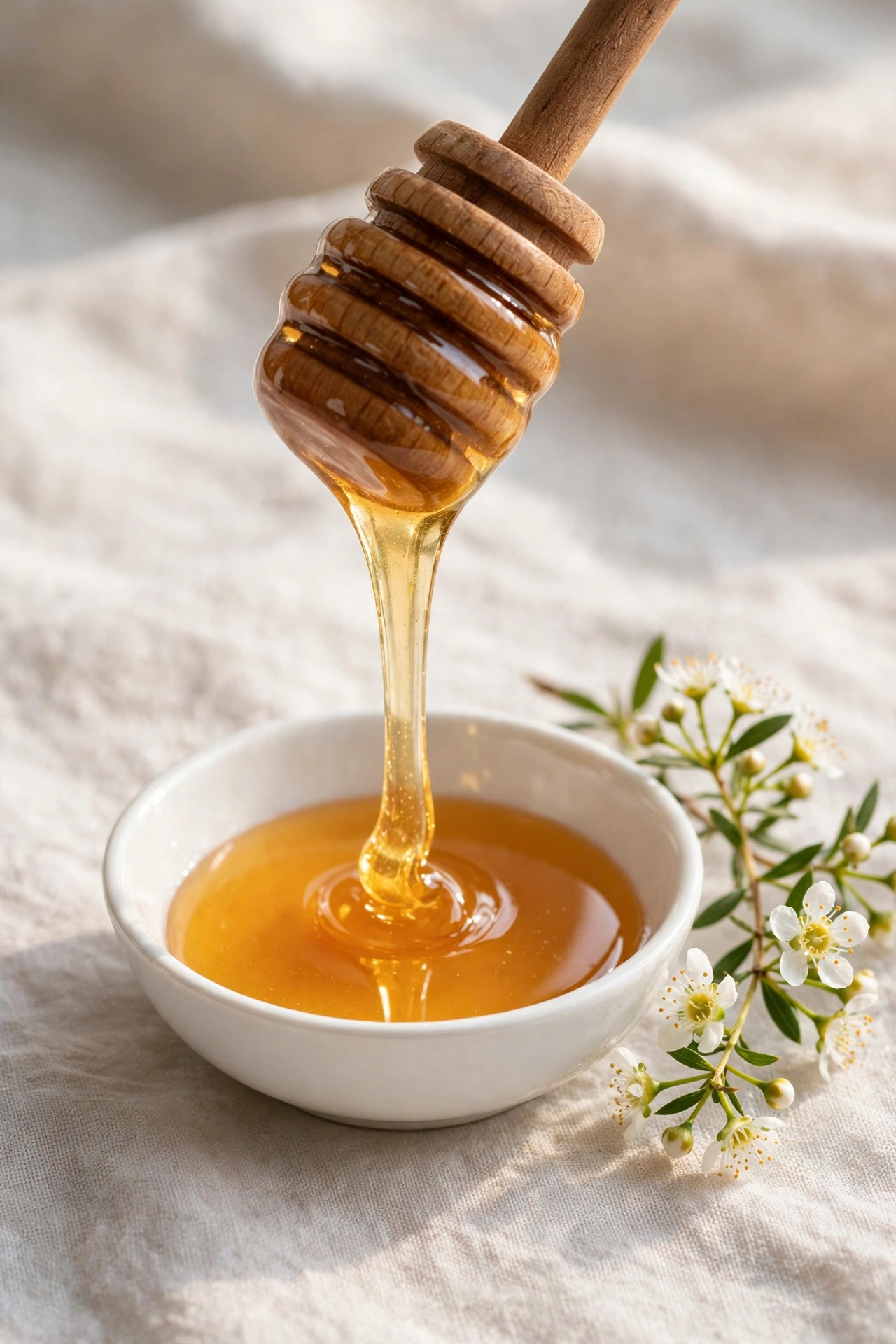
You have probably seen the jar by now — small, dark, expensive, with a number on the label that looks like a score. Manuka honey sits on shelves at several times the price of ordinary honey, and the manuka honey benefits printed on the label and repeated online are big ones: wound healing, sore throats, gut health, immunity, clearer skin. It is easy to assume a premium price means premium proof.
Here is the plain-English version: what manuka honey actually is, what the numbers on the label mean, which of those benefits have real evidence behind them, and which ones are hype dressed up as science.
What is manuka honey, exactly?
Manuka honey is honey made by bees that forage on the mānuka bush (Leptospermum scoparium), a plant native to New Zealand and parts of south-eastern Australia. The honey itself looks and tastes like honey — thick, golden, sweet — but it contains something ordinary honey barely has: methylglyoxal, usually shortened to MGO.
MGO is the compound behind manuka’s reputation. In 2008, German food chemists found that six New Zealand manuka honeys contained 38 to 761 mg of methylglyoxal per kilogram — up to 100 times more than conventional honeys. In the lab, that manuka stopped the growth of E. coli and Staphylococcus aureus even when diluted to 15 to 30 percent. That lab result is real, and it is also where the story gets complicated: killing bacteria in a dish is not the same as healing a person.
The honest frame is simpler: manuka honey is honey with an extra antibacterial compound. It is still honey — mostly sugar — and most of what it can do, it does the same way any honey does.
MGO and UMF ratings, explained
The numbers on the jar are the first thing to understand, because they are what you are paying for. There are two rating systems, and they measure different things.
MGO is the simplest: it is the amount of methylglyoxal in milligrams per kilogram of honey. MGO 400+ means at least 400 mg/kg. Higher number, more of the compound.
UMF stands for Unique Mānuka Factor. It is a grade from the UMF Honey Association, a New Zealand industry body that licenses producers. UMF is the broader measure: it checks four markers — MGO, leptosperin (a compound specific to mānuka), DHA, and HMF — and a jar with a valid UMF rating has been independently tested. The UMF Honey Association is blunt that MGO does not convert to UMF, because UMF is a combination of four measures and MGO is only one.
| UMF grade | Minimum MGO (mg/kg) | What it means |
|---|---|---|
| UMF 5+ | 83 | Everyday honey |
| UMF 10+ | 261 | A good starting point for therapeutic-quality honey |
| UMF 15+ | 512 | Stronger potency |
| UMF 20+ | 826 | High potency |
| UMF 25+ | 1,197 | Top end |
The association’s own guidance is more modest than the marketing: 5+ to 10+ as an everyday honey, 15+ to 20+ when you want more potency. “Therapeutic grade” is not a UMF category or a legal one — under food law, honey is food, and food cannot carry treatment claims. When you buy, look for the UMF licence number and check the brand with the UMF Honey Association, because counterfeit manuka is a real problem and the premium price attracts it.
The manuka honey benefits with real support
So what does the honey actually do? Here is what holds up once you separate the lab results from the human evidence.
Wound healing: the best-supported use — but not from the kitchen jar
- Honey dressings heal some wounds faster. This is manuka honey’s strongest evidence, and it is narrower than the marketing suggests. A 2015 Cochrane review of 26 trials and 3,011 participants found that honey dressings heal partial-thickness burns faster than conventional dressings, and infected post-operative wounds faster than antiseptics and gauze. Beyond those two comparisons, the reviewers were clear that the evidence is low or very low quality and “does not form a robust basis for decision making” — including for venous leg ulcers and diabetic foot ulcers.
- Medical-grade is a different product. The manuka honey used in hospitals is gamma-irradiated and registered as a medical device, and the U.S. Food and Drug Administration has approved medical-grade manuka honey for wound treatment. It is sterile, standardized, and applied as a dressing. The jar in your kitchen is none of those things.
- Do not put kitchen honey on a wound. A jar from the shelf is not sterile, and spreading it on an open wound, a burn, or a surgical site risks introducing bacteria into exactly the place you are trying to protect. For any wound beyond a minor scrape, use a sterile medical-grade product under professional guidance, not the jar.
Sore throats and coughs: real comfort, but any honey does it
- Honey helps a cough. A Cochrane review of six trials in 899 children over the age of one found that honey probably reduces how often they cough compared with no treatment or a placebo, mainly in the first few days. A 2021 Oxford review of 14 studies found that honey beat usual care for relieving cold and upper respiratory symptoms, easing both how often and how hard people coughed.
- The evidence is for honey generally, not manuka specifically. Nothing shows manuka works better than ordinary honey for a cough or a sore throat. The NHS suggests hot lemon and honey for a sore throat but says the evidence is limited, and manuka has no advantage in that advice. If you like the taste and the ritual, manuka is a fine choice — but you are not buying extra sore-throat relief for the extra money.
- How people use it. At the first sign of a scratchy throat, let half to one teaspoon of honey slowly coat the throat, or stir it into warm — not boiling — tea. The warmth and the coating are doing the soothing; the MGO number is not.
Skin: promising in the lab, unproven on your face
- The lab work is genuinely interesting. Manuka honey inhibits bacteria in the lab, including Streptococcus pyogenes biofilms, and research from the University of Sydney found that manuka honey with MGO 250+ significantly reduces Streptococcus mutans, the bacteria behind tooth decay. A 2026 lab study found that antibacterial activity rose with each UMF grade, and that whole honey outperformed MGO alone — so MGO is not the only compound that matters.
- Clinical proof for acne or skin healing is thin. There are no strong clinical trials showing manuka honey clears acne or heals skin better than ordinary honey or standard skincare. It may feel soothing on irritated skin, and a thin layer as a short face mask is a low-risk experiment for most people — but anyone selling it as an acne treatment is ahead of the evidence.
- Keep the frame honest, though. The same lab strength that makes manuka interesting also makes it easy to overclaim. A compound that kills bacteria in a dish still has to survive saliva, stomach acid, and skin barriers in a person, and most of the big claims skip that step entirely.
The claims without evidence: gut health, immunity, and detox
- Gut health. The most-cited human result here is a negative one: 20 grams a day of UMF 20+ manuka honey for four weeks did not change gut bacteria in healthy adults. There is no authorised digestion claim for honey, and no good evidence that manuka improves digestion or gut health in people.
- Immunity. A 2007 study found that a component of manuka honey stimulated immune cells through TLR4 pathways in the lab, which helps explain why honey has long been used in immune and wound-healing traditions. That is a lab mechanism, not a human outcome — no trial has shown that eating manuka honey makes people get sick less often.
- Detox. There is no evidence that manuka honey detoxifies your body. Your liver and kidneys handle that internally, and no study has shown honey removes toxins.
- “Better than regular honey.” For a cough, a sore throat, or a sweetener in tea, manuka has not been shown to beat ordinary honey. The one place it clearly differs is the lab dish and the wound dressing — and the wound dressing is a medical product, not a food.
Notice what is not on the supported list: anything that requires the honey to work inside your body beyond soothing a throat. Manuka’s real strength is topical and clinical, and that is where its benefits stop.
Manuka honey benefits: what’s real and what’s hype
This is where a little honesty helps. The honey is lovely and unusual, and the MGO number is real — just not a cure-all.
| Claim | What the evidence says |
|---|---|
| Heals wounds and burns | Yes, in medical-grade dressings — not the kitchen jar |
| Soothes a sore throat | Yes, comforting — but any honey does it |
| Eases coughs from colds | Yes, modestly — honey generally, not manuka specifically |
| Clears acne | Lab evidence only — no strong clinical trials |
| Improves gut health | No evidence in people |
| Boosts immunity | Lab mechanism only — no human outcome shown |
| Detoxes your body | No evidence |
| Beats ordinary honey for colds | Not shown |
The hype to skip: any jar, video, or article claiming manuka honey “detoxes,” “heals your gut,” or “boosts immunity” as if the MGO number were a medicine. And do not buy a higher grade to chase those results — a bigger number means more methylglyoxal in the jar, not more benefit in your body.
How to use manuka honey
The manuka honey benefits worth having come from using it the way the evidence supports: as honey, with the label understood. There is no official medical protocol for eating it — the steps below are what the evidence and the UMF Honey Association’s guidance point to.
- Pick a grade for the job. For everyday eating, UMF 5+ to 10+ is the association’s own suggestion. If you want more potency, 15+ to 20+ is the range they point to. There is no reason to buy the top grade for tea.
- Check that it is real. Look for the UMF licence number on the label and verify the brand with the UMF Honey Association. Counterfeit manuka is common precisely because the price is high.
- Use it in warm, not boiling, liquid. Stir it into warm tea or warm water. Boiling water is not needed and heat degrades the honey’s more delicate compounds.
- For a sore throat, let it coat the throat. Half to one teaspoon, taken slowly, up to a few times a day. The coating and the warmth are what soothe — the grade is secondary.
- For skin, keep it simple and short. A thin layer as a brief face mask is a low-risk way to try it. Rinse it off, do not leave it on overnight, and stop if your skin reacts.
- Never put the kitchen jar on a wound. For burns, open wounds, ulcers, or surgical sites, use a sterile medical-grade honey product under professional guidance.
Who should be careful with manuka honey
Manuka honey is safe for most adults as a food, but a few people should skip it or use it with care.
- Never give honey to a baby under one year old. All honey, including manuka, can carry spores of the bacteria that cause infant botulism, and a baby’s gut cannot handle them. This applies to every kind of honey, with no exceptions.
- If you have diabetes or watch your blood sugar, remember that manuka honey is still honey — mostly sugar. A spoonful in tea is a spoonful of sugar, whatever the label says, so count it like any other sweetener.
- If you are allergic to bees or pollen, be cautious. Manuka honey can trigger allergic reactions in people with bee or pollen allergies, and anyone with a known allergy should check with their clinician first.
- If you have an open wound or a chronic ulcer, do not treat it with the kitchen jar. See a clinician and use a medical-grade product if honey dressings are appropriate.
- If you are pregnant or breastfeeding, manuka honey as a food is generally considered the same as any honey — but ask your clinician if you are unsure, especially about higher-grade jars marketed for therapeutic use.
None of this makes manuka honey dangerous for a healthy adult. It makes it a food worth treating like one — a lovely, unusual honey, not a medicine.
What to do next
If this guide has you curious, here is how I would start:
- Buy UMF 10+ from a licensed brand. That is the association’s starting point for therapeutic-quality honey, and the licence number is your protection against fakes. No need to go higher for everyday use.
- Use it where honey actually helps. A sore throat, a cough, warm tea — that is where the evidence is. Judge it there, not on gut or immunity claims.
- Keep your expectations at the label. The MGO and UMF numbers describe what is in the jar. They do not promise what will happen in your body.
- Count the sugar. However good the honey is, a spoonful is still sugar. Enjoy it, and count it.
- For wounds, go medical-grade or go to a clinician. The kitchen jar stays in the kitchen.
The bottom line
The manuka honey benefits that hold up come down to a short list: medical-grade dressings help some wounds heal faster, and honey — any honey, manuka included — modestly eases coughs and soothes sore throats. The gut, immunity, detox, and acne claims have no solid human evidence behind them, and nothing shows manuka beats ordinary honey as a food. But as a beautiful, unusual honey with a genuinely interesting compound inside it, used where honey actually helps, it earns its place on the shelf. Buy a licensed jar, use it in warm tea or on a sore throat, and let the numbers stay on the label where they belong.
This post is for general information only and is not medical advice. If you have a health condition, check with your clinician before changing personal care or health routines.