If you have been reading AirDoctor reviews, you are asking the right question. You want to know whether the AD3500 is the right air purifier for your home. Purifiers all promise cleaner air, and most of them look the same on a product page. What sets one apart is what is actually inside it: the filter and how much air it moves. It also matters whether it does anything about the gases and smells a standard HEPA filter cannot catch. That is where the AD3500 makes its case, and it is where you should look hardest before you buy. This review walks through what the AirDoctor AD3500 is and what comes with it. It also covers how its filtration works, who it fits best, and what to know before you order one.
What the AirDoctor AD3500 Is
The AirDoctor 3500, model AD3500, is the brand’s classic mid-size purifier for medium to large rooms. AirDoctor calls it its best-selling purifier. AirDoctor designed it for the rooms where you spend the most time: bedrooms, living rooms, and kitchens.
The headline number is coverage. The AD3500 circulates the air in a 630-square-foot room four times per hour. It circulates the air in a 1,260-square-foot space twice per hour. That four-air-changes figure matters. AirDoctor notes a Harvard study, cited by the CDC, that recommends at least four air changes per hour. That rate effectively removes allergens like smoke, bacteria, viruses, dust, and pollen. In plain terms, it fits a real living room or a large bedroom, not just a small office.
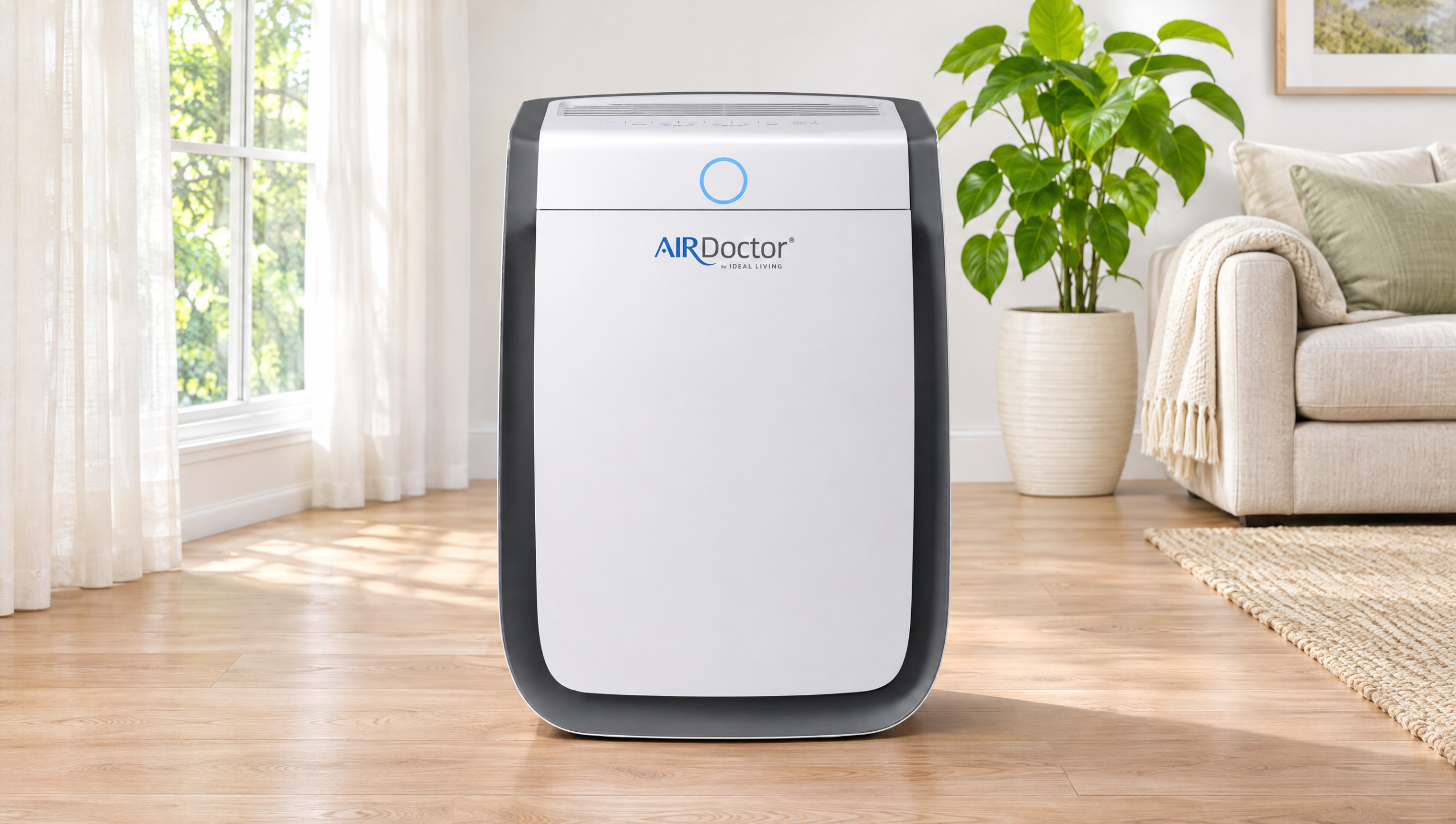
The unit is a floor-standing tower, about 23 inches tall, with a white front panel and dark gray sides. It has built-in recessed handles so you can move it between rooms. It has four fan speeds, a 24-hour timer, and an air quality sensor that drives its auto mode. There is also a WiFi-connected version, the Smart 3500i, which adds app control with the same filtration.
What’s in the AirDoctor AD3500 Box
The AD3500 arrives with its full filtration set. That set includes a washable pre-filter, a dual-action Carbon/VOC filter, and the H13 UltraHEPA filter. The pre-filter attaches to the Carbon/VOC filter. The three stages work as one sealed system inside the unit. There is nothing to assemble beyond taking the filters out of their packaging and sliding them into place.
That sealed-system detail is worth a moment. AirDoctor’s point is that the unit seals the air path fully. So the air that goes in passes through the filters instead of leaking around them. A purifier with gaps in its housing can pull dirty air straight back into the room.
You also get the basics: the purifier, its filters, and a power cord. There is no remote control with the classic AD3500, and no app. If you want to check air quality from your phone or get filter alerts on it, choose the Smart 3500i. The classic model keeps its controls on the unit. That includes the change-filter indicator light that tells you when a filter is due.
How Does the AirDoctor AD3500 Work?
The AD3500 runs air through three stages, and each one catches something the others cannot.
First is the pre-filter. It is washable, and its job is to catch the big stuff: pet hair, dust, and lint. Catching those up front keeps the finer filters behind it from clogging early.
Second is the dual-action Carbon/VOC filter, the stage most ordinary purifiers skip. A HEPA filter only catches particles; it does nothing about gases. The Carbon/VOC filter captures odors, toxic gases like ozone and nitrogen dioxide, and volatile organic compounds. Those compounds include benzene and formaldehyde, which come off furniture, flooring, paint, and cleaning products.
Third is the UltraHEPA filter, the stage behind the brand name. Standard HEPA filters are rated to capture particles down to 0.3 microns. AirDoctor’s UltraHEPA is rated to capture 99.99% of particles as small as 0.003 microns. That is 100 times smaller than the HEPA standard. It covers smoke, mold spores, pollen, pet dander, and dust. AirDoctor reports that its filter eliminated 99.99% of tested bacteria and viruses in third-party testing.
Around those three stages, the machine manages itself. The air quality sensor watches the room, and auto mode adjusts the fan speed to match. So the purifier works harder when the air is worse and settles down when it clears. The 24-hour timer lets you schedule purification around your day. The change-filter indicator lights up when a filter is due. AirDoctor lists the AD3500 with a smoke CADR of 340 and WhisperJet fans. The brand says those fans run 30% quieter than other purifiers.
Who Is the AirDoctor AD3500 Best For?
The AD3500 fits best if you have a medium to large room. You want one purifier to cover it properly. A bedroom, a living room, or an open kitchen-living space in that 630-square-foot range is its sweet spot. If your main room is much bigger than that, you would be asking one unit to do the work of two. In that case the larger 5500 is the better match. The smaller 2000 or 1000 fit small bedrooms and offices.
It is a strong fit if allergies or wildfire smoke are your main concern. The UltraHEPA stage handles the fine particles that trigger allergy symptoms. The Carbon/VOC stage handles smoke odors and gases that a particle filter alone would leave behind. Pet owners get the same logic. The pre-filter catches the hair, the UltraHEPA catches the dander, and the carbon stage works on the smell.
It also fits if you want a purifier you can set and forget. Auto mode, the filter-change light, and the timer mean the AD3500 mostly looks after itself once it is running. You do not need the app for that. The smart version only matters if you specifically want phone alerts, temperature and humidity readings, or control from another room. It is less of a fit if you need a small unit for a nursery or a desk. No portable purifier really delivers whole-home coverage from a single machine.
What to Know Before Buying the AirDoctor AD3500
First, filters are an ongoing cost. The Carbon/VOC filter needs replacing every six months and the UltraHEPA filter every twelve months, based on 24-hour daily use. The indicator light will tell you when the time comes, and the pre-filter is washable, which helps. Budget for the replacements as part of owning the machine.
Second, know which model you are buying. The classic AD3500 and the Smart 3500i filter the same air the same way. The difference is connectivity. The 3500i adds WiFi and the AirDoctor app, with air quality alerts, allergy monitoring, and filter alerts on your phone. It also adds temperature and humidity readings, remote control, and shared control. If none of that matters to you, the classic AD3500 gives you the same purification.
Third, measure your room. The 630-square-foot figure is for four air changes per hour, which is the rate AirDoctor recommends. If your room is larger, it will not hit that four-changes rate. A tape measure before you order beats a return after.
Fourth, the AD3500 comes with a 30-day money-back guarantee. So you can run it in your own home and see how it does with your air before you commit. It is also HSA and FSA eligible through Truemed. Truemed provides a Letter of Medical Necessity after a short intake form if you qualify.
Finally, a note on the lab numbers in this review. The 99.99% figures and the 0.003-micron rating come from AirDoctor’s own testing claims, including third-party lab testing the brand cites. They describe what the filter is rated to capture in testing. They are not a promise about any health outcome in your home. The honest way to judge the purifier is to run it for a month. Then see whether your air feels different.
My Take on the AirDoctor AD3500
What stood out to me in the research is that the AD3500 is not really selling one filter. It is selling the combination. A HEPA filter alone is a common purchase, and it is also a common disappointment. That is because the room still smells like the dog or the new furniture. The Carbon/VOC stage is the part that answers that disappointment. Also, it is the part most purifiers in this size do not have. Pairing it with a filter rated 100 times finer than the HEPA standard is a strong combination.
The other thing I kept coming back to is the sizing honesty. For example, AirDoctor publishes the coverage at four air changes per hour. It tells you plainly when a room is too big for the unit. That makes the decision simple: measure the room and match the model. The 30-day guarantee makes that decision low-risk. What I would watch is the filter schedule: six months for the carbon filter, twelve for the UltraHEPA. So it is a real ongoing cost, and the part of owning an air purifier people forget to budget for.
The Bottom Line on the AirDoctor AD3500
The AirDoctor AD3500 is a strong pick if you want one purifier for a medium to large room. It suits you if you care about gases and odors as much as particles. Its UltraHEPA filter is rated far finer than the HEPA standard. Also, its Carbon/VOC stage covers what HEPA-only purifiers miss. Its auto mode and filter alerts keep it simple to live with. Measure your room, budget for the filter replacements, and pick the smart version only if you want the app. You have been reading AirDoctor reviews to decide whether this is the one. Overall, the AD3500 is the model most people should start with. The 30-day guarantee gives you a month to prove it to yourself.