You spend roughly a third of your life on your mattress, so it’s a reasonable thing to care about what’s in it. And the mattress industry knows that — which is why “non-toxic,” “natural,” “organic,” and “clean” are plastered across mattress marketing, often on products that share very little beyond the label. Some of those words mean something specific. Some of them mean whatever the brand wants them to mean.
Here’s how to tell the difference, and what’s actually in your bed.
The first thing to know: “non-toxic” isn’t a regulated term
This is the sentence the whole guide hangs on. Unlike “organic” in food, which has a legal definition and a certification system behind it, “non-toxic” on a mattress is a marketing word. No agency defines it, no one tests for it, and two brands can use it to mean completely different things. One brand’s “non-toxic” mattress might be certified organic latex and wool. Another’s might be conventional foam with one fewer chemical than the last model.
So “non-toxic” is a claim to investigate, not a standard to trust. The way you investigate it is certifications — specific, third-party labels that each mean one defined thing. That’s where the real information lives.
The certifications that actually mean something
There are five labels worth knowing. Each certifies something different, and none of them certifies “this mattress is non-toxic” on its own.
| Certification | What it actually certifies | What it doesn’t mean |
|---|---|---|
| GOTS (Global Organic Textile Standard) | The textile fibers are organic, tracked through the whole supply chain, with limits on chemicals used in processing | It certifies the textiles, not necessarily every layer of the mattress |
| GOLS (Global Organic Latex Standard) | The latex is organic, from rubber trees grown without synthetic pesticides, with limits on additives | It certifies the latex only — a mattress can have GOLS latex and conventional everything else |
| OEKO-TEX Standard 100 | The finished textile was tested for a list of harmful substances and passed | It is NOT an organic certification — a conventional product can carry it |
| GREENGUARD | The product has low chemical emissions (VOCs) into indoor air | It measures emissions, not what’s inside the product |
| CertiPUR-US | The polyurethane foam contains no ozone depleters, heavy metals, or formaldehyde, and meets limits on certain flame retardants | It is industry-run, and it certifies foam — a CertiPUR-US mattress is still a foam mattress |
Read that table twice, because the pattern matters: every certification has a scope, and the scope is always narrower than the marketing implies. A mattress advertised as “GOTS certified” might have a GOTS-certified cotton cover over uncertified foam. That’s not a lie — but it’s not the whole mattress either. The question to ask isn’t “is it certified?” but “what exactly is certified, and how much of the mattress does that cover?”
The strongest combination is boring and specific: GOTS-certified textiles plus GOLS-certified latex plus a natural fire barrier. That’s a mattress where the certifications cover most of what’s in it, not just the cover.
What’s actually inside most mattresses
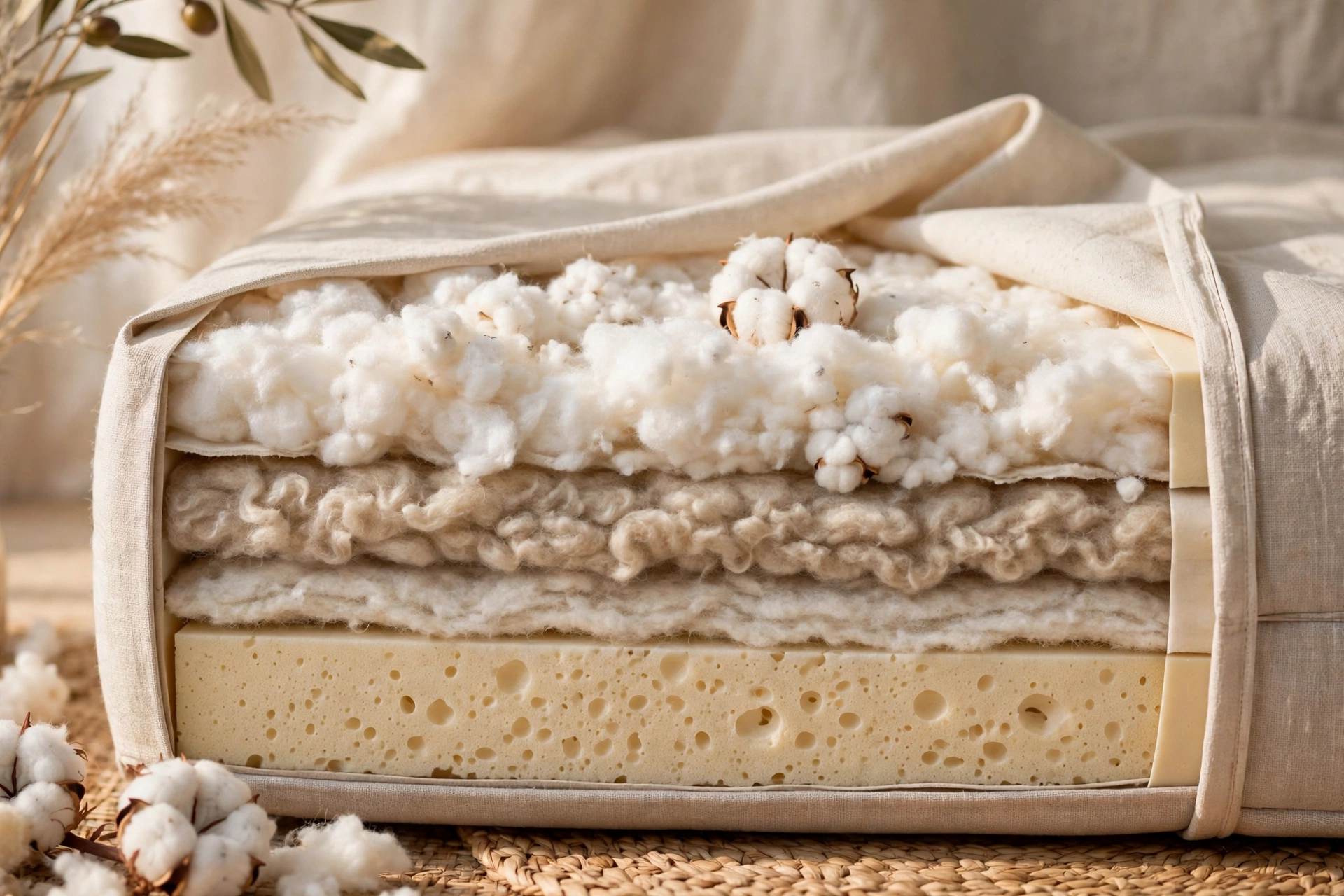
Strip away the marketing and mattresses are built from a short list of materials. Knowing them makes every product page easier to read.
- Polyurethane foam (including memory foam). The most common mattress material. It’s petroleum-based, it’s the main source of off-gassing, and it’s where most of the chemical questions live. CertiPUR-US is the relevant label here — it sets a floor for foam safety, but it doesn’t make foam “natural.”
- Natural latex. Tapped from rubber trees, processed into foam. Dunlop latex is denser and more common in mattresses; Talalay is softer and lighter. GOLS is the label that matters. Latex is durable and naturally resistant to dust mites, which is a genuine plus — but note that a small number of people have latex allergies, and that’s a real consideration, not a footnote.
- Wool. Used as a comfort layer and, importantly, as a natural fire barrier. Wool chars instead of catching fire, which is why better non-toxic mattresses use it instead of chemical treatments or fiberglass.
- Cotton. Usually the cover. GOTS cotton is the meaningful version; conventional cotton is fine but unremarkable.
- Innerspring coils. Steel springs. Nothing chemical to worry about, and they make a mattress more breathable than all-foam builds — which matters for heat, if not for toxicity.
The material list is the truth serum. A brand that lists every layer and its certification is a brand with nothing to hide. A brand that talks about “proprietary comfort foam” without saying what it is has told you everything you need to know.
Off-gassing: real, but usually short-lived
That “new mattress smell” is off-gassing — volatile organic compounds (VOCs) evaporating out of foam and adhesives. It’s real, it’s measurable, and it’s the reason GREENGUARD exists. What it usually isn’t: a long-term hazard in a normal home. For most mattresses, off-gassing is strongest in the first days and fades over weeks, especially if you ventilate the room.
A few honest qualifications. Smell is not a reliable measure of safety — some VOCs smell strong at harmless levels, and some harmful compounds have no smell at all. People with asthma, chemical sensitivities, or respiratory conditions are more affected than the average sleeper, and for them the first weeks matter more. And “low-VOC” is not “no-VOC” — it’s a comparison, not an absence.
Practical version: if off-gassing worries you, unbox the mattress in a ventilated room, let it air for a few days before sleeping on it, and keep the room aired while it settles. That’s the whole strategy. It’s unglamorous and it works.
The sleeper issue: fiberglass fire barriers
Here’s the thing most mattress marketing never mentions, and it’s the most useful thing in this guide.
Every mattress sold in the US must meet a federal flammability standard. Brands meet it in different ways: wool, chemical treatments, or a fiberglass fire barrier — a thin layer of fiberglass woven into the cover. Fiberglass barriers are cheap and common in budget foam mattresses, and they’re fine as long as the cover stays intact. The problem starts when someone unzips or removes the cover — to wash it, usually — and fiberglass particles escape. They’re nearly invisible, they irritate skin and lungs, and once they’re in your room, they’re extremely hard to clean up. There are entire forums of people who learned this the expensive way.
How to avoid it: check what the fire barrier is before you buy. Look for wool or a silica-based barrier, and be suspicious of any mattress whose cover says “do not remove” without explaining why. If a brand won’t tell you what its fire barrier is made of, that’s your answer — and it’s not the one you want.
“Organic mattress” doesn’t mean what you think
A mattress labeled “organic” might have one organic layer and five conventional ones. In textiles, GOTS certification applies to the fibers it covers — and a mattress can carry a GOTS label for its cover while the core is conventional foam. Same story with latex: GOLS latex inside a mattress with a conventional cover and adhesives is still, technically, a mattress containing GOLS latex.
The question to ask is always “organic what, and how much of it?” A genuinely mostly-organic mattress will say so in detail — percentages, layers, certificates. A mattress that just says “organic” in big letters and stops there is using the word as a vibe, not a fact.
What a non-toxic mattress won’t do
- Cure your allergies or asthma. A mattress with fewer chemicals and natural materials may reduce your exposure to irritants, and dust-mite-resistant latex may help some people. But a mattress is not a medical treatment, and no honest brand should claim it fixes a health condition.
- Fix your sleep. Materials affect comfort and temperature, and comfort affects sleep. But a non-toxic mattress doesn’t inherently sleep better than a conventional one — firmness, support, and your own body matter far more than whether the foam is certified.
- Be chemical-free. Everything is chemicals, including wool and latex. “Chemical-free” is a meaningless phrase. The real goal is fewer concerning chemicals, verified by third parties — not zero chemicals, which doesn’t exist.
What to look for before you buy
A short checklist, in the order I’d actually use it.
- The full material list, layer by layer. If the brand won’t list what’s inside, stop there.
- Certifications with scope. GOTS, GOLS, OEKO-TEX, GREENGUARD, CertiPUR-US — and for each one, what part of the mattress it covers.
- The fire barrier. Wool or silica-based. Not fiberglass, and not a mystery.
- Adhesives. Water-based adhesives are the better sign; solvent-based adhesives are a source of VOCs. Most brands won’t volunteer this — ask.
- The trial period. A mattress is a big purchase and a personal one. A real trial period (not a restocking-fee trap) matters more than any certification, because comfort is something you can only judge by sleeping on it.
- The law label. That white tag you’re not supposed to remove lists the materials by percentage. It’s unglamorous, it’s legally required, and it’s often more honest than the product page.
Buy the mattress whose paperwork you can read, not the one whose adjectives you like. That’s the whole guide in one sentence.
The bottom line
“Non-toxic” on a mattress is a starting question, not an answer. The answer lives in certifications with defined scopes, a material list you can actually read, and a fire barrier that isn’t fiberglass. Off-gassing is real but usually short-lived. “Organic” needs a follow-up question every time. And no mattress, however clean, cures anything or guarantees better sleep.
If you care about what’s in your bed — and spending a third of your life on it is a reasonable reason to care — the work is twenty minutes of reading labels before you buy, not a lifetime of worrying afterward. The brands that make that reading easy are usually the ones worth buying from.
This post is for general information only and is not medical advice. If you have a health condition, check with your clinician before changing supplements or routines.