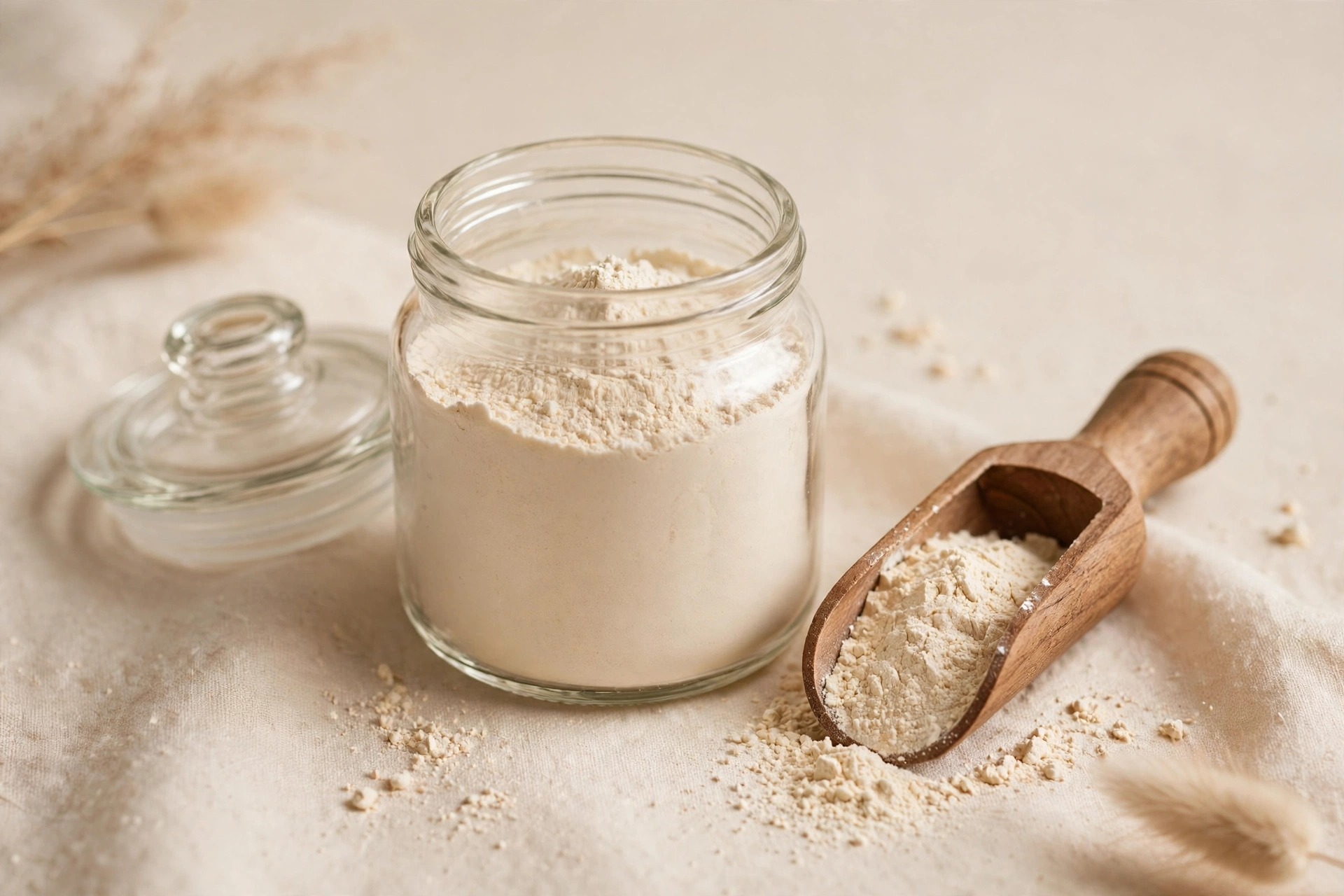
Collagen powder is everywhere now: in coffee, smoothies, protein bars, and skincare, promising firmer skin, stronger joints, a healthier gut, and shinier hair all at once. Your body does make collagen — it is the main structural protein in skin, tendons, ligaments, and bones — and production does slow with age. That much is true. What follows from it, in the marketing, is a leap: that scooping collagen into your coffee reverses the whole process. The evidence is better than you might expect for some claims, and much thinner than the ads suggest for others.
Here is collagen sorted honestly: what the forms mean, what the studies actually show, and how to avoid paying for hype.
What collagen is, and why eating it is not a straight swap
Collagen is a protein built mostly from three amino acids: glycine, proline, and hydroxyproline. Your body makes it from amino acids in your diet, with vitamin C playing a key role in the process. When you eat collagen, your digestive system breaks it down into amino acids and small peptide fragments, just like any other protein. Those fragments travel in the blood, and some research suggests they may signal skin and joint cells to make more collagen — but that is a signaling effect, not a delivery service. Eating collagen does not pipe it straight into your wrinkles or your knees. Your body decides where the building blocks go, based on its own priorities, and skin is rarely first in line.
That matters because it sets the ceiling for every claim below. Collagen supplements can plausibly support the body’s own collagen production. They cannot target one body part, rebuild cartilage on demand, or undo years of sun damage by themselves.
Peptides, marine, powder: what the labels mean
The words on the tub are confusing on purpose, so here is the plain translation.
Hydrolyzed collagen and collagen peptides are the same thing. “Hydrolyzed” means the long collagen chains have been broken into smaller peptide fragments, which dissolve in liquid and are easier for the body to absorb than intact gelatin. Nearly all the research uses hydrolyzed collagen peptides, so this is the form the evidence actually refers to. If a product just says “collagen” without “hydrolyzed” or “peptides,” it may be gelatin — the same stuff in jelly — which is thicker, harder to mix, and less studied.
Marine collagen is collagen from fish skin and scales. It is almost entirely type I collagen, the type most abundant in skin, and its peptides are smaller on average, which sellers claim means better absorption. The evidence for that absorption advantage in people is thin, and the studies on marine collagen specifically are fewer than those on bovine collagen. It is a reasonable choice if you avoid beef or pork, or if you prefer fish-sourced products, but it is not a stronger product by default.
Bovine collagen is collagen from cow skin and bones. It contains types I and III, the types found in skin, tendons, and blood vessels, and it is the form used in most of the research. Porcine collagen, from pigs, is similar but less common in supplements.
Type II collagen is a different product entirely. It is usually sold as undenatured type II collagen for joint health, in much smaller amounts, and it works through a different mechanism — training the immune system to be less reactive toward joint cartilage, rather than supplying building blocks. Do not compare a type II joint capsule to a scoop of peptides; they are not the same supplement doing the same job.
Skin: the strongest evidence, with honest limits
Skin is where collagen has its best support, and even here the story needs care. Multiple randomized trials, mostly lasting 8 to 12 weeks, have found that hydrolyzed collagen peptides improve skin hydration and elasticity modestly compared with placebo, and some find small improvements in wrinkle depth. The effect is real but modest — skin looks a bit more hydrated and springy, not transformed — and the trials are mostly small, often funded by collagen companies, and often run in middle-aged women, which limits how far the results generalize.
The before-and-after photos are where the honesty breaks down. Supplement ads show dramatic transformations, often with different lighting, makeup, angles, and filters between the two photos, and sometimes with skincare routines, treatments, or weight changes quietly happening at the same time. A real collagen result, if it comes, is gradual and subtle: skin that holds moisture a little better after a couple of months. If a photo promises a new face in thirty days, it is selling photography, not collagen.
Sun protection, sleep, and not smoking do far more for your skin than any powder. Collagen may add a small benefit on top of those basics; it cannot compensate for skipping them.
Joints: promising, mostly for mild discomfort
Joint evidence is the second-best area, and it is genuinely encouraging for a specific group: people with mild, everyday joint discomfort, especially in the knees, and some athletes with activity-related joint pain. Trials of hydrolyzed collagen over several months have found small-to-moderate improvements in comfort and function compared with placebo. The effect is not dramatic, and it takes months, not weeks.
What collagen does not do is rebuild damaged cartilage or treat arthritis. Osteoarthritis involves cartilage loss and joint changes that a protein powder cannot reverse, and anyone selling collagen as an arthritis treatment is selling hope, not evidence. If your joint pain is new, swollen, hot, locking, or getting worse, that needs a clinician, not a scoop. And if you are already managing joint disease, check with your clinician before adding a supplement — not because collagen is dangerous, but because it can distract from treatments that actually slow the condition.
Gut: the weakest claim on the label
Gut health is where collagen marketing runs furthest ahead of the evidence. The reasoning sounds plausible — collagen is a building block of the gut lining, so eating it should strengthen the gut barrier — but plausible is not proven. There are almost no good human trials showing that collagen supplements improve gut permeability, digestion, or conditions like irritable bowel syndrome. Most of the gut claims trace back to lab studies, animal studies, or reasoning from first principles.
If you bought collagen for your gut, you bought it for the claim with the least evidence behind it. A varied diet with enough protein, fiber, and fermented foods has far stronger support for gut health than a collagen scoop. That does not make collagen harmful for your gut — it is just protein, after all — but it does make the gut-health marketing a reason to be skeptical of the seller, not a reason to buy.
Hair and nails: small, inconsistent, and hard to separate from protein
Hair and nail claims rest on a handful of small studies, often without a placebo group, and on the simple fact that hair and nails are made of protein. If your diet is low in protein overall, adding any protein — collagen or otherwise — may help brittle nails or shedding. If your protein intake is already adequate, the extra benefit of collagen specifically is unclear, and the studies cannot separate “more protein helped” from “collagen helped.”
Hair loss in particular has many causes, and a collagen powder addresses almost none of them directly. Sudden, patchy, or severe hair loss deserves a clinician visit, not a supplement aisle.
Quality and contamination: the part nobody advertises
Collagen is an animal product, and animal products can carry contaminants. Independent testing has found heavy metals, including cadmium and lead, in some collagen products, because animals accumulate metals from their environment and feed. That is not a reason to panic — levels in most tested products are low — but it is a strong reason to buy from brands that publish third-party test results.
Look for NSF, USP, or ConsumerLab verification, or a brand that posts its own lab results for heavy metals and microbes. “Grass-fed” and “pasture-raised” sound reassuring, but they describe how the animal was raised, not whether the finished powder was tested. Wild-caught marine collagen sounds cleaner, but fish can carry mercury and other contaminants too, so the same testing rule applies. If a brand will not show testing, that is your answer — and it applies to every supplement, not just collagen.
A few more practical notes. Collagen is not a complete protein: it lacks tryptophan, so it does not replace a protein powder or a balanced meal for muscle building. People with fish or shellfish allergies should avoid marine collagen. And if you are pregnant, breastfeeding, or managing kidney disease, check with your clinician before adding a daily protein supplement — collagen is generally considered low-risk, but “generally” is not a personal recommendation.
Collagen claims, ranked honestly
| Claim | Evidence level | Honest version |
|---|---|---|
| Skin hydration and elasticity | Best supported | Modest improvement over 8 to 12 weeks in small trials, often industry-funded |
| Mild joint discomfort | Promising | Small-to-moderate comfort gains over months, for mild discomfort only |
| Gut health | Weakest | Almost no human trial evidence; plausible reasoning, not proof |
| Hair and nail strength | Small and inconsistent | May help if protein intake is low; hard to separate from general protein |
| Rebuilding cartilage or treating arthritis | Not supported | Collagen does not regrow cartilage or treat joint disease |
| Targeted wrinkle or knee repair | Not how it works | The body distributes amino acids by its own priorities, not by your wishes |
The bottom line
Collagen’s honest story is a modest one: a daily scoop of hydrolyzed peptides may slightly improve skin hydration and elasticity over a couple of months, and may ease mild joint discomfort over a longer stretch. The gut claims are mostly marketing, the hair claims are hard to separate from plain protein, and the before-and-after photos promise far more than the trials deliver. If you try it, buy hydrolyzed peptides from a brand that publishes third-party testing, give it at least two to three months before judging, and keep the basics — sun protection, sleep, a varied protein-rich diet — doing the heavy lifting. The powder is a small plus, not a transformation, and a seller who tells you otherwise is selling you something else entirely.
This post is for general information only and is not medical advice. If you have a health condition, check with your clinician before changing supplements or routines.