You’ve seen it everywhere: the “stress herb” in gummies, powders, lattes, and sleep blends, promising calm, better sleep, more energy, and balanced hormones all at once. Ashwagandha has been used in Ayurvedic practice for a very long time, and modern research has actually studied it — which puts it ahead of most wellness trends. But the gap between what the studies show and what the marketing promises is wide, and the safety fine print matters more here than with most herbs.
Here’s the honest version: what ashwagandha does, what it doesn’t, and who should skip it.
What ashwagandha actually is
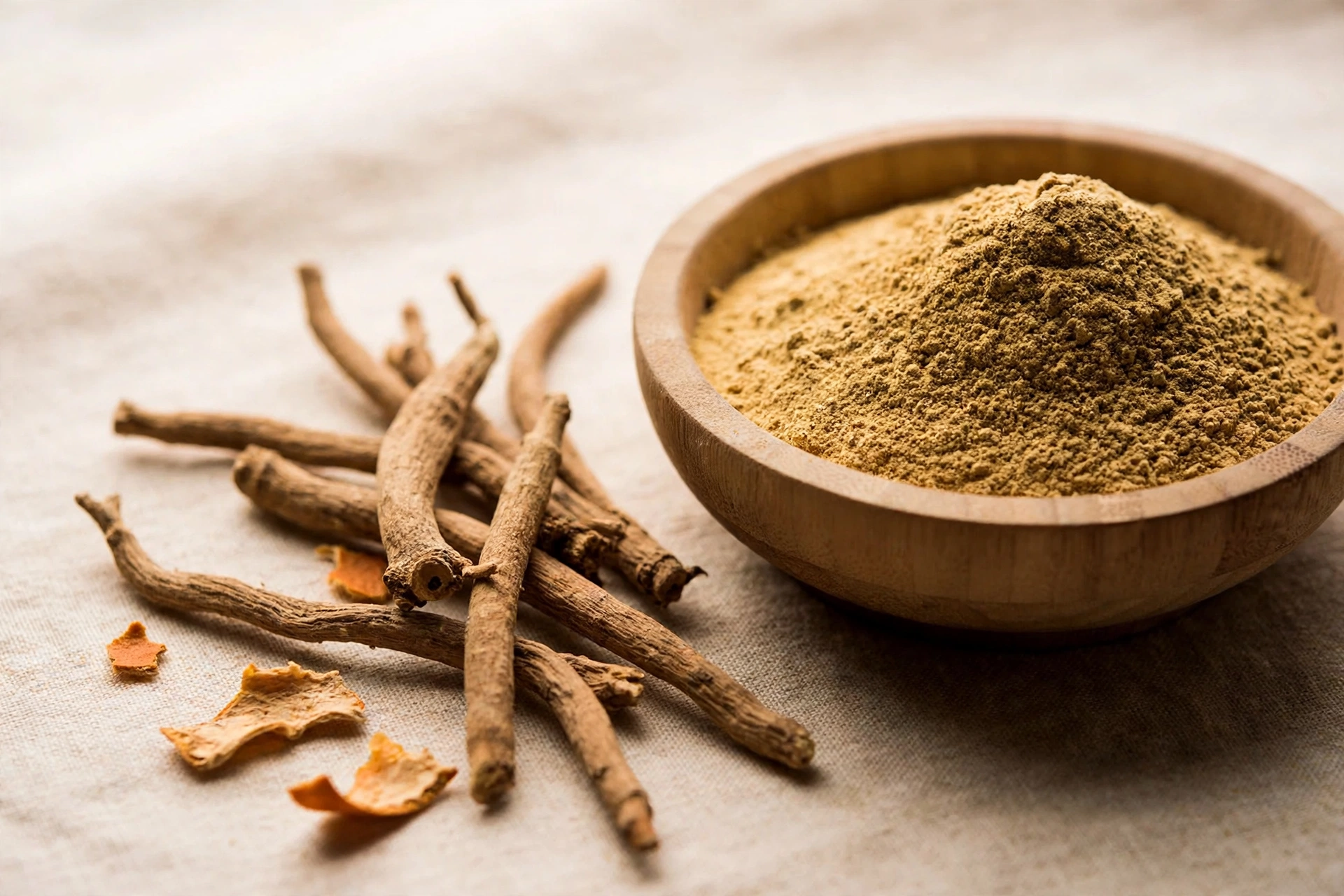
Ashwagandha (Withania somnifera) is a shrub whose root — and sometimes leaves — are dried and made into powders, capsules, and extracts. In Ayurveda it’s classed as an adaptogen, a substance said to help the body handle stress. That word gets thrown around a lot; what it means in practice is that ashwagandha seems to nudge stress-hormone signaling rather than sedating you or stimulating you outright.
The form matters more than the brand name. Most of the research uses standardized root extracts, not generic ground root powder and not gummies of unknown strength. When you see KSM-66 on a label, that’s a specific root-only extract standardized to a set percentage of withanolides (the active compounds). Sensoril is a different extract, root plus leaf, standardized differently. A cheap “ashwagandha powder” capsule may contain far less of the active compounds than the extracts used in studies — or an unknown amount. If a product doesn’t say what’s standardized and to what, you’re guessing.
The benefits, ranked honestly
Stress and anxiety. This is the strongest ground, and it’s genuinely decent. Multiple small-to-moderate randomized trials have found that standardized ashwagandha extracts reduce self-reported stress and anxiety scores, and some show lower cortisol levels, over 6 to 8 weeks. The effect is modest, not dramatic — people feel a bit calmer, not transformed — and the trials are short and mostly small. But unlike many herbs, this isn’t one study stretched into a miracle. It’s a pattern across several trials pointing the same direction.
Sleep. Related to the stress effect, and the second-best-supported benefit. Trials in people with insomnia and in stressed adults have found improvements in sleep quality and time to fall asleep, again over weeks, not nights. It’s not a sleeping pill — don’t expect to take it at 10pm and conk out. The sleep benefit seems to come through the same calming pathway as the stress benefit, building over time.
Strength and recovery. A few trials in people doing resistance training found slightly greater strength and muscle-size gains with ashwagandha versus placebo, plus small improvements in perceived recovery. The effect is small, the studies are small, and it doesn’t replace training, protein, or sleep. If you don’t lift, this benefit doesn’t apply to you at all.
Energy and fatigue. People often report feeling less fatigued, which makes sense if stress and sleep both improve. Direct evidence for “more energy” as its own effect is weaker — it’s mostly downstream of the first two benefits. Anyone selling ashwagandha as a stimulant or a caffeine replacement is overselling it.
The pattern: stress and sleep have real, modest evidence; everything else is either small, downstream, or marketing. That’s a good herb, honestly. It just isn’t the cure-all the gummy ads describe.
What it won’t do
- Balance your hormones, full stop. Ashwagandha affects cortisol, and cortisol is a hormone — but “hormone balance” as a marketing phrase covers everything from thyroid to estrogen to testosterone, and the evidence doesn’t stretch that far. One specific hormone claim needs its own section, below.
- Fix your thyroid. Ashwagandha can raise thyroid hormone levels in some people, which is sometimes marketed as a benefit for low thyroid. That’s a drug-like effect on a gland that needs careful management, not a wellness perk — and a risk if your thyroid is already overactive. More on this below.
- Replace anxiety treatment. The trial results are modest and short-term. If you have an anxiety disorder, ashwagandha is not a substitute for therapy, medication, or a clinician’s guidance.
- Work overnight. The trials run 6 to 8 weeks. A week of gummies tells you nothing.
The testosterone question, honestly
This is the claim men keep asking about, so let’s be direct. A handful of small studies, mostly in men doing resistance training or with fertility concerns, found increases in testosterone with ashwagandha versus placebo. The studies are small, short, and specific to those groups — they don’t show that ashwagandha raises testosterone in healthy men generally, and they certainly don’t make it a testosterone booster in the way the ads imply.
If you’re buying ashwagandha for testosterone, you’re buying it for the weakest claim on the label. The stress and sleep evidence is far stronger. And if you have a hormone-sensitive condition, that’s a reason to talk to your clinician first, not a reason to self-experiment.
Forms, in plain English
| Form | What it is | Best for | Watch out for |
|---|---|---|---|
| KSM-66 root extract | Standardized root-only extract, the most-studied form | Matching what the trials actually used | Higher price; still check third-party testing |
| Sensoril extract | Root + leaf extract, standardized differently | People who want the leaf-inclusive form used in some trials | Different withanolide profile than KSM-66 — not interchangeable |
| Generic root powder | Dried, ground root, unstated withanolide content | Budget option, traditional use | Dose of active compounds unknown; weakest link to the research |
| Gummies | Ashwagandha (often generic extract) + sweeteners | People who hate capsules | Sugar, low/unstated extract content, easy to overdo |
| Tea / latte blends | Small amounts in a drink mix | A pleasant ritual | Usually far below study amounts — flavor, not therapy |
The boring rule holds: standardized extract + third-party testing beats a pretty label. Third-party testing matters here because herbs can carry heavy metals and contaminants, and ashwagandha is no exception. Look for USP, NSF, or ConsumerLab verification, or a brand that publishes its own lab results. If a brand won’t show testing, that’s your answer.
Who should be careful — read this before your first bottle
Ashwagandha is well tolerated by most healthy adults — the common side effects are mild: stomach upset, drowsiness, headache. But the caution list is longer than most herbs, and it matters.
- Pregnancy and breastfeeding. Traditionally considered unsafe in pregnancy — some evidence suggests it may cause miscarriage at high doses. Avoid entirely. No debate here.
- Thyroid conditions. Ashwagandha can raise thyroid hormone levels. If you have hyperthyroidism, or you take thyroid medication, this can throw off your levels. Check with your clinician and get labs monitored if you use it.
- Autoimmune conditions. Because it may stimulate immune activity, clinicians generally advise caution with lupus, multiple sclerosis, rheumatoid arthritis, and similar conditions.
- Liver concerns. Rare case reports link ashwagandha to liver injury. It’s uncommon, but if you have liver disease or take other liver-taxing substances, this is a real reason to check first — and to stop and get checked if you develop jaundice, dark urine, or unusual fatigue.
- Sedatives and blood pressure medication. Ashwagandha can add to drowsiness from sleep aids, anti-anxiety medication, and anesthesia, and it may lower blood pressure. Tell your doctor and your anesthesiologist — and stop it at least two weeks before surgery.
- Diabetes medication. It may lower blood sugar, which can stack with diabetes drugs. Monitor and check.
- Children. There’s little safety data for children. Skip it.
If anything on this list applies to you, the right move is a clinician conversation, not a gummy. Ashwagandha’s risks are low for most people and genuinely serious for a few — and the marketing never mentions the few.
The bottom line
Ashwagandha’s honest story is a good one, just smaller than the hype: real, modest help for stress and sleep over several weeks, small possible strength benefits if you train, and a testosterone story that’s far weaker than the ads. The safety profile is gentle for most healthy adults and serious for a few — pregnancy, thyroid, autoimmune, and liver concerns top the list — and the product quality varies wildly, so standardized extracts with third-party testing are the only sensible buy.
If you try it, try it with your eyes open: weeks, not days, a real extract, not a candy, and a clinician looped in if anything on the caution list applies to you. If you were hoping for a miracle herb, the miracle isn’t in the bottle — but a modestly calmer, better-sleeping version of you might be, and that’s not nothing.
This post is for general information only and is not medical advice. If you have a health condition, check with your clinician before changing supplements or routines.