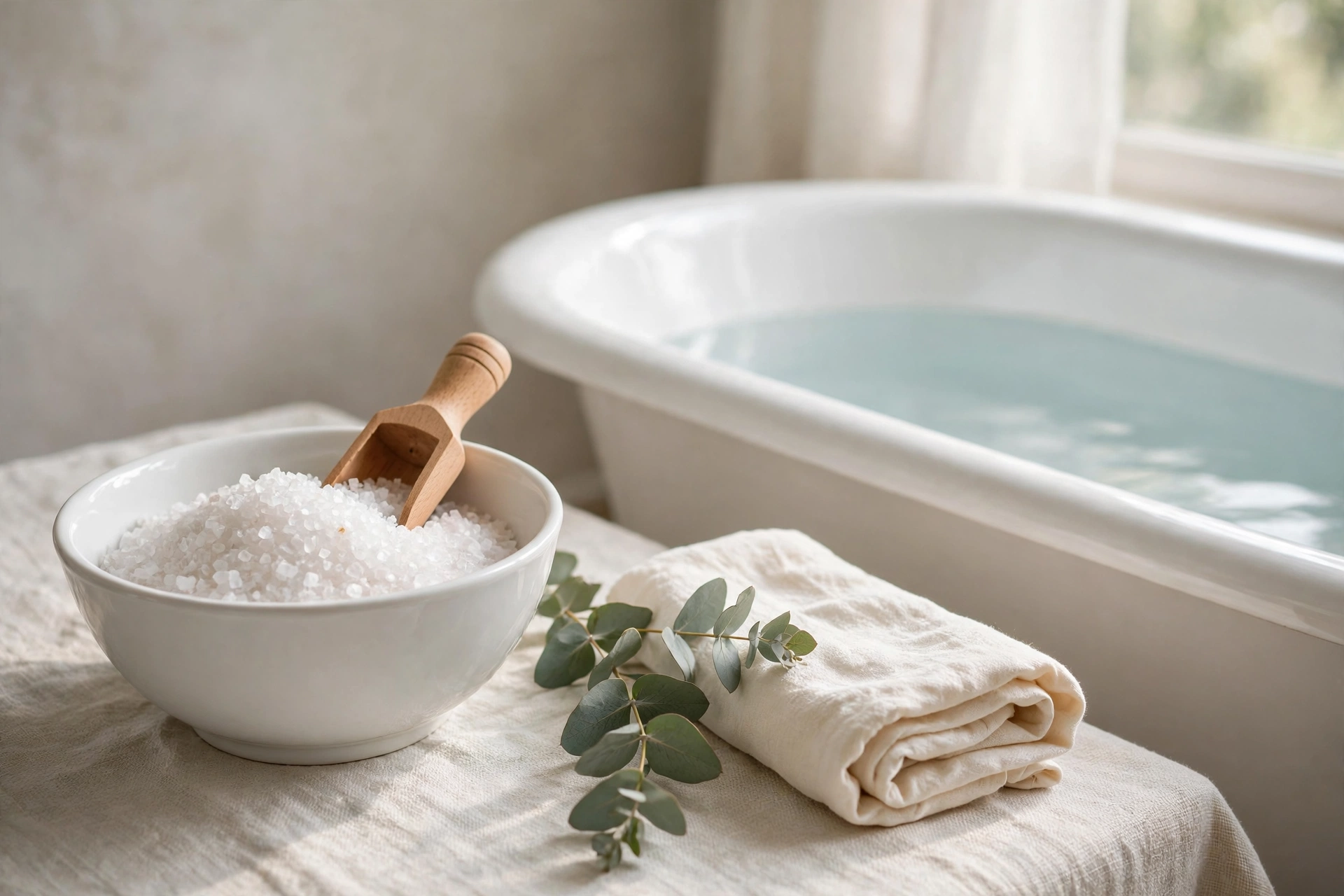
You have probably seen the bag in the pharmacy aisle by now — plain white crystals, cheap and unglamorous, promising relief for sore muscles, better sleep, softer skin, and a full-body detox. Epsom salt has gone from old-fashioned remedy to wellness staple, and the epsom salt bath benefits claimed for it have grown with it.
Here is the plain-English version: what Epsom salt actually is, which of those benefits have real evidence behind them, how to take a soak without overdoing it, and which claims are hype.
What is Epsom salt, exactly?
Epsom salt is magnesium sulfate — a mineral compound, not a cooking salt. It contains no sodium at all. It takes its name from Epsom, a town in England where the compound was first found in a natural spring, and it has been a folk remedy for sore muscles for a couple of centuries.
A standard tub takes about 1 to 2 cups, dissolved in warm water. The crystals disappear completely, splitting into magnesium and sulfate ions. That is the whole ingredient list: magnesium, sulfate, water.
Here is the part that matters most: the epsom salt bath benefits people talk about are usually credited to the magnesium — the idea being that it soaks through your skin and tops up your body’s magnesium. That magnesium claim is the one to test first, because everything else hangs on it.
The epsom salt bath benefits with real support
So what does the soak actually do? Here is what holds up once you separate the warm water from the salt — and one honest note about where the credit belongs.
Sore muscles: the warm water does the work
- Looser muscles after a soak. Warm water genuinely helps sore muscles: heat increases blood flow to tired tissue, relaxes muscle spindles, and dampens pain perception. A 15 to 20 minute soak in warm water will ease stiffness whether or not you added salt — and no well-designed trial has shown that an Epsom salt bath outperforms a plain warm bath of the same temperature for soreness. The salt’s contribution is unproven; the warmth is not.
- A note on magnesium and soreness. A 2024 systematic review did find that oral magnesium modestly lowered how sore people felt after exercise — but that was magnesium by mouth, not in bathwater. A bath is not a back door to the same result.
Relaxation and sleep: a real wind-down ritual
- A calmer evening. A warm 15 to 20 minute soak relaxes muscles, lowers the shoulders, and makes an excellent wind-down ritual before bed. Those effects are real whether or not a single milligram of magnesium crosses your skin. Warm water widens blood vessels near the skin and improves circulation, and the drop in body temperature after you get out is the same cue your body uses to get sleepy.
- Keep the frame honest, though. What no trial has shown is that the salt itself improves sleep beyond what the warm water does. The ritual works; the mineral is along for the ride.
Skin: softer, not detoxed
- Softer skin and softer calluses. A warm soak softens skin, which is why a foot soak helps with rough heels and callused feet. That is a surface effect of warm water, not a mineral treatment.
Notice what is not on this list: detoxing. There is no clinical evidence that a bath removes toxins from the body. Your kidneys and liver handle that internally — your skin has no toxin compartment a bath can drain.
Does the magnesium actually get in?
This is the question the whole Epsom salt story turns on, so it deserves a straight answer: on current evidence, no — not in any meaningful amount.
Your skin’s outermost layer, the stratum corneum, exists specifically to keep water and dissolved substances out. It is a stack of flattened dead cells sealed in lipids — dermatologists compare it to brick and mortar. Charged particles like magnesium ions are precisely the kind of thing this barrier blocks best, because ions cannot slip through fatty membranes the way small oily molecules can.
What does the research say? A 2017 review in the journal Nutrients examined the evidence for transdermal magnesium and concluded that claims of meaningful absorption through intact skin are not supported by rigorous data. The studies most often cited in favor were small, unpublished in peer-reviewed form, or methodologically shaky. One small pilot often quoted by the bath industry reported magnesium rising after repeated baths — but it was published only on a commercial website, had 19 subjects, and no control group. A 2017 pilot that put magnesium in a skin cream and measured blood and urine levels found no statistically significant rise across the group.
Hair follicles and sweat glands offer a theoretical shortcut through the barrier, but they cover roughly 0.1 to 1 percent of your skin’s surface — too little plumbing to matter.
If your goal is genuinely more magnesium, the reliable route is the one your gut evolved for: leafy greens, nuts, seeds, legumes, and whole grains, or an oral supplement. A bath will not fill the tank.
Epsom salt bath benefits: what’s real and what’s hype
This is where a little honesty helps. The soak is genuinely pleasant and useful — just not for the reasons on the bag.
| Claim | What the evidence says |
|---|---|
| Eases sore muscles | Warm water, yes — the salt itself adds nothing proven |
| Raises your magnesium levels | Not shown — skin blocks magnesium ions |
| Detoxes your body | No — your kidneys and liver do that |
| Helps you sleep | The warm soak helps you wind down; the salt itself is unproven |
| Softens skin and calluses | Yes — warm water softens skin |
| Cures cramps | No evidence a bath does this |
The hype to skip: any product claiming an Epsom salt bath “detoxes” you, “replenishes magnesium,” or replaces anything your clinician has prescribed. And do not drink the bathwater — oral Epsom salt is a strong laxative and can cause severe diarrhea, dehydration, and electrolyte imbalance.
How to take an Epsom salt bath
The epsom salt bath benefits worth having come from doing the soak right: warm water, the right amount of salt, and enough time to actually relax. The amounts below are what most packages direct and what clinicians quote — there is no official medical dose.
- Use 1 to 2 cups in a standard tub. Dissolve the crystals in warm water and stir until they disappear. Cleveland Clinic guidance lands around a cup and a quarter; more is not stronger, it mostly dries the skin.
- Keep the water warm, not hot — about 98 to 100°F. Very hot water dries the skin, raises dizziness risk when you stand, and is hard on people with heart or blood pressure concerns.
- Soak 12 to 20 minutes. Set a timer. Longer does not add benefit — mostly you get prunier, with more chance of dry skin and dizziness on standing.
- Rinse afterward if your skin runs dry. A quick rinse and a moisturizer keep the soak from stripping your skin.
- Drink a glass of water before and after. A warm soak is dehydrating on its own, and the salt pulls water out of the skin during long soaks.
The epsom salt foot soak
A foot soak is the smaller version of the same idea, and the epsom salt bath benefits apply here too — the warm water does the work.
Use about half a cup to a cup of Epsom salt in a basin of warm water, soak for about twenty minutes, then dry your feet thoroughly. It soothes tired feet and softens rough skin and calluses — and the drying step matters, because damp feet are exactly the environment fungi like.
One caution belongs here more than anywhere: if you have diabetes with reduced feeling in your feet, check with your clinician or podiatrist before foot soaks. Reduced sensation means you may not notice water that is too hot or skin that is getting irritated, and softened skin is more vulnerable to infection that heals slowly.
Who should be careful with Epsom salt
Epsom salt is a simple mineral, but a few people should think twice.
- If you have kidney disease, check first. Your kidneys clear excess magnesium, and when they are impaired even a small extra load can build up.
- If you have diabetes, especially with reduced feeling in your feet, check first — burns from too-hot water and unnoticed skin injuries are the real risks.
- If you have open wounds, burns, or a serious skin infection, skip the soak. Salt water stings damaged skin and irritates it.
- If you are pregnant, ask your clinician first — the same goes for heart disease, low blood pressure, or significant circulation problems.
- If you are soaking a child, ask a pediatrician about the amount first, and never leave a child unsupervised in a bath.
- Do not use Epsom salt in a hot tub or whirlpool unless the manufacturer allows it — salts can damage pumps and filters.
None of this makes an Epsom salt bath dangerous for a healthy adult. It makes it a warm soak worth treating like one.
What to do next
If this guide has you curious, here is how I would start:
- Buy a plain bag. USP or bath-grade magnesium sulfate. No scent, no added color, nothing to pay extra for.
- Try 1 to 2 cups in a warm bath, 15 minutes, in the evening. Notice how you feel after — looser, calmer, sleepier — not the scale or a lab number.
- Use the foot-soak version when your feet are tired. Half a cup to a cup in a basin, twenty minutes, dry well after.
- Keep it to a few soaks a week at most. Daily long soaks mostly dry the skin.
- If you have kidney disease, diabetes, or an open wound, check with your clinician first.
The bottom line
The epsom salt bath benefits that hold up come down to warm water, not magnesium crossing your skin. A 15 to 20 minute soak in comfortably warm water eases sore muscles, calms the evening down, and softens skin — and the salt makes it a nicer ritual, not a treatment. It is not a detox, not a magnesium supplement, and not a cure — but as a simple, cheap wind-down ritual used the right way, it earns its place in the bathroom. Start with a cup or two, warm water, and twenty minutes, and see how it feels.
This post is for general information only and is not medical advice. If you have a health condition, check with your clinician before changing personal care or health routines.