Intro
If you spend any time in wellness corners of social media, you’ve seen the Lumebox — a small white panel, held in one hand, glowing red. It’s marketed by doctors, functional medicine practitioners, and influencers as the portable red light tool worth owning. But a handheld device at a premium tier raises an obvious question: can something that small actually deliver, or are you paying for portability over performance? Here’s what Lumebox is, what it does well, and where it falls short.
What Lumebox Is
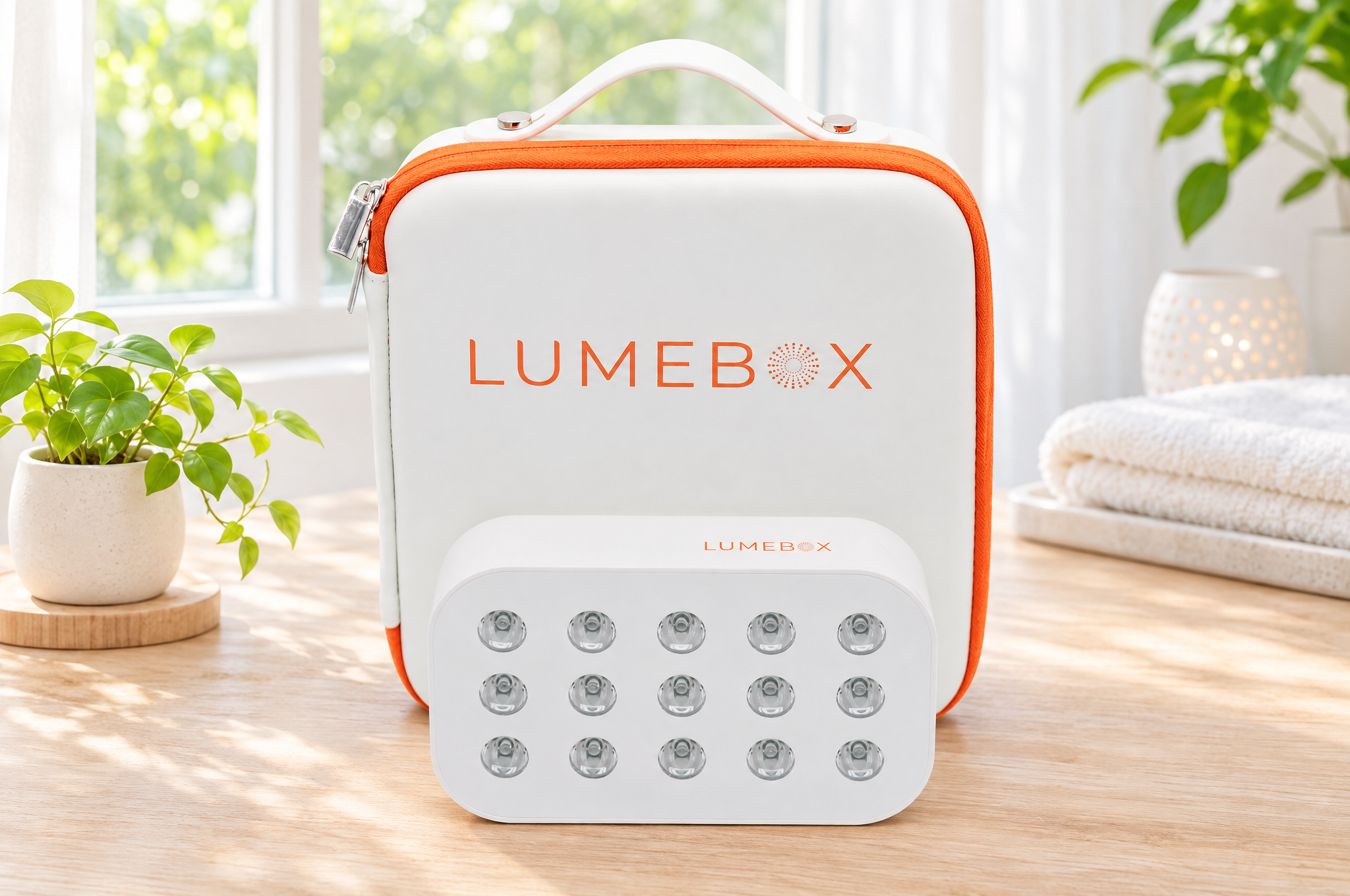
The Lumebox 2.0 is an FDA-registered, handheld red light therapy device — a portable mini-panel, roughly the size of a small tablet or a thick paperback, weighing around 2.5 pounds. Unlike full-body panels that treat your whole front or back at once, Lumebox is a targeted spot-treatment tool: you hold it over one area at a time.
It uses the two most research-backed wavelengths in photobiomodulation:
- 660nm red light — visible light for skin-level effects: circulation, collagen production, and surface healing
- 850nm near-infrared (NIR) light — invisible light that penetrates deeper, aimed at muscle, joint, and connective tissue recovery
One button toggles between red, near-infrared, or both, and built-in timer presets (6- and 12-minute sessions) keep sessions simple. There’s no app, no Bluetooth, no pairing — charge it, pick a mode, and it beeps when time’s up. A padded carrying case is included, and the brand offers a dose calculator on its website plus accessories for hands-free mounting.
Power: The Real Selling Point
Lumebox’s main claim is that it delivers panel-level power in a handheld size. Reviewers cite irradiance figures around 125 mW/cm² for red light and 140 mW/cm² for near-infrared — strong numbers for a consumer device, and notably higher than most handheld wands, which tend to be underpowered. That’s the case for Lumebox in one sentence: it’s not a weak novelty light, it’s a genuinely powerful device in a small form.
The honest caveat: power per square centimeter isn’t the whole story. Total light delivered per session also depends on treatment area, and Lumebox treats roughly 4–6 inches of skin at a time. A full panel treats your whole body in one 10-minute session; Lumebox treats one spot, then you move it.
What Reviewers Consistently Praise
- Premium build. Solid casing, ergonomic handle, quality materials — it feels like a real device, not a gadget.
- Simple to use. No app, no setup, no firmware updates. Timer presets and a beep at the end.
- Stays cool. Good heat management even across back-to-back sessions.
- Genuinely portable. Small, with a padded case — easy to take to the gym, office, or on trips. Charge it, then use it unplugged.
- Noticeable effects with consistent use. Reviewers report less post-workout soreness, looser stiff joints, and improved skin texture over weeks of regular use.
Where It Falls Short
- Premium price tier. This is the most common complaint — a lot of money for a small device, especially next to budget panels with more coverage.
- Small treatment area. Treating a whole back or both quads takes multiple sessions and real patience. It’s a spot-treatment tool, not a full-body solution.
- Manual labor. You hold it over the area for 10–20 minutes per spot, which gets tiring for hard-to-reach areas like your own back. Hands-free mounting accessories help but add cost.
- Battery-powered (2.0 version). Charge it, then use it unplugged — no outlet needed during a session.
- Basic spectrum. The 660/850nm pairing is the research standard, but it lacks the additional wavelengths some newer panels offer.
Lumebox vs. a Full Panel
This is the decision that matters. A full panel (like Hooga or Joovv) treats your whole body at once, costs more overall, and takes up real space — but one session covers everything. Lumebox costs less than a full panel, travels anywhere, and delivers comparable power per area — but whole-body coverage takes much longer, spot by spot.
Buy Lumebox if you want targeted treatment (a sore knee, a stiff shoulder, facial skin), you travel or lack space for a panel, or you want to try red light therapy without committing to a full-panel setup. Buy a panel if you want whole-body sessions, daily full-body recovery, or you know you’ll use it on large areas every day.
Safety and Realistic Expectations
A few things worth stating plainly:
- Wear the eye protection. Protective goggles are included — use them, especially for facial sessions. Don’t stare into the LEDs.
- FDA-registered is not FDA-approved. Registration as a Class II device means the device is listed with the FDA; it doesn’t mean the FDA has validated its health claims.
- Consistency is everything. Red light therapy effects build over weeks of regular use. A few sessions won’t tell you much, and no device replaces medical care for injuries or skin conditions.
- Check with a clinician if you’re pregnant, have a photosensitive condition, take photosensitizing medication, or have a history of skin cancer.
Who It’s For
Lumebox makes the most sense if you want powerful, targeted red light therapy in a portable form — for recovery, joints, or skin — and you accept the trade-off of treating one area at a time. It’s less suited to anyone wanting full-body sessions, anyone who won’t hold a device for 10–20 minutes per spot, or anyone on a tight budget (a budget panel gives more coverage per dollar, just less portability).
My Experience
I own a Lumebox and I love it. I use it on my stomach area.
The Bottom Line
I think Lumebox earns its reputation, with one clear boundary: it’s the best version of a targeted red light device, not a replacement for a full panel. The power is real, the build is premium, and the simplicity is refreshing in a category full of apps and ecosystems. The price and the small treatment area are fair objections — you’re paying for power plus portability, not coverage. If spot treatment fits how you’d actually use red light therapy, it’s an easy recommendation. If you want whole-body sessions, save for a panel instead.
This post is for general information only and is not medical advice. If you have a health condition, check with your clinician before changing supplements or routines.