You have probably seen matcha everywhere by now — bright green lattes on café menus, smoothie bowls, ice cream, even face masks. And you have probably wondered whether it is actually good for you, or just green tea with better marketing.
Here is the plain-English version: what matcha is, what the matcha benefits really are, how it differs from the green tea you already know, and how to make a cup that tastes good instead of like lawn clippings.
What is matcha, exactly?
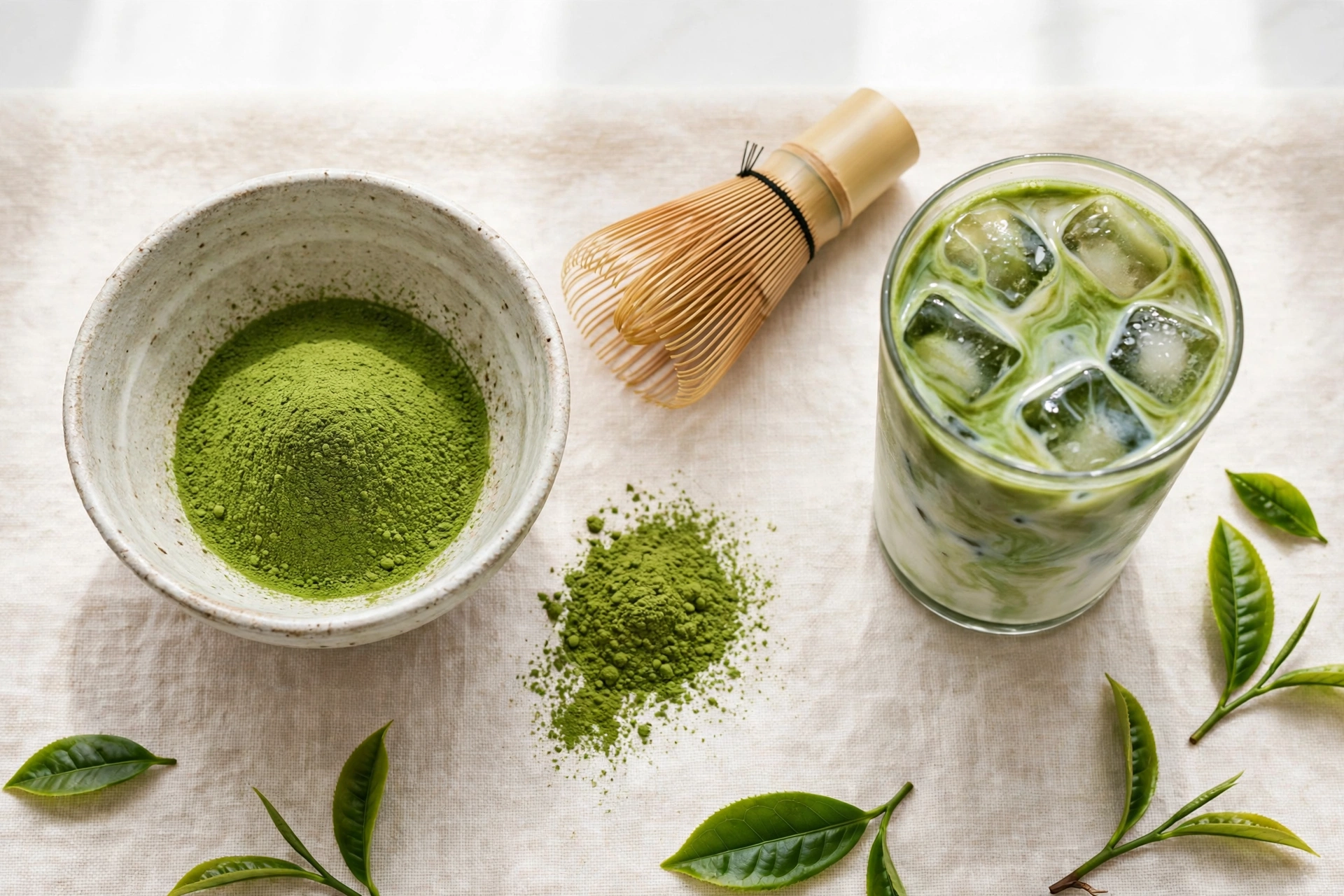
Matcha is green tea, but in a different form. It comes from the same plant as regular green tea — Camellia sinensis — but the leaves are shade-grown for about three to four weeks before harvest, then steamed, dried, and stone-ground into a fine powder.
That powder is the whole point. With regular green tea, you steep the leaves in hot water and throw them away. With matcha, you whisk the powder directly into water or milk and drink the entire leaf. Nothing is discarded, which means you get everything the leaf contains — the caffeine, the antioxidants, and the amino acids — in a much more concentrated form than a steeped cup.
The word “matcha” simply means powdered tea. It has been part of Japanese tea culture for centuries, and the bright green color is a good first clue about quality: vivid green means fresh, well-made matcha; dull yellow-green usually means old or low-grade powder.
Matcha vs green tea: what’s actually different
Same plant, very different cup. Here is the comparison at a glance:
| Matcha | Green tea | |
|---|---|---|
| Form | Whole leaf, stone-ground into powder | Loose leaves or tea bags, steeped |
| How you drink it | Powder whisked into water or milk — you drink the whole leaf | Leaves steeped, then removed |
| Caffeine | About 70 mg per teaspoon (2 g) | About 30 mg per cup |
| L-theanine | Much higher — about 20–46 mg per serving | About 8 mg per cup |
| Antioxidants (EGCG) | Much higher — you consume the whole leaf | Lower — only what steeps out |
| Flavor | Rich, grassy, slightly sweet when good; bitter when poor quality | Lighter, more delicate, sometimes astringent |
| Preparation | Whisked with a bamboo whisk or frothed | Steeped 2–3 minutes in hot water |
The headline difference is concentration. Because you drink the entire leaf, a cup of matcha delivers roughly double the caffeine of green tea, several times the L-theanine, and several times the EGCG — the catechin antioxidant green tea is known for.
The matcha benefits worth knowing about
So what does all that concentration actually do for you? Here are the benefits with real support behind them.
- Steady energy, not a jolt. A teaspoon of matcha has about 70 mg of caffeine — less than a cup of coffee (about 95 mg) and more than green tea (about 30 mg). The difference is the L-theanine, an amino acid that slows how caffeine hits you. People describe it as calm alertness: awake, but not wired.
- Calm focus. L-theanine is the reason matcha feels different from coffee. It promotes alpha brain waves, the relaxed-but-alert state, and it works together with caffeine rather than against it. Small studies have found the combination improves attention more than caffeine alone.
- A serious dose of antioxidants. Matcha is one of the most concentrated sources of EGCG, the catechin linked in research to heart health and healthy aging. Because you drink the whole leaf, you get far more EGCG per cup than from steeped green tea.
- A gentle metabolism nudge. Green tea catechins have been studied for their effect on fat burning and metabolism, and the evidence is modest but real. Matcha is not a weight-loss drink — anyone selling it that way is overselling it — but the catechins do a little real work.
- Skin support from the inside. The same antioxidants that make matcha interesting for overall health are the reason it shows up in skincare. Drinking it is not a skin treatment, but the EGCG and vitamin C in the leaf are genuinely useful nutrients.
Notice what is not on this list: detoxing, curing anything, or replacing sleep. Matcha is a better cup of tea, not a miracle.
Matcha benefits: what’s real and what’s hype
This is where a little honesty helps. The research on green tea compounds is genuinely promising — decades of studies, mostly on green tea generally rather than matcha specifically. Matcha contains more of those compounds per cup, which is a reasonable argument, not a proven fact for every claim.
What is solid: the caffeine and L-theanine combination is well documented, and the antioxidant content is measurable and high. What is softer: most of the big health claims — heart protection, brain health, longevity — come from population studies of green tea drinkers, not from trials where people drank matcha specifically. Those studies show association, not proof.
The hype to skip: any product claiming matcha “detoxes” your body, “melts fat,” or “replaces coffee” outright. Your liver does the detoxing. Matcha can replace your morning coffee if you like the taste and the gentler energy — but it is still a caffeinated drink, and it still counts toward your daily caffeine.
How much caffeine is in matcha?
About 70 mg per teaspoon (2 g) of powder, though it varies with grade and how heaped your scoop is — a heavy scoop can push past 100 mg. For comparison, a cup of brewed coffee has about 95 mg and a cup of steeped green tea about 30 mg.
A matcha latte from a café often uses two or three teaspoons, which puts it right around a cup of coffee’s caffeine. Worth knowing if you order one in the afternoon and wonder why you are still awake at midnight. That slower landing is one of the matcha benefits people notice first — steady energy without the spike and crash coffee can bring.
Most healthy adults are advised to stay under 400 mg of caffeine a day. One or two cups of matcha fits comfortably inside that. Four or five, plus coffee, does not.
How to make matcha at home
You do not need a ceremony. You need hot water, powder, and something to whisk with.
- Sift the powder. Push a teaspoon through a small fine strainer into a bowl. This takes ten seconds and is the difference between smooth matcha and lumpy matcha.
- Add a little hot water. About 2 ounces of water just off the boil — not boiling, which scorches the powder and turns it bitter. Around 175°F is the sweet spot.
- Whisk hard. A bamboo whisk (chasen) works best, in a fast M or W motion for about 15 seconds, until it is frothy. A small milk frother works too.
- Top it up. Add more hot water for traditional matcha, or steamed milk for a latte. Sweeten lightly if you like — a little honey or maple syrup goes further than sugar.
The most common beginner mistake is using too much powder or water that is too hot. Start with one level teaspoon, and if it tastes bitter, use slightly cooler water next time rather than more sweetener.
Ceremonial vs culinary grade: what the labels mean
You will see these two grades everywhere, and the difference is real.
Ceremonial grade comes from the first harvest, the youngest leaves, and is meant to be whisked with water and drunk straight. It is the brightest green, the smoothest, and the sweetest. It costs more because the yield is smaller.
Culinary grade comes from later harvests, is more bitter and less vibrant, and is meant for lattes, smoothies, and baking — anywhere milk, sweetener, or other flavors cover the bitterness. It is cheaper, and there is nothing wrong with it for those uses.
A practical rule: if you are drinking it straight, ceremonial is worth it. If it is going into a latte or a smoothie, culinary is the sensible buy. And whatever the grade, bright green is the quality signal — dull or yellowish powder has lost its freshness. For the full matcha benefits, freshness matters more than grade: bright green powder, used within a few weeks of opening, beats a stale ceremonial tin every time.
Who should be careful with matcha
Matcha is a real food with real caffeine, so a few people should think twice.
- If you are sensitive to caffeine, matcha will still affect you — just more gently than coffee. Try a half teaspoon first, and skip it after mid-afternoon.
- If you are pregnant, matcha counts toward your daily caffeine limit, and most guidance caps caffeine at about 200 mg a day during pregnancy. One cup is usually fine; three probably is not.
- If you take iron supplements or are low in iron, the catechins in tea can reduce iron absorption from food. Drink your matcha between meals rather than with them.
- If you drink a lot of it, know that tea plants absorb lead from soil, and matcha — the whole leaf — carries more of it than steeped tea. Levels in tested matcha are generally low, but it is one more reason not to drink five cups a day, and to buy from reputable sources.
- If you take medication, especially blood thinners or stimulants, check with your clinician. Green tea compounds can interact with some drugs.
None of this makes matcha dangerous. It makes it a caffeinated food worth treating like one.
What to do next
If this guide has you curious, here is how I would start:
- Buy a small amount of ceremonial grade first. A little goes a long way, and good matcha tastes dramatically better than the dull powder at the back of the grocery shelf.
- Make it the traditional way once. Whisked with hot water, no milk, no sweetener. You will know immediately whether you like matcha itself or just matcha lattes.
- Try it in place of your second coffee. The gentler energy is the matcha benefit most people notice first, and it is the easiest one to test on yourself.
- Keep it to one or two cups a day. That is the range where the benefits show up and the caffeine stays comfortable.
- Store it properly. Matcha fades fast — keep it sealed, away from light and heat, and use it within a few weeks of opening.
The bottom line
Matcha benefits come down to concentration: the same leaf as green tea, shade-grown and stone-ground, drunk whole instead of steeped. That means about 70 mg of caffeine per cup, far more L-theanine and EGCG than green tea, and a steadier kind of energy than coffee. The evidence for the big health claims is promising but mostly borrowed from green tea research, so skip the miracle language and enjoy it for what it is — a genuinely good cup of tea with a real, modest edge. Start with one good teaspoon, whisked properly, and see how it feels.
This post is for general information only and is not medical advice. If you have a health condition, check with your clinician before changing personal care or health routines.