You have probably flipped over a bag of candy or a box of cereal and wondered what is making it that bright shade of red or blue — and whether the “naturally colored” claim on the front means anything at all. Here is the plain-English version: what natural food coloring is, where the color comes from, how it compares with artificial dyes, and how to read a label without the hype.
First, what natural food coloring actually is
A natural food dye is a color that comes from a plant, mineral, or animal source rather than being made in a lab from petroleum-based chemicals — the deep red of a beet, the golden yellow of turmeric, the vivid blue of spirulina, extracted and added to food in concentrated form.
That is the whole definition, and it is worth holding onto: “natural” sounds like a promise, but it is just a description of origin. A natural dye can still be highly processed — the beet on your plate is not the beetroot extract in a candy.
The common sources — and the colors they give
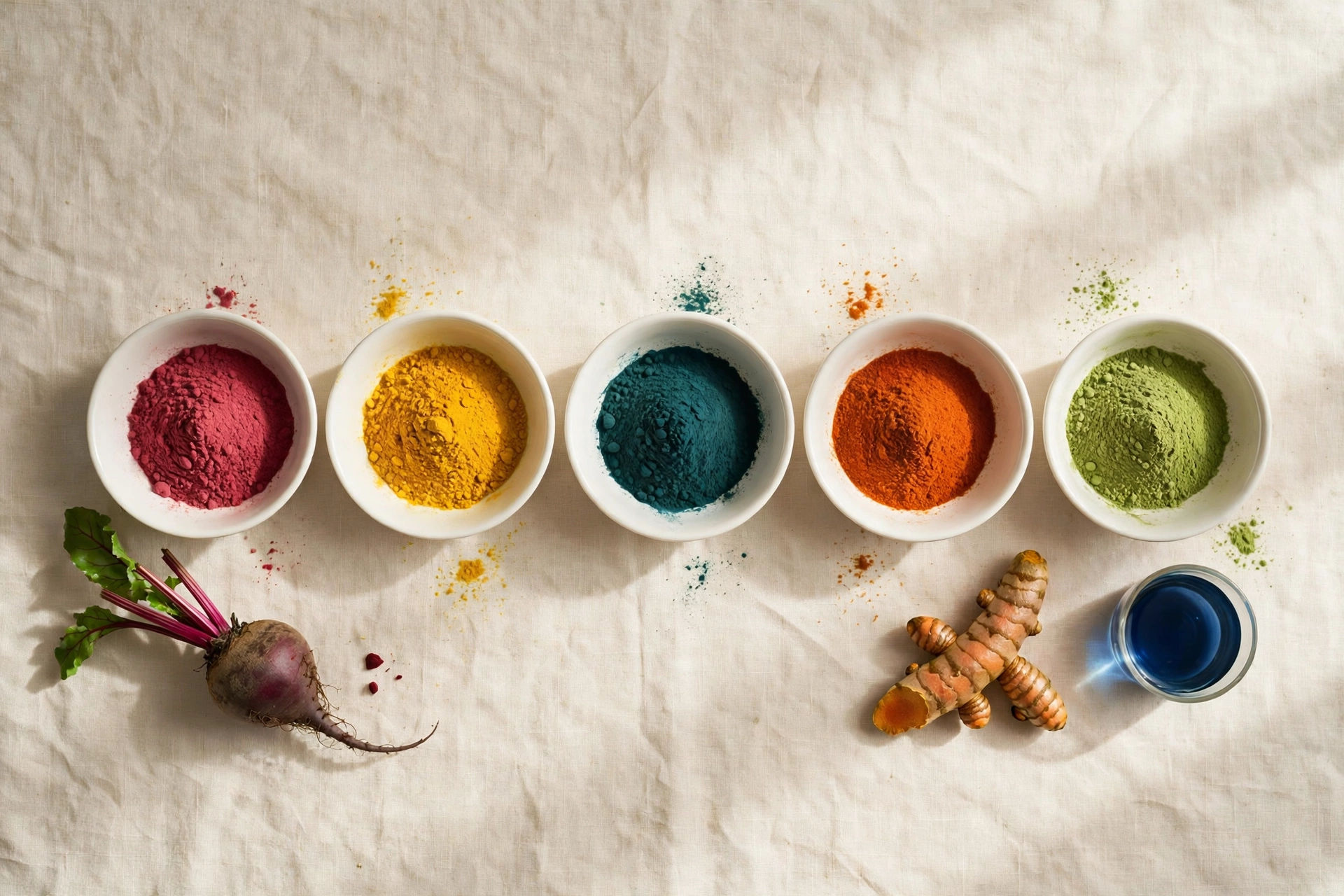
Most natural food dyes come from a small set of familiar ingredients you have probably eaten already, just not as dyes:
- Beetroot — a deep pink-red used in yogurt, frosting, and drinks.
- Turmeric — a warm golden yellow from the curry spice, used in drinks, snacks, and sauces.
- Spirulina — a blue-green algae, one of the few natural sources of true blue.
- Annatto — from achiote tree seeds, giving a yellow-orange. It is the reason cheddar is orange.
- Paprika — a red-orange from dried peppers, used in sauces and snacks.
- Butterfly pea flower — a blue-purple flower that turns pink with lemon juice, popular in drinks.
- Purple carrot, purple sweet potato, and red cabbage — deep purples and blues, used in drinks, candy, and cereals.
- Cochineal (carmine) — a red made from cochineal insects. Natural, but not plant-based, and widely used in food and cosmetics.
Notice the gap: nature is generous with reds, yellows, and purples, but true blue and bright green are rare — which is why artificial blues and greens are still so common.
Natural food coloring vs. artificial dyes: what is actually different
Artificial food dyes are synthetic colors made from petroleum-derived chemicals — Red 40, Yellow 5, Yellow 6, Blue 1, Green 3, and a handful of others. They are cheap, intensely bright, and extremely stable, while natural dyes are softer, pricier, and fussier about heat, light, and acidity. Here is the comparison at a glance:
| Natural dyes | Artificial dyes | |
|---|---|---|
| Source | Plants, minerals, or animals — beetroot, turmeric, spirulina, annatto | Synthetic, petroleum-derived chemicals |
| Color range | Strong in reds, yellows, purples; true blue and bright green are rare | Full spectrum, including vivid blues and greens |
| Brightness | Softer, more muted tones | Intense, saturated color |
| Stability | Sensitive to heat, light, and acidity | Very stable through cooking, storage, and shelf life |
| Cost | More expensive to produce and use | Cheap, which is why manufacturers love them |
| Label names | Named by source — beetroot extract, turmeric, spirulina | Numbered names — Red 40, Yellow 5, Blue 1 |
| Research | Generally considered safe, less studied as concentrates | More studied, more debated, especially for children |
That last row is the one people care about most. Artificial dyes have been linked in some studies to hyperactivity and attention issues in sensitive children, and a few countries restrict them or require warning labels. The evidence is genuinely debated — not settled, and not a scare story either. Natural dyes do not carry that debate, but “natural” is not “risk-free”: some people are sensitive to annatto or cochineal.
Where artificial dyes show up most
The usual suspects are foods that depend on bright, consistent color: candy, breakfast cereals, flavored drinks, icing and cake mixes, flavored yogurts, ice cream, packaged snacks, and children’s medicines and vitamins. The color does real work — it signals flavor and keeps every batch identical.
A naturally colored strawberry yogurt can vary from batch to batch; an artificially colored one looks identical every time. Manufacturers like predictability, and artificial dyes deliver it.
What “natural” on a label does and does not guarantee
This is where the front of the package gets slippery. “Naturally colored” means the coloring ingredient came from a natural source. It does not mean the food itself is healthy, unprocessed, or low in sugar, salt, or additives — a naturally colored candy can still be mostly sugar.
A few label traps worth knowing:
- “No artificial colors” is not the same as “no colors.” The product may still contain natural dyes doing a lot of the work.
- “Colored with fruit and vegetable juice” is real — but the juice is there for color, not nutrition.
- “Natural flavors” and “natural colors” are different claims — a product can have one and not the other.
- “Natural” is not tightly regulated on most food labels. The ingredient list is the real label — the front is marketing.
The stability problem: why natural colors fade
Here is the practical downside of natural dyes, and why food companies have been slow to switch: they are delicate. Heat dulls them, light fades them, and acidity changes them. Beetroot red turns brownish in baking, turmeric yellow fades in sunlight, butterfly pea blue turns pink with lemon juice, and spirulina blue does not survive high heat well.
For manufacturers, that means reformulating recipes and changing packaging to block light. For you at home, it means naturally colored frosting may look different after an afternoon in the fridge — that is normal; the color is behaving like food, not like a chemical.
How to spot dyes on an ingredient list
Reading the ingredient list takes about ten seconds once you know what to look for. Artificial dyes show up as numbered names — Red 40, Yellow 5, Blue 1 — or as “FD&C” plus a color and number. Natural dyes appear as the source itself: beetroot extract, turmeric, spirulina extract, or “vegetable juice for color.”
A few habits that help:
- Scan for numbers. A number next to a color name is almost always an artificial dye.
- Read past the front of the pack. The badge says “no artificial colors”; the ingredient list tells you what is actually in there.
- Check the order. Ingredients are listed by weight, so a dye near the end is present in a small amount — but a little of a very bright dye goes a long way.
- Watch for cochineal and carmine. They are natural reds, but if you avoid animal-derived ingredients, they are easy to miss because the name does not sound like an insect.
- Remember that “color” can hide in plain sight. “Caramel color” and “beta-carotene” are coloring ingredients too — beta-carotene is a natural orange from carrots; caramel color is made by heating sugars.
Simple swaps for home cooking and baking
If you want to try natural food coloring at home without reaching for a bottle of artificial dye, the pantry already has most of what you need. The colors are softer and less predictable than the bottled kind, but they work well for everyday cooking:
- Pink and red: beetroot powder or a spoonful of beet juice in frosting, pancake batter, or smoothies.
- Yellow and gold: a pinch of turmeric in rice, icing, or baked goods — a little goes a long way, and too much adds flavor.
- Blue and purple: butterfly pea flower tea in drinks and jellies, or purple cabbage juice, which turns pink with lemon.
- Orange: paprika or a little carrot juice in sauces and doughs.
- Green: matcha or spinach powder in smoothies, pasta dough, or icing — soft, not neon, and that is fine.
Add natural color near the end of cooking, since heat dulls it, and store colored food away from light. In baking, expect the color to soften in the oven — the trade-off for a dye that comes from a plant.
What to do next
If this guide has you looking at your pantry with fresh eyes, here is how I would work through it:
- Pick one category to check first. Candy, cereal, or drinks are easiest — flip three or four boxes over and look for numbered dyes.
- Decide what matters to you. Some people avoid artificial dyes entirely; others just want to know what they are eating.
- Try one home swap. Beetroot powder in frosting or turmeric in rice shows you what natural color looks and tastes like in your own kitchen.
- Read the ingredient list, not the badge. “No artificial colors” is a start — the back of the pack tells you what is really there.
- Keep it in proportion. The overall pattern of what you eat matters far more than any single dye.
The bottom line
Natural food coloring is color from plants, minerals, and animals — beetroot red, turmeric yellow, spirulina blue — and it differs from artificial dyes mainly in brightness, stability, and cost, not in a simple good-versus-bad story. Artificial dyes are cheaper, brighter, and more stable, which is why they are everywhere; natural dyes are softer, fussier about heat and light, and pricier. The label is your best tool: a numbered color is artificial, a named plant source is natural, and the front of the pack is marketing while the ingredient list is the truth. Want fewer artificial dyes? Read the back of three boxes you already buy — that is the whole habit.
This post is for general information only and is not medical advice. If you have a health condition, check with your clinician before changing personal care or health routines.