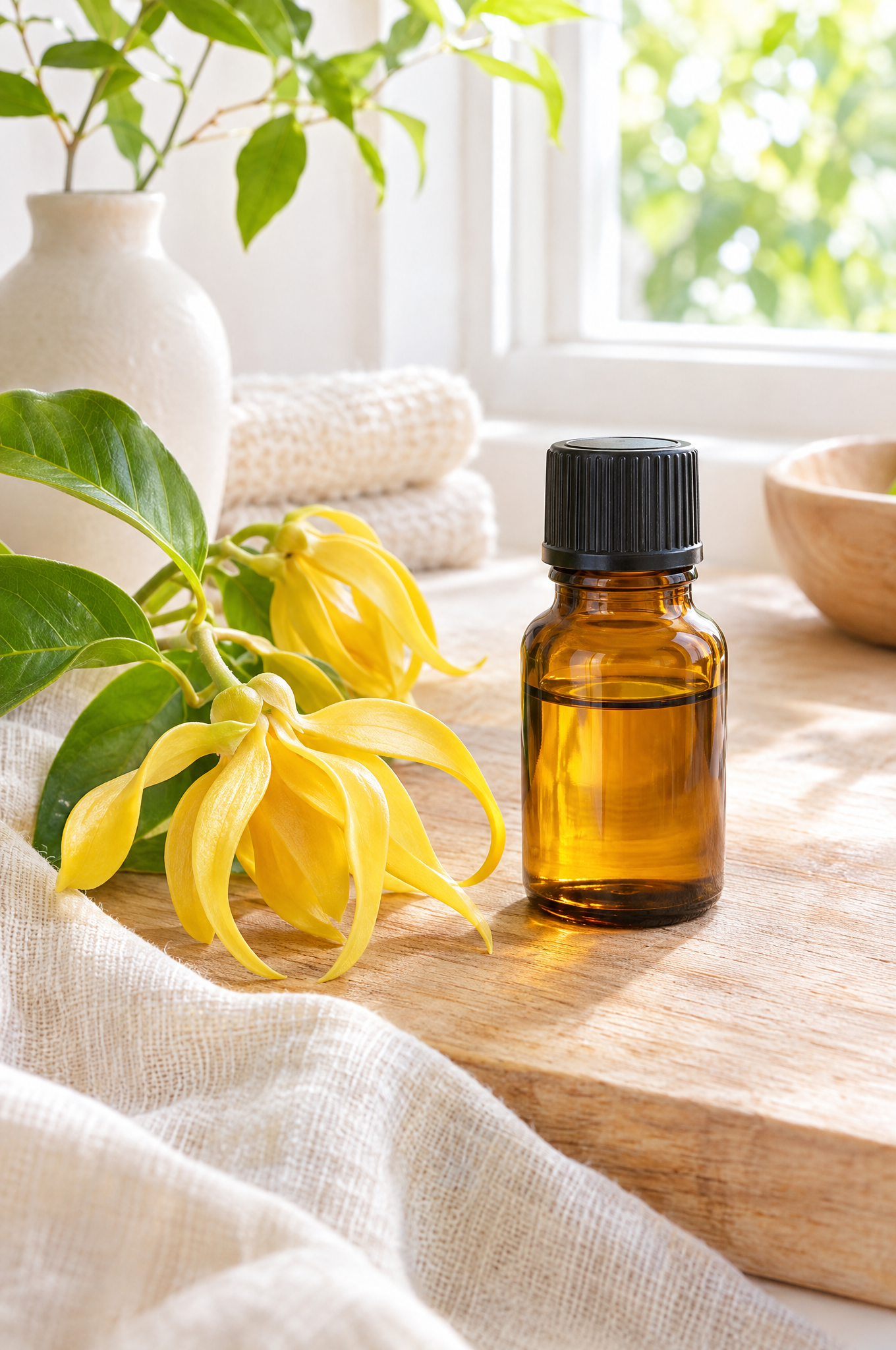
If you have ever caught the scent of ylang ylang, you have not forgotten it — sweet, creamy, and deeply floral, like jasmine with a warm, almost banana-like softness underneath. It is the scent of tropical evenings, and it comes from a flower so beloved that its name means “flower of flowers.”
Ylang ylang essential oil benefits for skin, hair, and calm are why this oil has been treasured for centuries. This guide shares what it is, what it is good for, how I use it safely, and the dilution rules that matter most — because this beautiful oil is stronger than it smells.
On This Page
- What Ylang Ylang Essential Oil Is
- Ylang Ylang Essential Oil Benefits for Skin
- Ylang Ylang Essential Oil Benefits for Hair
- Ylang Ylang Essential Oil Benefits for Calm and Sleep
- How to Use Ylang Ylang Essential Oil
- Ylang Ylang Essential Oil Safety
- Ylang Ylang Essential Oil: Good If You
- The Bottom Line on Ylang Ylang Essential Oil Benefits
What Ylang Ylang Essential Oil Is
Ylang ylang essential oil comes from the star-shaped yellow flowers of the ylang ylang tree, Cananga odorata, a tropical tree native to the Philippines and Southeast Asia. The flowers are picked early in the morning, when their scent is strongest, and steam-distilled into the oil over a full day. The oil is collected in fractions as it comes off the still — Extra first, then I, II, and III — with Extra the most intensely floral.
The oil is sweet, creamy, and heavy, with a warm floral heart and a spicy finish. Its main compounds are linalool, germacrene, and benzyl acetate — linalool is the same calming compound that makes lavender so relaxing — and together they give ylang ylang its rich, heady scent that fills a room from a single drop.
In Indonesia and the Philippines, ylang ylang flowers have decorated weddings and ceremonies for centuries. It has always been a beauty oil first, and a mood oil second — and I love it for both.
If you love warm, resinous oils too, my Frankincense Essential Oil Benefits guide is a lovely companion read — the two oils blend beautifully together in a diffuser.
Ylang Ylang Essential Oil Benefits for Skin
Ylang ylang essential oil benefits for skin are why most people buy their first bottle, and I understand why. It is a balancing oil, traditionally loved for skin that cannot decide whether it is oily or dry, and it brings a soft, dewy look to tired skin.
Here is what I love about it for skin:
| Benefit | Why I love it |
|---|---|
| Balances oil | Traditionally loved for skin that is oily in places and dry in others |
| Supports mature skin | A softening, smoothing feel on skin that is starting to show its age |
| Calms the look of redness | Its soothing compounds help skin look less reactive |
| Adds a glow | A drop in face oil leaves skin looking dewy and fresh |
I use it the way I use all my face oils: one drop in two teaspoons of jojoba oil, warmed between my palms and pressed onto clean skin at night. A little goes a long way here — ylang ylang is a strong oil, and one drop is plenty.
Ylang Ylang Essential Oil Benefits for Hair
Ylang ylang essential oil benefits for hair go back further than almost any other use — it was a hair oil before it was a perfume oil. In the Philippines, the flowers were traditionally used to adorn and scent the hair, and in the nineteenth century, ylang ylang was the heart of Macassar oil, the pomade men used for glossy, scented hair.
I love it as a hair treatment now: a drop or two mixed into a tablespoon of coconut oil, massaged into the scalp and through the ends, wrapped in a towel for an hour before washing. It leaves hair soft and shiny, and the scent lingers in the loveliest way. It is also a beautiful addition to shampoo or conditioner — one drop per wash is enough to scent the whole shower — and its balancing nature suits both dry, flaky scalps and scalps that get oily too fast.
Ylang Ylang Essential Oil Benefits for Calm and Sleep
Beyond beauty, ylang ylang essential oil benefits for calm are why I keep a bottle by my bed. The scent is deeply relaxing — one breath and my shoulders drop. It is the oil I reach for when the day has been loud and I want the evening to be quiet.
Small studies on healthy volunteers have found that inhaling ylang ylang was linked with a slower heart rate and lower blood pressure, and a calmer mood — and linalool, its main compound, has been studied for its calming effects. I love that there is something real behind the feeling: a few drops in the diffuser at the end of a long day, and the whole house smells like a tropical evening.
I also love it as a sleep scent: a drop on a tissue beside the pillow, or three drops in the diffuser while I read, is enough — ylang ylang is strong, and more is not better with this one.
How to Use Ylang Ylang Essential Oil
Ylang ylang essential oil is wonderfully versatile once you know the dilution rules — and with this oil, the dilution rules matter more than most:
On skin, always diluted, and more diluted than other oils. Ylang ylang is one of the oils most likely to irritate skin, so keep it gentle: about one drop in two teaspoons of carrier oil for the face, and no more than four drops per ounce (30 ml) of carrier oil for the body.
In a diffuser. Add just one to three drops to your diffuser with water and let it run for thirty minutes in the evening. Ylang ylang is heavy and heady — a little fills a room, and too much can bring on a headache.
In a bath. Mix two or three drops into a tablespoon of carrier oil or a cup of Epsom salts first, then stir that into warm bath water — never drop essential oil straight into bath water, where it floats on top and can irritate skin.
As a hair treatment. A drop or two in a tablespoon of coconut oil, massaged into the scalp and ends, wrapped in a towel for an hour before washing — my favorite way to use it.
When you shop, look for the botanical name on the label — Cananga odorata — and choose a brand that shares GC/MS test results. Extra grade is the most floral and the loveliest for diffusing.
Ylang Ylang Essential Oil Safety
Ylang ylang is one of the most beautiful oils on my shelf, and also one of the ones I treat with the most respect. A few rules keep it that way:
Dilution is the big one. Never apply ylang ylang essential oil undiluted — it is more likely to irritate skin than most oils. Always patch test first: a little of your diluted blend on the inside of your forearm, then wait a full day.
Too much of a good thing is real with this oil: breathing in a lot of it for a long time can bring on headaches and nausea, so keep diffuser sessions short and the room ventilated.
Keep it away from your eyes and the inside of your nose, and do not use essential oils on babies or young children. If you are pregnant or breastfeeding, check with your healthcare provider first. And ylang ylang essential oil is not for internal use — skin, diffusing, and hair only.
One more rule that matters: ylang ylang is toxic to cats and dogs. Keep the bottle where pets cannot reach it, and do not diffuse it in a room where your pets spend time.
Store the bottle upright in a cool, dark place with the cap on tight.
Ylang Ylang Essential Oil: Good If You
Ylang ylang essential oil is a lovely oil if you want something beautiful and versatile — one bottle for skin, hair, and calm. It suits you if you love rich, floral scents, if your skin is on the combination or mature side, or if you want a grounding scent for evenings and a glossy hair treatment in the same bottle.
Try it first as a single drop in the diffuser one evening and see how the scent sits with you. If the scent is too heavy on its own, blend it with sweet orange or lavender — a drop of each lightens it beautifully.
The Bottom Line on Ylang Ylang Essential Oil Benefits
Ylang ylang essential oil benefits for skin, hair, and calm are why this tropical flower still earns its place on a modern shelf — sweet, balancing, and genuinely useful: a drop in your face oil, a drop in your hair treatment, and an evening that smells like a garden in bloom.
Start with proper dilution, patch test first, and let this old, beautiful oil do its quiet work. A flower called the flower of flowers has earned its name.
This article is for general information only and is not medical advice. Talk to your doctor before using essential oils if you are pregnant, nursing, taking medication, or managing a health condition. Never apply essential oils undiluted to skin.