You have probably seen the cup by now — a frothy mug on your feed, a scoop of powder stirred into hot water, and a list of promises underneath it: sharper focus, steadier energy, calmer mornings, better sleep. Mushroom coffee is everywhere at the moment, and the mushroom coffee benefits printed on the bag sound like a better version of your morning coffee with nothing taken away.
Here is the plain-English version: what mushroom coffee actually is, how much caffeine is really in the cup, which of those benefits have real evidence behind them, and which ones are hype dressed up as science.
What is mushroom coffee, exactly?
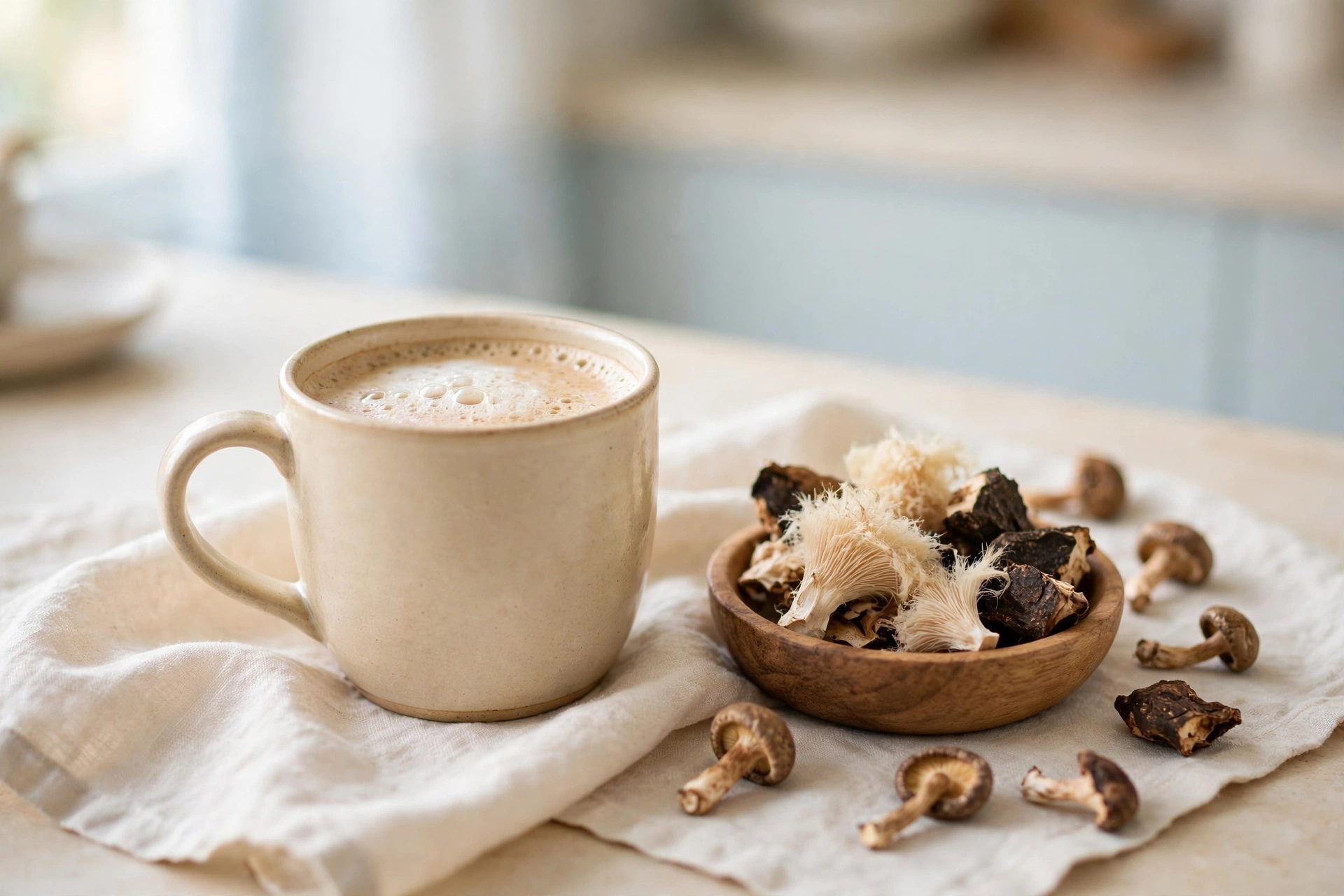
Mushroom coffee is coffee blended with powdered extracts of so-called functional mushrooms. The four that turn up in almost every blend are lion’s mane (sold for focus and memory), reishi (for stress and sleep), chaga (for antioxidants), and cordyceps (for energy and endurance). The mushrooms themselves contain no caffeine — the caffeine comes entirely from the coffee part of the blend.
Most blends come in two forms. Instant blends are a scoop of powder you stir into hot water, and they are mostly mushroom powder with a smaller amount of instant coffee. Ground blends are real coffee beans with mushroom extract mixed in, brewed like ordinary coffee. That difference matters more than anything on the label, because it decides how much caffeine you actually get — and how much mushroom you actually get.
There is no standard recipe. One blend might carry a gram or two of mushroom extract per serving; another might carry a few hundred milligrams split across four species. The bag rarely tells you the full story, which is why the claims on the front and the evidence behind them so often part company.
Mushroom Coffee Caffeine: The Difference Is Real
This is the one difference between mushroom coffee and regular coffee that is checkable and not in dispute: most mushroom coffee has about half the caffeine of a regular cup.
| Drink | Caffeine per serving |
|---|---|
| Instant mushroom coffee blend | 30–60 mg |
| Ground mushroom coffee blend | About 80–100 mg |
| Regular brewed coffee, 8 oz | About 95 mg |
| Mushroom coffee alternative (no coffee) | 0–35 mg |
The 95 mg figure for brewed coffee comes from Harvard’s Nutrition Source, and the U.S. Food and Drug Administration cites 400 mg a day as an amount most healthy adults can have. An instant mushroom coffee at around 48 mg sits closer to a cup of tea than to a cup of coffee, and that alone explains a lot of what people report: fewer jitters, less of an afternoon crash, easier sleep. The mushrooms may or may not be doing anything — the lower caffeine is doing something, and it is doing it on day one.
If you currently drink two or three strong coffees a day and switch overnight, expect to notice the drop. A few people get a headache for the first day or two, the same way they would cutting back on coffee any other way.
Lion’s mane and focus: the most interesting evidence, and still thin
Lion’s mane is the mushroom with the most developed human evidence, and it is still early, small, and mixed. A 2025 systematic review found only five randomised trials of lion’s mane in people, mostly small and mostly in older adults.
The most-cited trial gave 30 Japanese adults aged 50 to 80 with mild cognitive impairment 3 grams of dried lion’s mane powder a day for 16 weeks. Their scores on dementia-screening tests improved at weeks 8, 12, and 16 — then fell again four weeks after they stopped taking it. A 2023 pilot study gave 41 healthy adults aged 18 to 45 a daily 1.8-gram dose for 28 days: they were measurably faster on one attention task an hour after a single dose, but less accurate on an immediate word-recall test, and after 28 days there was no significant improvement in overall cognition or memory. The drop in self-reported stress fell just short of statistical significance.
Two things to hold onto from that. First, the human trials used 1.8 to 3 grams of lion’s mane a day. A serving of mushroom coffee typically contains a fraction of that, because most of the scoop is coffee. Second, no trial has tested lion’s mane inside coffee, or tested a finished mushroom coffee product at all. What lion’s mane might do at full dose in a capsule is not what a cup of mushroom coffee has been shown to do.
Reishi, chaga, and cordyceps: the claims run ahead of the trials
Reishi has been studied more than the others, and the reviews are not flattering. A Cochrane review of five trials in 398 people with type 2 diabetes, using 1.4 to 3 grams a day for 12 to 16 weeks, found reishi did not improve blood glucose, cholesterol, or blood pressure — the changes were small and not statistically significant. A 2016 randomised trial gave 3 grams a day to 84 people with type 2 diabetes and metabolic syndrome and found no meaningful benefit on the cardiovascular risk markers it measured. The claim that reishi in a coffee blend will meaningfully reduce your stress is not supported by the trials that exist.
Chaga is genuinely high in antioxidants — in the lab. There are no consistent human trials of chaga at consumer doses, and coffee itself is, for many people, the single largest source of antioxidants in their diet, so the extra benefit of adding chaga to it has not been demonstrated. Chaga also carries the clearest documented risk of the four: it is very high in oxalates, and case reports describe oxalate kidney damage, including end-stage kidney disease, after years of daily chaga powder. Cleveland Clinic notes that chaga is high in oxalates and known to increase kidney stones.
Cordyceps has been studied for oxygen use and endurance with mixed results, mostly in small trials and often at doses well above what a coffee blend contains. A 2010 trial used a CS-4 cordyceps strain at roughly 1 gram a day for 12 weeks in healthy older adults; another tested a different cordyceps species in recreationally active adults. Nothing in that literature supports an energy claim for a cup of mushroom coffee.
The Mushroom Coffee Dose Problem, Stated Plainly
Every benefit above rests on the same gap: the studies used grams per day of a single mushroom, and a serving of mushroom coffee delivers a fraction of that, split across several mushrooms. The combination itself — coffee plus mushroom extracts at commercial serving sizes — has not been studied as a single unit. Caffeine is the most-evidenced ingredient in the blend by a wide margin, and it is the one doing the reliable work: alertness, at a lower dose than your usual cup.
That does not make mushroom coffee useless. It makes it a gentler cup of coffee with an interesting, unproven bonus — not a brain supplement that happens to taste like coffee.
Mushroom coffee benefits: what’s real and what’s hype
| Claim | What the evidence says |
|---|---|
| Sharper focus | Possible, preliminary — lion’s mane has the best human evidence, but trials are small, mixed, and used far higher doses than a cup delivers |
| Steadier energy, no crash | Mostly the lower caffeine — real, but it is a caffeine effect, not a mushroom effect |
| Less stress, better sleep | Uncertain — reishi trials show no meaningful benefit on the markers tested; the sleep benefit is more plausibly the lower caffeine later in the day |
| Stronger immunity | Not supported — no human evidence that these mushrooms in coffee improve immune outcomes |
| More antioxidants | Lab evidence only — coffee is already a major antioxidant source, and the extra benefit is unproven |
| Better gut health | No evidence in people |
| Weight loss | No evidence — a 3.6K/mo search term, not a supported claim |
The hype to skip: any bag, video, or article claiming mushroom coffee detoxes, heals your gut, boosts immunity, or burns fat as if the mushroom powder were a medicine. And do not pay extra for a higher mushroom dose on the label unless the label actually states the amount per serving — most do not.
How to make mushroom coffee, and what to look for on the label
If you want to try it, the making is simple. For an instant blend, stir one scoop into hot — not boiling — water and whisk or froth it until smooth; a splash of milk or a little honey takes the earthy edge off. For a ground blend, brew it exactly like ordinary coffee. Start with half a serving for the first few days: the most common complaint when people start is mild digestive upset — bloating, gas, or looser stools — and it usually settles once your stomach adjusts.
The label is where the real choosing happens. Look for four things:
- The mushroom amount per serving, in milligrams. If the label does not state it, you have no way of knowing whether you are getting a meaningful dose or a dusting.
- Which mushrooms, and how much of each. A blend that lists four species but only gives a total weight is mostly marketing.
- Fruiting body, not just mycelium. The compounds studied in the trials come largely from the fruiting body; mycelium grown on grain can be mostly grain.
- Third-party testing. Mushroom powders are one of the categories where independent testing for heavy metals and actual content matters, because the bag is the only evidence you have.
And check the caffeine number the same way you would check anything else: instant blends usually list 30 to 60 mg a serving, ground blends land near a normal cup. If the label does not say, assume it is roughly half a cup and plan your day accordingly.
Who should be careful with mushroom coffee
Mushroom coffee is well tolerated by most healthy adults, and a 2025 systematic review found side effects from lion’s mane are rarely reported — mainly stomach discomfort, headache, and allergic reactions. But a few people should check with a clinician first, or skip it.
- If you are allergic to mushrooms, do not drink it. A mushroom allergy is the one common effect you should not wait out — stop and seek care if you notice a rash, swelling, or difficulty breathing.
- If you take blood thinners or antiplatelet medication, be cautious. Reishi may have antiplatelet effects, and chaga may interact with anticoagulants.
- If you take diabetes medication, check first. Some of these mushrooms may lower blood sugar, which matters when you are already on treatment for it.
- If you have kidney disease or a history of kidney stones, be careful with chaga in particular — its high oxalate content is the best-documented risk in the whole category.
- If you take immunosuppressant medication or have an autoimmune condition, ask your clinician. Cordyceps may stimulate the immune system, which is the opposite of what those treatments are doing.
- If you have liver problems, note that liver injury has been reported with reishi powder in case reports.
- If you are pregnant or breastfeeding, the effects of mushroom extracts are not documented in pregnancy, and the safe caffeine limit in pregnancy is 200 mg a day — check with your clinician before adding it.
- Children under 18 should not drink mushroom coffee without medical guidance.
None of this makes mushroom coffee dangerous for a healthy adult. It makes it a supplement-flavoured drink worth treating like one — check the label, check your medication list, and ask your clinician if anything on it applies to you.
What to Do Next With Mushroom Coffee
If this guide has you curious, here is how I would start:
- Decide what you actually want from it. If the answer is gentler caffeine, any instant blend will do that on day one. If the answer is lion’s mane for focus, know that no cup has been shown to deliver a trial dose.
- Read the label before the marketing. Mushroom amount per serving, which species, fruiting body, third-party testing, caffeine per serving — if those are missing, you are buying a story.
- Start with half a serving. Give your stomach a few days to adjust, and give yourself a fair test of the lower caffeine before deciding how it feels.
- Keep your expectations at the label. The lower caffeine is real and you will feel it. The rest is plausible, early, and unproven — worth watching, not worth promising.
- Check the safety list first. Allergy, blood thinners, diabetes medication, kidney stones, pregnancy — if any of those apply, ask your clinician before your first cup.
The Bottom Line on Mushroom Coffee
The mushroom coffee benefits that hold up come down to a short list: less caffeine than a regular cup, which means fewer jitters and an easier afternoon, and a set of mushrooms — lion’s mane first among them — with interesting early human evidence at doses far higher than any cup delivers. The focus, stress, immunity, and antioxidant claims have no solid human evidence behind them at coffee-cup doses, and no trial has tested a finished mushroom coffee product at all. But as a gentler morning ritual with a plausible bonus inside it, used where lower caffeine actually helps, it earns its place on the shelf. Buy a blend that states its numbers, start with half a serving, and let the mushrooms stay a maybe while the caffeine does the work you can feel.
This post is for general information only and is not medical advice. If you have a health condition or take medication, check with your clinician before adding mushroom coffee or any supplement to your routine.