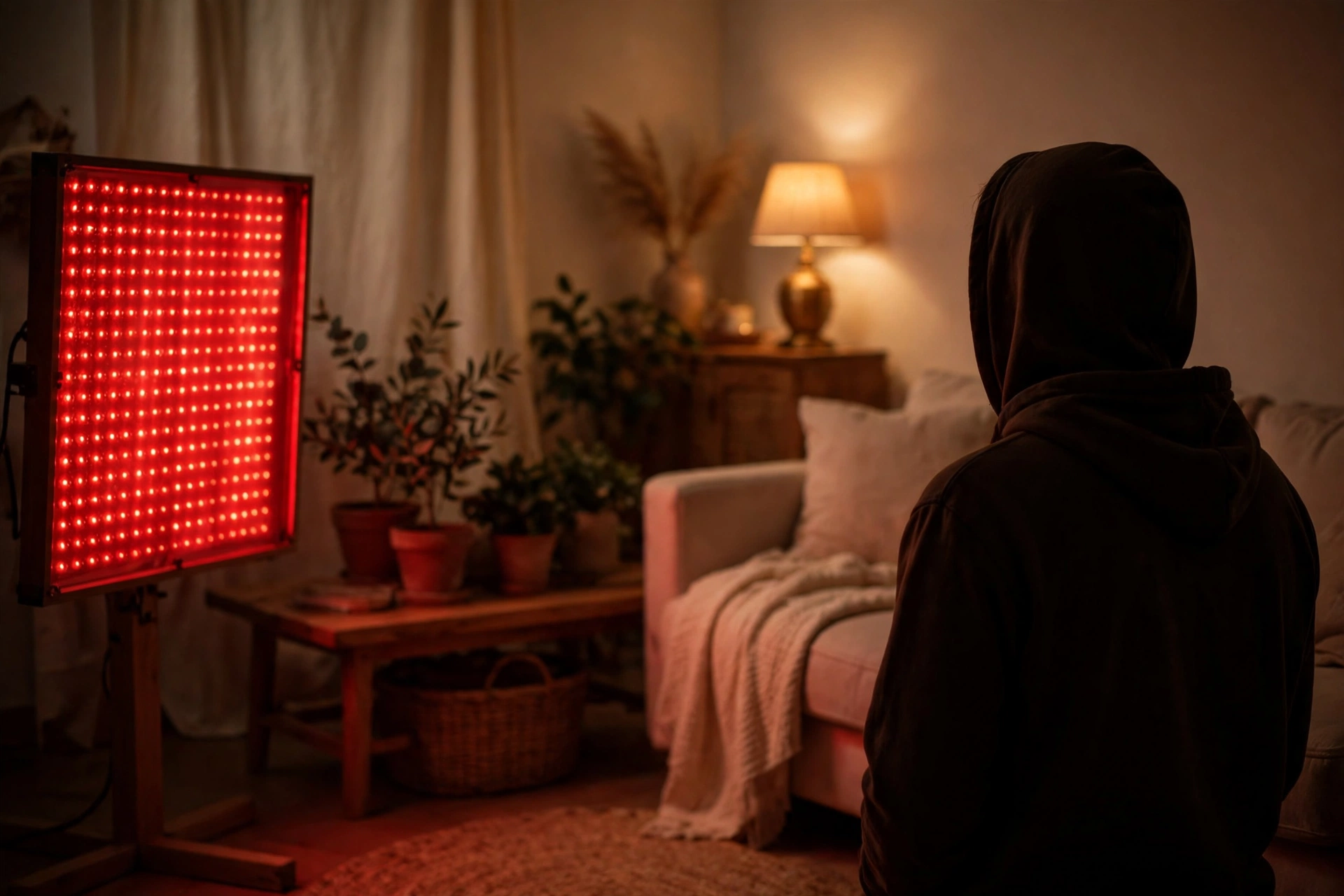
You’ve seen the photos: someone standing in front of a glowing red panel in their living room, wearing what look like welding goggles, bathed in light like a sci-fi movie. It looks either futuristic or ridiculous, depending on your mood. And the claims around it are all over the place — better skin, faster recovery, less pain, better sleep, even weight loss.
So what does red light therapy actually do? Short answer: it does something real, but less than the ads promise. Here’s the honest version.
What red light therapy actually is
Red light therapy — researchers call it photobiomodulation, which is a mouthful for “light changing how your cells behave” — uses red and near-infrared light, usually around 660 nanometers (visible red) and 850 nanometers (near-infrared, which you feel more as warmth than see as light). You sit or stand in front of a panel, wear a mask, or hold a small device against an area for several minutes.
The proposed mechanism is straightforward: your cells’ mitochondria, the parts that produce energy, absorb this light. That absorption seems to bump up cellular energy production and nudge along repair processes. It’s a plausible story, and lab studies support the basic mechanism. The jump from “cells in a dish respond to light” to “this panel will fix your skin” is where things get shakier, because real bodies, real devices, and real study designs vary a lot.
Two things it’s not: it’s not UV light, so it doesn’t tan you or carry the sunburn and skin-cancer risks of UV. And it’s not a laser zapping anything off — the light is low-level, it doesn’t cut or burn when used as directed, and it doesn’t heat you up the way a sauna does.
The light is the easy part. The dose is where it gets tricky. Wavelength, brightness, distance from the device, and session length all change what you actually get, and devices differ wildly on all four. That’s why two people can have completely different experiences with “red light therapy” — they may not be getting the same treatment at all.
The benefits with the best evidence
Let’s rank these by how solid the evidence is, because the marketing treats everything as equally proven and it’s not.
Skin. This is the best-studied area, and it’s where I’d put the most confidence. Multiple small trials have found that red light improves skin texture and the appearance of fine lines, mostly by supporting collagen production. It’s also studied for wound healing — cuts and minor skin injuries healing a bit faster with light exposure. The effects are modest, not dramatic: think “skin looks a bit better over weeks” rather than a facelift. And the face-mask version of this is why masks are everywhere — your face is a small, easy target for consistent sessions.
Muscle recovery. Athletes were early adopters for a reason. Light therapy after hard training is studied for reducing soreness and helping muscles bounce back, and the results are generally positive in small trials. If you lift or run regularly, a session after training is one of the more sensible uses. It won’t replace sleep, food, and rest days — nothing does — but as an add-on, the evidence is decent.
Pain, especially joints and muscles. Red and near-infrared light is studied for chronic joint and muscle pain, including knees and backs, with a fair number of trials showing reduced pain scores. This is also where the evidence gets messiest: pain is subjective, placebo effects are strong, and studies use different devices and doses. I read this as “promising, not proven” — worth trying if you have a nagging issue and your clinician is fine with it, but not something to bet the farm on.
Hair growth. Low-level light is studied for pattern hair loss, and some trials show increased hair density over months. The effect is slow and partial — it’s not regrowing a full head of hair — and it needs ongoing sessions to maintain. Masks and caps built for the scalp exist for exactly this reason.
Sleep. This one is indirect but interesting. Bright light at night, especially blue light from screens, messes with your sleep signals. Red light doesn’t suppress melatonin the way blue light does, so some people use red light in the evening as their wind-down lighting. That’s a different claim than “red light improves your sleep” — it’s more “red light doesn’t wreck your evening the way your phone does.” Keep those two ideas separate.
Mood and brain health. Early research exists here, and it’s genuinely interesting, but it’s also the earliest-stage evidence of the bunch. Small studies, lots of open questions. I wouldn’t buy a panel for this reason alone.
The pattern across all of this: small studies, short timelines, real but modest effects. Red light therapy isn’t fake. It’s just early, and the gap between “studied” and “proven” is bigger than the ads admit.
Panels, masks, and wands, in plain English
The device shapes the experience more than most people expect. Here’s how the main types compare.
| Device | What it covers | Typical session | Best for |
|---|---|---|---|
| Full-body panel | Large areas, or your whole front or back at once | 10–20 minutes per side | Recovery, general use, people who want one device for everything |
| Face mask | Just your face | 10 minutes | Skin, fine lines, an easy daily habit |
| Handheld wand | One small spot at a time | A few minutes per spot | A single knee, shoulder, or sore spot |
| Bed or pod | Your whole body at once | 10–20 minutes | Full-body sessions without turning around halfway |
Panels are the most versatile and the most expensive category. Masks are the easiest habit — you put it on, you sit there, you’re done. Wands are the cheapest entry point but the slowest if you want to cover a large area, because you’re treating one patch at a time. Beds are the luxury option: convenient, pricey, and mostly found in clinics and gyms.
One practical note: the distance from the device matters as much as the session length. A panel used from six inches away is a very different dose than the same panel from three feet away. Follow the device’s own guidance on distance — that’s not fine print, it’s the treatment.
How to actually use one
If you’re starting out, the routine is simple, but consistency is everything.
- Follow your device’s distance and time guidance. This is the single most important rule. More is not better here — longer sessions past the recommended time don’t add benefit.
- Be consistent for weeks, not days. This is the honest answer to “how long until I see benefits”: most studies run several weeks of regular sessions before measuring results. If you use it twice and declare it useless, you haven’t really tried it.
- Several sessions a week beats one long session. Three to five shorter sessions a week is the pattern most studies use.
- Protect your eyes. Don’t stare directly into the light. Panels used near your face usually come with goggles — wear them. Masks have built-in eye protection for a reason.
- Track one thing. Pick the thing you actually care about — skin texture, soreness after workouts, a sore knee — and notice it over a month. Vague “I feel better” is hard to trust; one specific thing is easier to judge honestly.
Consistency is the whole game with red light. The people who report benefits are almost always the people who used it regularly for weeks. The people who call it a scam often used it a handful of times. Both experiences are real — they’re just not the same experiment.
What it won’t do
A few claims deserve a firm no, because they show up constantly.
- Weight loss. Red light is marketed for fat loss, and the evidence there is thin. A few small studies show modest changes, but nothing close to what the ads imply, and light doesn’t replace food and movement. If a device promises to melt fat, that’s your cue to be skeptical of everything else it says.
- Detox. Same story as saunas: your liver and kidneys handle detoxing. Light doesn’t flush toxins out of you.
- Cure anything. Red light doesn’t cure chronic disease, and any brand that implies it does is selling you something you shouldn’t buy. It’s a supportive tool with modest effects, not a treatment.
- Replace medical care. A sore knee that keeps getting worse, a skin change that looks new or strange, pain that doesn’t ease — those need a clinician, not a panel.
Who should be careful
Red light therapy is low-risk for most healthy adults, but a few situations deserve a pause first.
- Pregnancy. The evidence here is limited, and most guidance leans cautious — check with your clinician before starting.
- Light-sensitive conditions or medications. Some conditions and medicines make skin more sensitive to light. If either applies to you, ask your clinician first.
- Eye conditions. If you have an eye condition, be extra careful about eye protection, and skip panels aimed at your face unless your eye doctor is fine with it.
- History of skin cancer or suspicious skin changes. Get anything new or changing checked before you start shining light on it.
- Active cancer treatment. Light therapy around tumors is an area with real unknowns — this is a “talk to your oncologist, not the internet” situation.
None of this is meant to scare you off. It’s the same logic as any wellness device: low risk doesn’t mean no risk, and a quick check with your clinician is cheap insurance when something on this list applies to you.
The bottom line
Red light therapy sits in the same honest middle ground as a lot of wellness tech: not a miracle, not a scam. The best evidence is for skin and muscle recovery, with pain and hair growth in the “promising” tier and everything else further back. Effects are modest, they take weeks of consistent use, and the device and dose matter enormously — which is why experiences vary so much.
If you’re curious, the sensible way in is a clear goal, a device that fits that goal, and a month of consistent sessions before you judge it. That’s the whole experiment. And if a brand promises you dramatic results in days, believe the evidence instead of the ad.
This post is for general information only and is not medical advice. If you have a health condition, check with your clinician before changing supplements or routines.