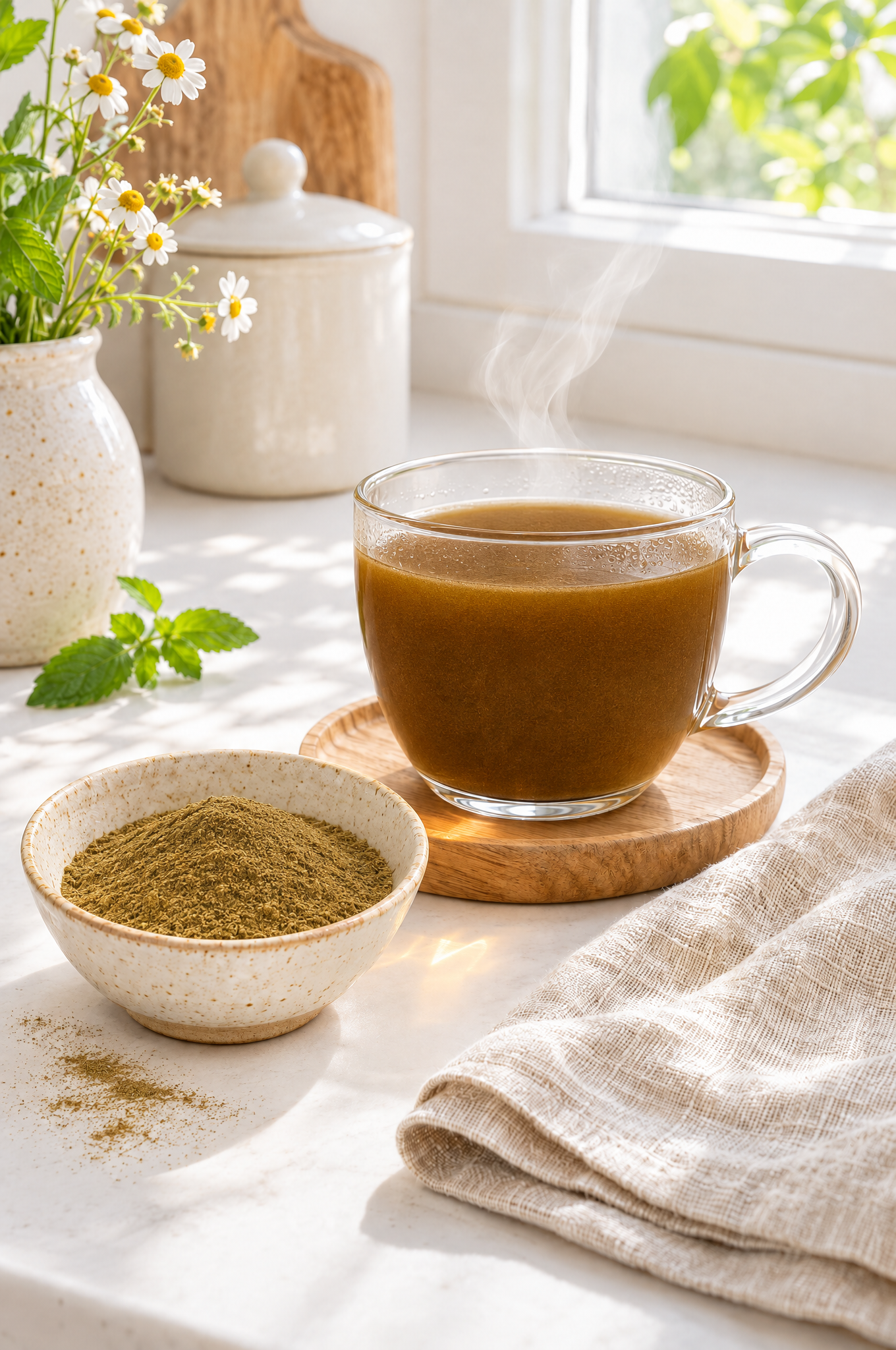
If you spend any time in the world of traditional herbal teas, you will meet essiac tea sooner or later. Eight simple herbs, a Canadian nurse, and a recipe passed from hand to hand for a hundred years — I love a tea with a story, and essiac tea has one of the best.
Essiac tea is a gentle herbal tonic I reach for when I want something grounding and simple — a quiet, earthy cup that feels like a small daily ritual, made from eight herbs loved in folk herbalism for generations. Here is what essiac tea is, what is in it, how to brew it, and how I drink it.
On This Page
- What Essiac Tea Is
- Essiac Tea Ingredients
- Essiac Tea: The Outdated Four-Herb Formula
- Essiac Tea Benefits
- How to Make Essiac Tea
- How I Drink Essiac Tea
- Where I Get My Essiac Tea
- Essiac Tea: Good If You
- The Bottom Line on Essiac Tea
What Essiac Tea Is
Essiac tea is a traditional herbal blend of eight plants: burdock root, sheep sorrel, slippery elm bark, Turkish rhubarb root, blessed thistle, red clover, kelp, and watercress. The name is the surname Caisse spelled backwards, after Rene Caisse, the Canadian nurse who brought the formula to the wider world in the 1920s after learning it from a patient who said it came from an Ojibwa healer. Caisse spent the rest of her life sharing it.
Later in her career, Caisse worked with Dr. Charles Brusch, her colleague and research partner, on an expanded eight-herb version of the formula — the one she used toward the end of her career. That eight-herb blend is the complete, authentic essiac tea, and it is the one I drink.
What I love about essiac tea is how simple it stays. Eight powdered herbs, simmered in water, and sipped as a daily tonic. People have turned to it for generations as a cleansing, immune-supporting ritual, and it is still brewed at home today from the dry herb blend, or bought ready-made in bottles.
The tea itself is a warm amber color with a mild, earthy, slightly bitter taste. It is caffeine-free, so it works any time of day, and a small glass goes a long way — this is a tonic you sip in small amounts, not a big mug you gulp down.
If you love learning about traditional teas, my Matcha Benefits guide walks through another favorite of mine — a very different kind of tea, but the same love of a simple daily ritual.
Essiac Tea Ingredients
The authentic essiac tea formula has eight herbs, and each one brings something lovely to the cup:
Burdock root is the grounding base of the blend. In folk herbalism it has long been loved as a cleansing root, traditionally used to support the liver and skin, and it gives the tea its deep, earthy flavor.
Sheep sorrel is the bright, tangy green of the blend. It is a small leafy plant with a lemony bite, and it is the herb most associated with essiac tea’s traditional cleansing reputation. The real formula includes sheep sorrel with the root — that little detail is one of the marks of an authentic blend.
Slippery elm bark is the soothing one. In hot water it forms a gentle, slippery gel, and it has been used for generations to comfort the throat and the digestive tract.
Turkish rhubarb root (also called Indian rhubarb root) rounds out the original four with gentle digestive support. It has been used in traditional herbalism to keep things moving comfortably, and adds a subtle bitterness that makes the tea taste like a proper tonic.
Blessed thistle has a long history in herbal traditions, loved for digestive comfort.
Red clover brings plant compounds called isoflavones, and a gentle sweetness that softens the blend.
Kelp is a sea vegetable rich in minerals, including iodine, and brings the minerals of the ocean to the cup.
Watercress is the leafy green that gives the tea its slight bitter note — that bitterness is by design, and it comes mainly from the watercress.
The herbs are powdered, not cut — a fine powder, the way Caisse herself prepared them. Powdered herbs give the brew more surface area, so more of the good compounds steep into the tea, and the powder stays in the tea when you drink it. That matters, and I will explain why in the brewing section below.
Essiac Tea: The Outdated Four-Herb Formula
Here is something I wish I had known sooner: the four-herb essiac tea you see in most stores is the outdated formula.
The original blend Caisse shared in the 1920s had four herbs — burdock root, sheep sorrel, slippery elm bark, and rhubarb root. But as her work went on, she realized the extra four herbs increased the potency of the original four, and she discontinued the four-herb formula for good. The eight-herb blend is the one she used toward the end of her career, and it is the most complete version of essiac tea.
Most companies stopped at four herbs. The research and the tradition did not. The eight-herb formula keeps the original four in the same ratios and simply adds blessed thistle, red clover, kelp, and watercress — so you are not missing out on any of the original four, and you are getting four more herbs that help the original four work better.
How do you spot the real thing? Three things to look for: eight herbs, not four; powdered herbs, not cut; and sheep sorrel with the root included. If a blend has only four herbs, or tells you to strain the sediment out, it is not the complete formula.
Essiac Tea Benefits
The essiac tea benefits I love most are the quiet, everyday ones — a tea that supports you gently, day after day.
Here is what draws me to it:
- Gentle daily cleansing support — the eight herbs are traditionally loved as a cleansing, tonic blend
- Antioxidant-rich herbs — burdock, sheep sorrel, red clover, and rhubarb root all bring plant antioxidants
- Digestive comfort — slippery elm soothes, blessed thistle comforts, and rhubarb root keeps things moving gently
- Immune support — a daily tonic ritual that supports the body’s own defenses
- Calm, caffeine-free ritual — a warm cup with no caffeine, perfect for evenings
What I love most is the ritual itself. Brewing a pot of essiac tea, pouring a small glass, and sitting with it for a few quiet minutes feels like a tiny act of care — and there is something lovely about drinking a tea with that much history in it.
The antioxidants in the blend are a real part of the appeal for me. Each herb brings its own plant compounds — burdock root is rich in polyphenols, sheep sorrel brings its own antioxidant profile, red clover brings isoflavones — and together they make a tea that feels like it is doing something good, one small glass at a time.
How to Make Essiac Tea
Brewing essiac tea at home is simple, and the dry herb blend keeps for months in a jar. Here is the traditional way I make it:
Start with the dry eight-herb powdered blend. Bring a large pot of filtered water to a boil — about a gallon, plus a little extra to allow for evaporation. Stir in 4 ounces (113 grams) of the powder, about one 4-ounce packet. Keep the pot at a moderate boil for ten minutes, stirring occasionally. Then take it off the heat, cover it, and let it sit at room temperature for twelve hours, so the roots and barks release everything they have.
Then stir the tea vigorously to disperse the herbs, and pour it into a clean glass jar or pitcher. Do not strain it. This is the part most people get wrong: the powdered herbs belong in the tea. They are meant to be taken into your body along with the tea, and straining them out throws away the good compounds. Stir the pitcher before every serving so you drink some of the herbs each time.
Keep the brewed tea in the fridge, in glass, and it stays fresh for up to three weeks. One gallon batch is about a two-week supply when you drink it three times a day.
If you would rather skip the brewing, ready-made essiac tea is sold in bottles at health food stores — just shake, pour, and drink the same way. But brewing a batch yourself costs a fraction of the bottled price, and it takes just ten minutes once every two weeks.
How I Drink Essiac Tea
A serving of essiac tea is small — three ounces, three times a day. I drink mine on an empty stomach, about half an hour before meals: a small glass in the morning, one midday, and one in the evening. For general maintenance, three ounces twice a day is the gentler pace.
You can drink it cold straight from the fridge or warm it gently — either way works. I take mine cold in a thermos on busy days, and warm on slow mornings. Do not add milk — a little raw honey, fruit juice, or stevia is fine if you want to soften the earthy, slightly bitter taste.
The suggested use is daily for at least six months. I like that shape — a steady daily ritual, not a quick fix — so listen to your body and find the rhythm that feels good to you.
A few practical notes: stir the pitcher before every pour, so the herbs do not all settle at the bottom. Keep the brewed tea in a glass jar in the fridge, not plastic. Start with the smaller serving for the first week, so your body can get used to a new herbal blend.
Where I Get My Essiac Tea
I buy mine from Genuine Essiac. Theirs is the eight-herb powdered formula in Caisse’s ratio, with sheep sorrel root included, and every batch is tested for purity. It is a family business — Bryan Paulhus was personally trained by Dr. Charles Brusch, Caisse’s colleague and research partner — and they have been doing only this, for 21 years, with a six-month money-back guarantee behind every order.
If you buy through my link, I may earn a commission at no extra cost to you — and it is the same tea I brew in my own kitchen.
Essiac Tea: Good If You
Essiac tea is a lovely fit if you enjoy traditional herbal tonics and want a gentle, caffeine-free daily ritual — especially if you like earthy teas or are curious about the classic eight-herb blend.
Try it first in a small serving for a week and see how it feels. If you love the taste and the ritual, it is an easy one to keep — and if the earthy flavor is not for you, a spoonful of honey helps.
Talk with your doctor before starting essiac tea if you are pregnant or nursing, take prescription medicines, or are managing a health condition. Herbs are gentle, but they are still active, and a quick check-in is always worth it.
The Bottom Line on Essiac Tea
Essiac tea is a beautiful example of how simple herbal traditions can be: eight herbs, hot water, a little patience, and a daily ritual loved for a hundred years. I love it for its history, its earthy taste, and the quiet way it fits into a morning.
Start small, brew it with care, and enjoy the ritual. A little glass of essiac tea is one of the simplest tonics I know, and sometimes simple is exactly right.
This article is for general information only and is not medical advice. Talk to your doctor before starting any new herbal tea, especially if you are pregnant, nursing, taking medication, or managing a health condition.