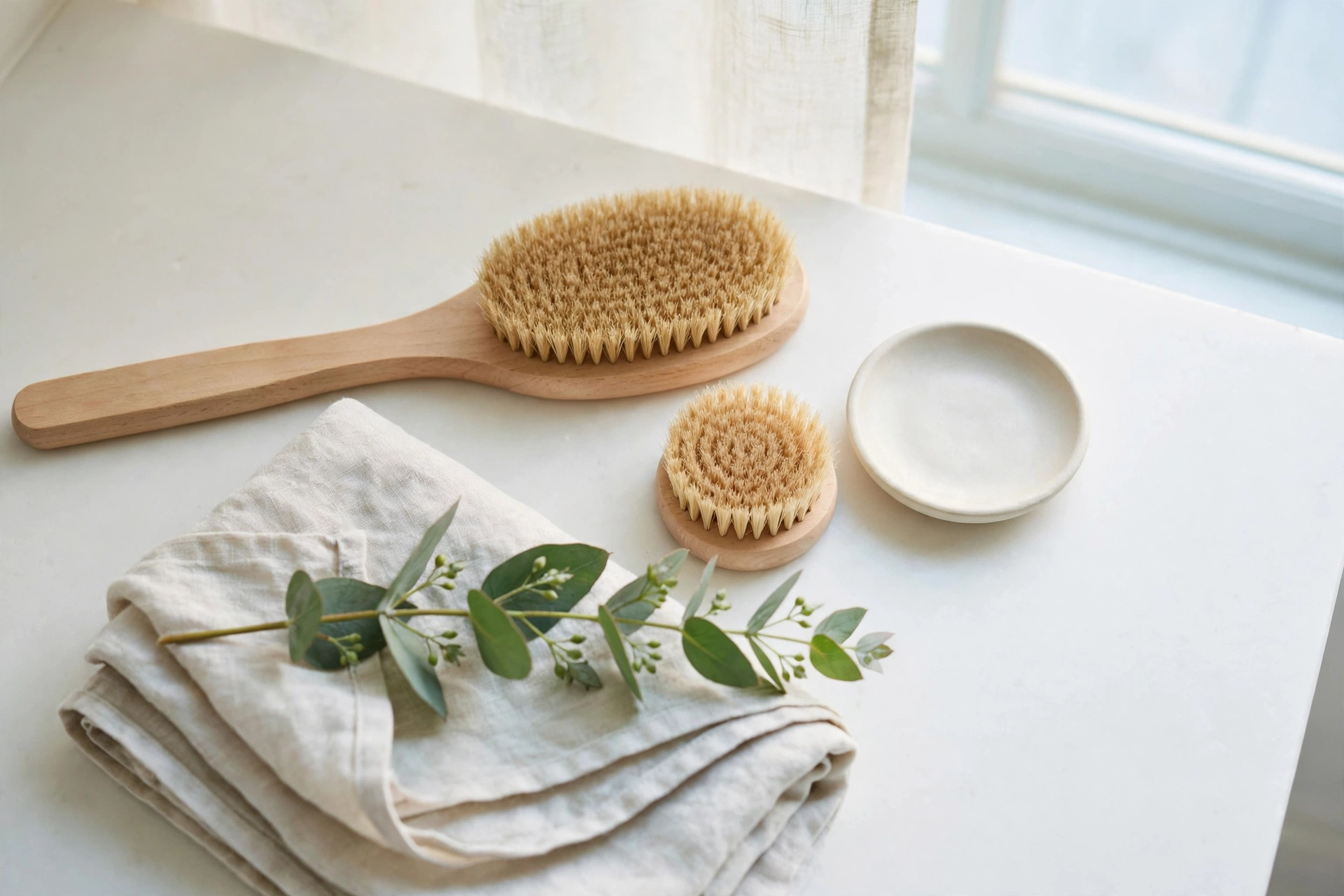
You have probably seen the ritual by now — someone sweeping a stiff natural-bristle brush over dry skin before their morning shower, long strokes up the legs, circles over the stomach, promising smoother skin, better circulation, a drained lymphatic system, and cellulite that simply melts away. Dry brushing has gone from an ancient Ayurvedic practice to a bathroom-shelf staple, and the dry brushing benefits claimed for it grow louder every year.
Here is the plain-English version: what dry brushing actually is, which of those benefits have real evidence behind them, how to do it without hurting your skin, and which claims are hype.
What is dry brushing, exactly?
Dry brushing is sweeping a dry, stiff-bristled brush over dry skin, usually right before you shower. No water, no oil, no lotion during the brushing itself — just the brush and your skin. The tool is usually a natural-bristle body brush, often with a long handle so you can reach your back, and the strokes go upward on the limbs and in circles on the torso.
The practice comes from Ayurveda, where it was called garshana — literally “friction by rubbing” — and it is thousands of years old. The traditional idea was that the friction would stimulate circulation and help the body clear waste through the skin. The modern version keeps the ritual and adds new claims: detox, lymphatic drainage, cellulite reduction, even better digestion.
The honest frame is simpler: dry brushing is a form of mechanical exfoliation. The brush physically lifts dead cells off the surface of your skin. That is the one effect every source agrees on, and it is the effect everything else should be measured against.
The dry brushing benefits with real support
So what does the brushing actually do? Here is what holds up once you separate the one confirmed effect from the bigger claims.
Smoother-feeling skin: the best-supported claim
- It exfoliates. This is the benefit the sources agree on. Brushing lifts loose, flaky surface cells, and skin feels noticeably smoother and softer right afterward. Medical News Today calls exfoliation the only confirmed benefit of dry brushing. Cleveland Clinic dermatologist Dr. Shilpi Khetarpal says the mechanical action is “excellent for exfoliating rough, dry skin” and that it unclogs pores in the process.
- Moisturizer may work better after. Once the layer of dead cells is swept away, the lotion or oil you put on after your shower may spread more evenly and absorb more readily. The improvement is mild and temporary, but it is real — and it is the most practical reason to keep the ritual.
- Keep the frame honest, though. There is no strong evidence that dry brushing exfoliates better than any other form of exfoliation. A washcloth, a scrub, or a chemical exfoliant all remove dead surface cells. The brush is a satisfying tool for the job, not a superior one.
A temporary circulation boost: real, but short-lived
- Skin looks briefly flushed and plumper. Brushing increases blood flow near the surface of the skin, which is why skin looks pink and feels warm afterward. That extra blood flow can make skin look temporarily smoother and slightly plumped — which is very likely what people interpret as cellulite looking better after a session.
- What that means in practice. The effect is surface-level and short-lived. There is no strong evidence that dry brushing improves overall cardiovascular or circulatory health. It changes how the surface of your skin looks for a while, not how your circulation works.
The claims without evidence: detox, lymph, and cellulite
- Detox. There is no scientific evidence that dry brushing helps detoxify your body. Your liver and kidneys handle detoxing internally — your skin has no toxin compartment a brush can drain, and no study has shown brushing removes toxins.
- Lymphatic drainage. The evidence here is limited to the point of absence: no study has shown that ordinary dry brushing measurably improves lymphatic function in healthy people. Manual lymphatic drainage is a real therapy, but it is a featherlight, precisely sequenced technique performed by trained therapists for diagnosed lymphedema — nothing like brisk brushing. A healthy lymphatic system is moved along by muscle contraction, breathing, and one-way valves, and it does not need outside help.
- Cellulite. Cleveland Clinic is blunt: there is no proof dry brushing reduces cellulite or the appearance of cellulite, and the claim is not supported by any scientific evidence. Cellulite is structural — fat deposits held in place by fibrous bands under the skin — and surface brushing cannot change that anatomy. Cellulite affects the large majority of women after puberty, regardless of weight or fitness, and even in-office medical procedures aimed at it produce results that are modest, variable, and often temporary.
Notice what is not on the supported list: anything below the surface. Dry brushing works on the top layer of your skin, and that is where its benefits stop.
Dry brushing benefits: what’s real and what’s hype
This is where a little honesty helps. The brushing feels good and does one thing well — just not the things on the bottle.
| Claim | What the evidence says |
|---|---|
| Exfoliates dead skin | Yes — the one confirmed benefit |
| Smoother-feeling skin | Yes, mild and temporary |
| Boosts circulation | Briefly, near the surface only |
| Helps moisturizer absorb | Plausibly, after exfoliation |
| Detoxes your body | No evidence |
| Drains the lymphatic system | No evidence in healthy people |
| Reduces cellulite | No evidence — effect is temporary plumping |
| Better than other exfoliation | Not shown |
The hype to skip: any product or video claiming dry brushing “flushes toxins,” “drains your lymph,” or “melts cellulite in a week.” And do not brush harder to chase those results — more pressure does not reach deeper structures, it just irritates the skin.
How to dry brush
The dry brushing benefits worth having come from doing it gently: light pressure, short sessions, and moisturizer after. There is no official medical protocol — the steps below are what dermatologists who tolerate the practice suggest.
- Do it before your shower, on dry skin. This is when the loose cells sweep away cleanly, and the shower afterward rinses them off. Morning is the usual time, but any time before a shower works.
- Use a natural-bristle brush, preferably with a long handle. Look for firm natural bristles — sisal, hemp, or other plant fibers — rather than harsh synthetics. If your skin is sensitive, a plain dry washcloth is a gentler option that does the same job.
- Start at your feet and work upward in long, fluid strokes. On arms and legs, use long strokes toward your heart. On your torso and back, use gentle circular motions. Lighten the pressure on sensitive areas like the abdomen, breasts, and neck.
- A few overlapping swipes per area is enough. Do not keep scrubbing the same spot. Going over one area for too long can cause irritation or even bleeding. The brushing should feel invigorating, never painful — if your skin turns excessively red, ease up.
- Shower immediately afterward, then moisturize. Rinse away the loosened cells, then put on body lotion or oil while your skin is still slightly damp. Exfoliation can temporarily leave the skin barrier more vulnerable to moisture loss, so the moisturizer matters.
- Start slow on frequency. Experts disagree on how often: Cleveland Clinic describes daily brushing, Westlake Dermatology suggests two to three times a week, and Medical News Today says start weekly. Begin two or three times a week and see how your skin responds before doing it more often.
Who should be careful with dry brushing
Dry brushing is safe for most adults with healthy, intact skin when done gently, but a few people should skip it or choose a gentler option.
- If your skin is broken, burned, or infected, skip it. Do not brush over cuts, scrapes, open wounds, sunburn, rashes, active infections, or areas of redness, irritation, or inflammation — including cellulitis and skin cancer. Stop right away if brushing causes redness, swelling, or irritation.
- If you have eczema, psoriasis, rosacea, or active acne, be cautious. Westlake Dermatology advises against dry brushing with these conditions, and the American Academy of Dermatology suggests people with dry, sensitive, or acne-prone skin may prefer a washcloth or a mild chemical exfoliant instead.
- Never brush over moles, warts, or raised bumps. Brushing over them can irritate or injure them. See your dermatologist if you have questions about a specific spot.
- Avoid your face. Facial skin is more sensitive than the skin on the rest of your body, and Cleveland Clinic’s dermatologist advises against using a dry brush there.
- If you use retinoids or other strong exfoliating products, think twice. Combining a brush with products that already thin or sensitize the skin can add up to real irritation. If you are unsure, ask your dermatologist first.
None of this makes dry brushing dangerous for a healthy adult. It makes it a bathroom ritual worth treating like one — a pleasant exfoliation step, not a treatment.
What to do next
If this guide has you curious, here is how I would start:
- Use a plain natural-bristle brush. No special features, no added ingredients, nothing to pay extra for. A dry washcloth works too if your skin is sensitive.
- Try two or three times a week, before your shower. Light pressure, long strokes upward, a few swipes per area — then shower and moisturize.
- Judge it by how your skin feels. Smoother, softer, less flaky — that is the benefit you are actually getting. Not the shade of your thighs or a lab number.
- Stop if it irritates. Redness that lingers, soreness, scratches, or dryness that gets worse are all signs to ease up or quit. The ritual is optional, not a necessity.
- Keep the rest of your routine exactly as before. Dry brushing sits on top of the basics — gentle cleansing and moisturizing — it never replaces a step.
The bottom line
The dry brushing benefits that hold up come down to one thing: it exfoliates, leaving skin feeling smoother and softer, with a brief flush of surface circulation that can make skin look temporarily plumper. It does not detox your body, does not meaningfully drain your lymphatic system, and does not reduce cellulite — and no trial has shown it beats any other form of exfoliation. But as a simple, cheap ritual used gently, a few times a week before your shower, it earns its place in the bathroom. Start with a soft touch, a few strokes, and a good moisturizer, and see how your skin feels.
This post is for general information only and is not medical advice. If you have a health condition, check with your clinician or dermatologist before changing personal care or health routines.