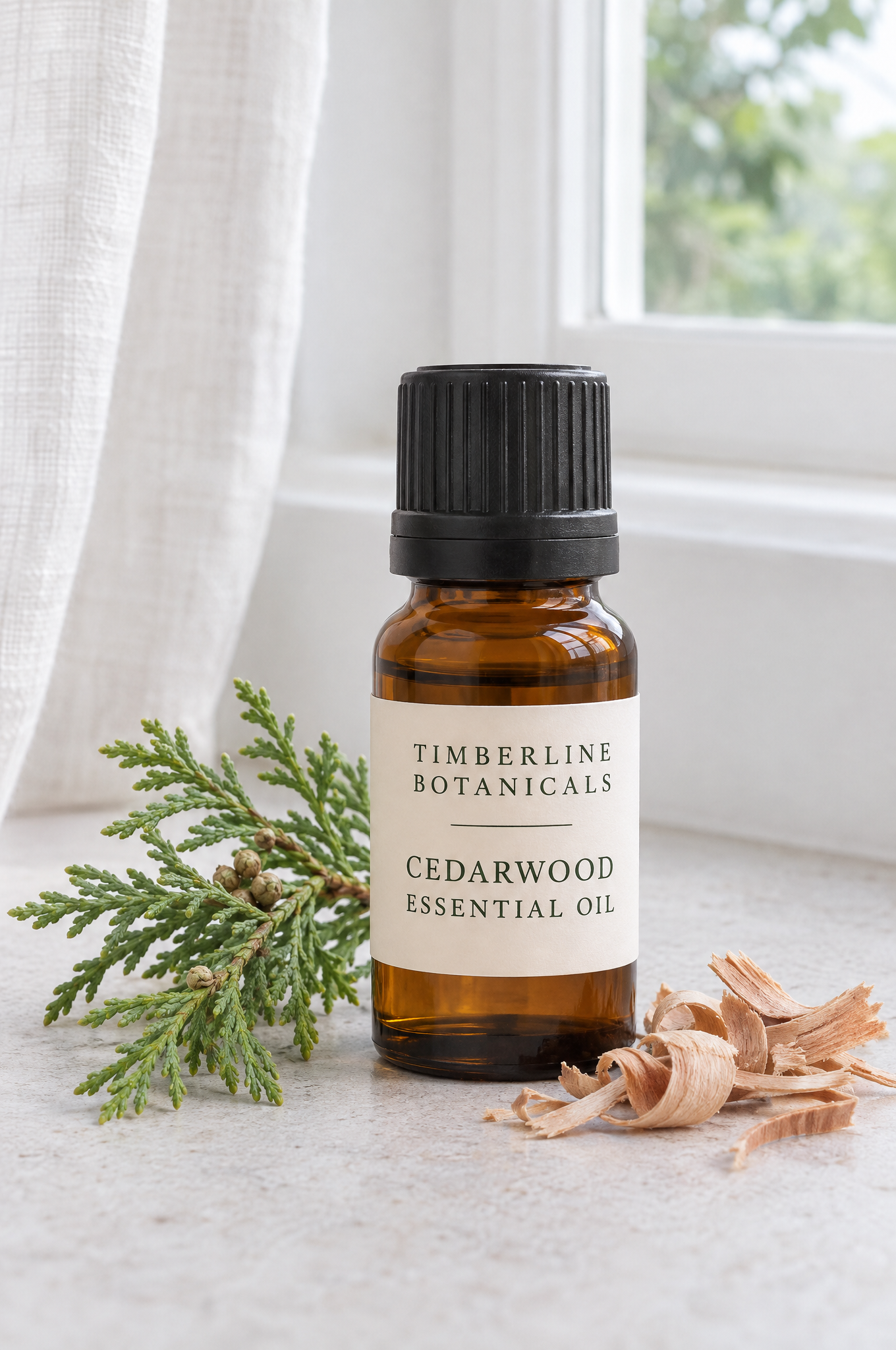
You know the smell of a cedar chest, or a walk through a pine forest after rain — warm, woody, dry, and a little bit sweet? Cedarwood essential oil is that smell in a bottle, and it is one of the most grounding oils I own. It is not a bright, cheerful oil like lemon or peppermint. It is a quiet, steady one: the bottle I reach for in the evening, for my hair, and for the rooms of the house that need to smell like a forest instead of a candle.
What Is Cedarwood Essential Oil?
Cedarwood essential oil is steam-distilled from the wood of cedar trees, and there are two kinds you will see on shelves: Atlas cedarwood, from Cedrus atlantica, and Virginian cedarwood, from Juniperus virginiana. Both are sold as cedarwood oil, both smell warm and woody, and either one works for the uses in this guide — I use Virginian most often because it is the easier one to find and a little sweeter in scent, while Atlas is drier and more resinous.
The main compound in both is cedrol, the molecule behind the wood’s scent and much of its traditional reputation. The oil is pale yellow, a little thicker than citrus oils, and a little goes a long way — two or three drops in a diffuser will scent a whole room, and one drop in a spoonful of carrier oil is plenty for skin or hair.
Cedarwood Essential Oil Benefits for Hair
Hair is where cedarwood earns its place on my shelf. It is traditionally used for the scalp and hair — massaged in, left to sit, and washed out — and it is the oil I add to my scalp oil whenever my hair feels flat or my scalp feels dry and tight. My routine is simple: a few drops of cedarwood in a tablespoon of jojoba or sweet almond oil, massaged into the scalp with my fingertips, left for half an hour, then washed out with my usual shampoo. My hair feels fuller and softer afterwards, and my scalp feels comfortable rather than tight.
I also add a drop to my shampoo bottle — one drop per wash, shaken in before I use it — which is the easiest way to use cedarwood for hair if you do not want a separate scalp treatment. And for a dry scalp in winter, a drop of cedarwood with a drop of rosemary in a spoonful of oil, massaged in before bed and washed out in the morning, is the blend I come back to most. I keep the dilution gentle and I never use it undiluted on my scalp, the same as any essential oil.
Cedarwood Oil Benefits for Skin
For skin, cedarwood is a quiet helper rather than a star. It is traditionally used for skin that looks oily or blemish-prone, and for the occasional spot that needs a little extra care. I use it in a simple evening face oil: one drop of cedarwood in a teaspoon of jojoba, smoothed over clean skin at night, sometimes with a drop of lavender beside it. It feels balancing rather than drying, and it suits my skin best when it is acting up.
Cedarwood also earns its keep in a simple body oil for rough or dry patches — a few drops in a spoonful of sweet almond oil, massaged over elbows or heels, leaves skin feeling soft and smelling faintly of the forest. I patch test every new blend on my inner arm first and wait a day before using it on my face, and I skip cedarwood on broken or irritated skin.
If you like calming oils in general, my Lavender Essential Oil Benefits guide covers the bottle I pair with cedarwood most often — lavender in the evening, cedarwood beside it, and the two blend beautifully together in a diffuser.
Cedarwood Essential Oil Uses Around the Home
The home is where cedarwood is most at home, quite literally. Its traditional use as a moth repellent is the one I rely on most: a few drops on a cotton ball or a small cedar block tucked into a drawer or a wardrobe keeps woollens safe and smelling wonderful, the modern version of the old cedar chest. I refresh the drops every few weeks, and I keep the oiled cotton away from direct contact with delicate fabrics.
Cedarwood is also my deodoriser of choice for shoes and musty corners — a drop on a cotton ball inside a pair of shoes, or a few drops in a spray bottle of water for the air in a closed-up room. And in the diffuser it is my evening oil: two or three drops with a drop of lavender, run for an hour before bed, makes the house smell like a forest cabin and helps the whole evening slow down. It is the scent I choose when I want the room to feel calm rather than bright.
How to Use Cedarwood Essential Oil
There are three simple ways I use cedarwood oil, and they cover almost everything. In the diffuser, two to three drops in water, run for thirty to sixty minutes — alone for a woody scent, or with lavender for a calmer evening blend. On skin and hair, one to two drops per teaspoon of carrier oil for skin, or a few drops per tablespoon for a scalp treatment, with a patch test first. Around the home, a few drops on cotton balls or cedar blocks for drawers and wardrobes, or ten drops in a spray bottle of water for a room spray.
A few habits keep it simple and safe. I store the bottle upright in a cool, dark cupboard, because wood oils keep well but still prefer the dark. I keep the cap on tight, and I keep the bottle out of reach of children and pets. Cats are sensitive to essential oils, so I never diffuse in a small closed room with a cat in it, and I always leave a door open so they can leave.
Cedarwood Essential Oil Safety: What to Know
Cedarwood is gentle as oils go, but it still deserves respect. The big rule is dilution: never use it undiluted on skin, and keep it away from your eyes. If you are pregnant, nursing, taking medication, or managing a health condition, check with your clinician before using it — cedarwood is one of the oils I skip entirely during pregnancy, and I ask first rather than guessing. Never take cedarwood oil internally, and if you notice redness, itching, or irritation, stop use and wash the area with plain carrier oil or soap and water.
One more note: buy from a seller who names the species on the label — Cedrus atlantica or Juniperus virginiana — so you know what you are getting. A bottle that just says “cedarwood oil” with no species and no Latin name is a bottle I pass on, because the two kinds smell and behave a little differently, and I want to know which one I am buying.
Cedarwood Essential Oil: Best For
Cedarwood essential oil is best for you if you love warm, woody scents, if you want one bottle that covers hair, skin, and the home, or if you are looking for a calm evening oil that is not lavender. Try it first in the diffuser — three drops on a quiet evening is the easiest way to meet this oil — and then try the scalp oil once your skin has passed a patch test. If you are building a small oil collection and want one bottle that feels like a forest, this is the one I would add.
The Bottom Line on Cedarwood Essential Oil Benefits
Cedarwood essential oil is the grounding bottle in my collection: a warm, woody oil that cares for hair and scalp, balances skin, keeps the wardrobe fresh, and settles a room in the evening. The rules are simple — dilute it, use a drop or two at a time, store it cool and dark — and in return one little bottle does the work of three. If your oil shelf has room for one more steady, forest-scented staple, this is the one I would add.
This article is for general information only and is not medical advice. Talk to your doctor before using essential oils if you are pregnant, nursing, taking medication, or managing a health condition, and stop use if you notice irritation. Never take cedarwood essential oil internally.