You’ve probably seen the glucose-spike videos by now: someone eats a bagel, their monitor line shoots up like a ski jump, and a voiceover tells you that blood sugar spike is quietly wrecking your energy, your skin, and your future. Then comes the fix — a special order to eat your food in, a spoonful of vinegar, a supplement, a gadget.
Some of that is real. Some of it is a sales pitch dressed up as science. This guide is the honest version: what blood sugar actually is, what a spike is and when it matters, what’s normal after you eat, and which food and habit changes have real evidence behind them — plus the ones that don’t deserve the hype. No products, no gadgets, no miracle fixes. Just the basics, done properly.
What Is Blood Sugar, Really?
Blood sugar is glucose — the sugar your body runs on — floating in your bloodstream. You get most of it from the carbohydrates you eat: bread, rice, pasta, fruit, beans, milk, and anything sweet. Your digestive system breaks those carbs down into glucose. The glucose enters your blood. Then a hormone called insulin moves it from your blood into your cells. There, it’s burned for energy or stored for later.
That rise and fall after a meal is completely normal. Your blood sugar is supposed to go up when you eat and come back down afterwards. The system only becomes a problem when the rises get very large, very often. It also becomes a problem when your body stops responding to insulin the way it should. That state is called insulin resistance. Over years, insulin resistance can lead to prediabetes and then type 2 diabetes. That is why the everyday habits in this guide matter even if your numbers are fine today.
A useful way to think about it: your blood sugar is a curve, not a single number. What matters is the shape of that curve. How high does it climb after a meal? How fast does it climb? And how quickly does it settle back down? A gentle hill is normal. A sharp mountain, several times a day, every day, is the pattern worth smoothing out.
What Causes Blood Sugar Spikes?
A blood sugar spike is a fast, steep rise in glucose after eating. It usually peaks 30 to 90 minutes after you start a meal. The size of the spike depends on what you ate, how much of it, and what you ate it with. It also depends on what your body was doing that day. Sleep, stress, and movement all change the curve.
Blood Sugar Spikes After Refined Carbs and Sugary Drinks
The biggest spikes come from foods that turn into glucose fast, with nothing to slow them down. White bread, white rice, pastries, breakfast cereals, and fruit juice are mostly starch or sugar. They have very little fiber, protein, or fat to slow digestion. Your stomach empties quickly. The sugar hits your bloodstream in a rush, and the curve shoots up.
Sugary drinks are the fastest of all, because liquid sugar needs almost no digestion. A sweetened coffee or a soda can push your blood sugar up within minutes. There is no fiber or protein in the glass to put the brakes on. This is also why whole fruit behaves so differently from juice. An apple comes with fiber that slows everything down. Apple juice, by contrast, is the sugar without the brake pedal. The fruit isn’t the problem — the processing is.
Portion size matters just as much as the food itself. A small serving of rice with vegetables, beans, and chicken produces a very different curve from a heaping plate of rice on its own. Same food, different spike — which is good news, because it means you don’t have to give up foods you love. You mostly have to change what goes with them and how much of them lands on the plate at once.
Blood Sugar Spikes, Stress, and Short Sleep
Food isn’t the only thing that moves your blood sugar. Stress does too. When you’re stressed, your body releases cortisol and adrenaline, and those hormones tell your liver to release stored glucose into your blood — fuel for a fight-or-flight moment that, in modern life, never actually arrives. A tense week can raise your blood sugar even when your meals haven’t changed at all.
Short sleep does the same thing from a different direction. In a classic 1999 study from the University of Chicago, healthy young men restricted to four hours in bed for six nights handled glucose measurably worse the next day. Their evening cortisol ran higher too. One bad night won’t ruin anything. But a pattern of short sleep quietly pushes your blood sugar curve in the wrong direction. And, just like stress, it does it without you eating a single extra thing.
This is why the advice in this guide isn’t only about food. Sleep and stress are blood sugar habits too, and for some people they’re the bigger lever.
Blood Sugar After Eating: What’s Normal?
If you’ve ever looked at your own numbers — or a friend’s glucose monitor — and wondered whether they’re normal, here are the reference ranges the American Diabetes Association uses. These are the diagnostic thresholds from its 2026 Standards of Care, for adults who aren’t pregnant:
| Test | Normal | Prediabetes | Diabetes |
|---|---|---|---|
| Fasting glucose (after 8+ hours without food) | Below 100 mg/dL | 100–125 mg/dL | 126 mg/dL or higher |
| A1C (average over ~3 months) | Below 5.7% | 5.7–6.4% | 6.5% or higher |
| 2-hour oral glucose tolerance test | Below 140 mg/dL | 140–199 mg/dL | 200 mg/dL or higher |
A few things worth knowing about these numbers. First, one high reading isn’t a diagnosis. Outside of clearly high results with symptoms, the ADA asks for two abnormal results before diabetes is confirmed. Second, these are diagnostic lines, not treatment targets. Once someone has diabetes, their doctor usually sets different goals. For most adults, that’s roughly 80–130 mg/dL before meals and under 180 mg/dL one to two hours after. Third, a single spike after a big meal doesn’t mean you have prediabetes. What matters is the pattern across days and weeks. That is exactly what the A1C — a three-month average — is designed to capture.
If you wear a continuous glucose monitor, remember that it reads fluid under the skin, not blood directly. It lags behind your actual blood glucose by about 5 to 15 minutes. A monitor also doesn’t diagnose anything on its own. It shows you the shape of your curve, which is useful. But the curve needs a doctor to interpret it, not a supplement brand.
How Blood Sugar Spikes Affect Your Body Over Time
A single spike after a birthday dinner is not a health crisis. Your body is built to handle occasional rises. The concern is the pattern: large spikes, several times a day, day after day, for years. That pattern is associated with insulin resistance, and insulin resistance is the slow road toward prediabetes and type 2 diabetes.
What does a big spike feel like in the moment? For many people, the honest answer is: nothing obvious. Some people notice a burst of energy followed by a crash. That crash can mean sleepiness, a craving for something sweet, or trouble concentrating an hour or two after a carb-heavy meal. It happens because a very sharp rise often triggers a strong insulin response. That response can overshoot and pull your glucose down fast. But plenty of people feel nothing at all. That is why spikes are easy to ignore until a lab result flags them years later.
This is also where I want to be straight with you about what the evidence does and doesn’t say. We know that large, frequent glucose excursions are linked to worse metabolic health over time. We do not have proof that flattening every single spike in a healthy person prevents disease. Most of the strong evidence comes from people who already have prediabetes or diabetes. So think of the habits below as sensible, low-risk ways to smooth the curve. They are not a guarantee. And they are not something to obsess over meal by meal.
Foods That Help Steady Blood Sugar
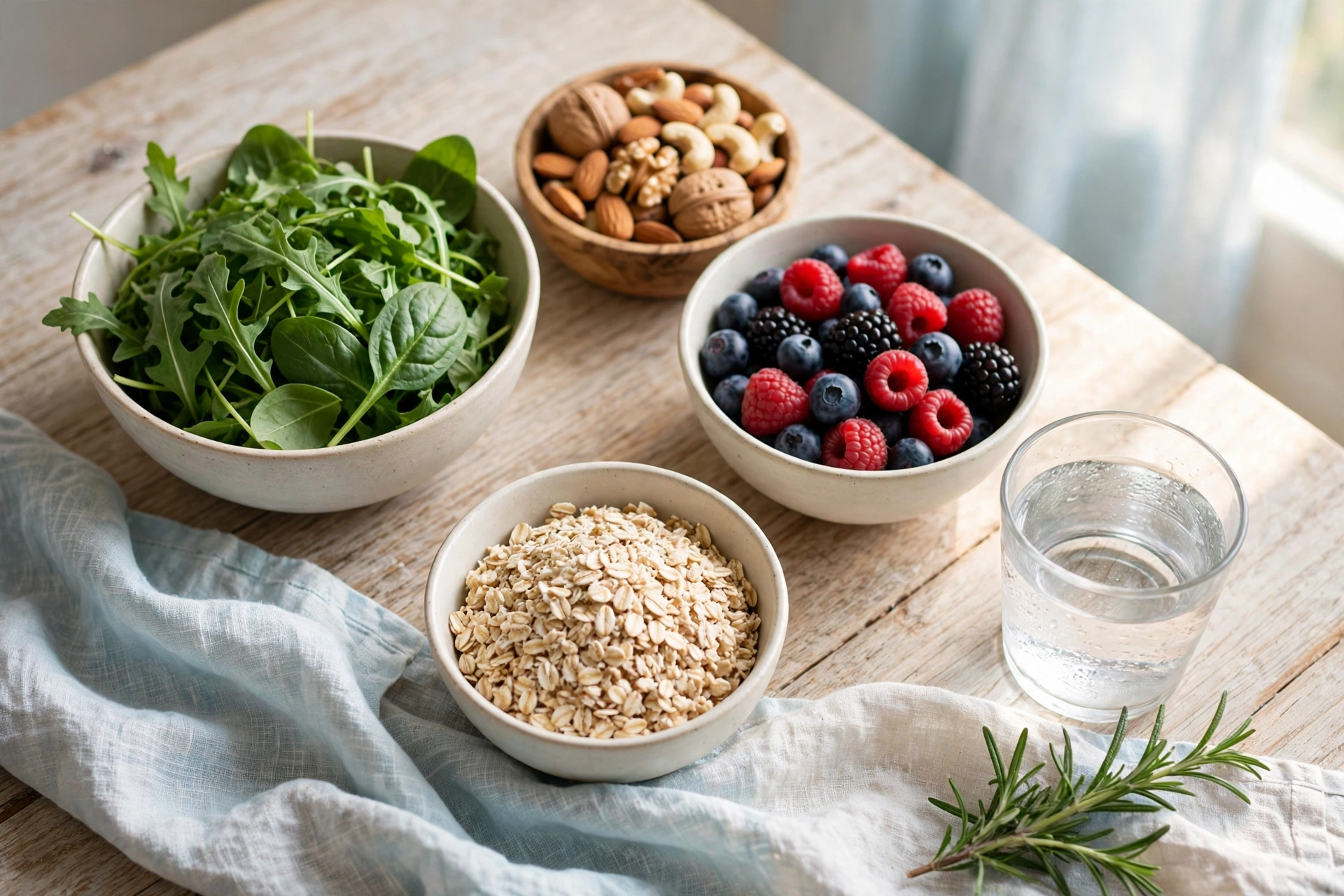
No single food lowers your blood sugar on its own. What steadies the curve is the combination on your plate: fiber that slows digestion, protein and fat that slow the stomach’s emptying, and carbohydrates that arrive gradually instead of all at once. These are the foods that do that job well.
Vegetables, Beans, and Nuts for Steady Blood Sugar
Leafy greens and non-starchy vegetables — spinach, kale, broccoli, green beans, peppers, salad leaves — are the foundation. They’re high in fiber and water, very low in digestible carbohydrate, and they add volume to a meal without adding much glucose at all. Eating a good portion of them first is the simplest version of the food-order trick I’ll get to below.
Beans, lentils, and chickpeas deserve a special mention. They’re one of the rare foods that combine fiber and protein in the same bite, and their starch digests slowly. A meal built around beans produces a noticeably gentler glucose curve than the same amount of carbohydrate from white bread or rice.
Nuts and seeds — walnuts, almonds, pumpkin seeds, chia, flax — bring fat, fiber, and a little protein with almost no fast carbohydrate. A small handful with a piece of fruit slows the fruit’s glucose rise considerably, which is why “apple with almond butter” behaves so differently from an apple on its own.
Fatty fish, eggs, and plain yogurt add protein and fat without carbohydrate, and protein is the nutrient that most reliably slows the stomach’s emptying. A breakfast with eggs will almost always produce a flatter morning curve than a breakfast of cereal and juice with the same calories.
How Whole Grains and Fruit Affect Blood Sugar
Whole grains — steel-cut oats, brown rice, quinoa, whole wheat bread — still raise blood sugar, because they are still carbohydrate. The difference is speed: their fiber and intact structure mean the glucose arrives over a longer stretch instead of a rush. They’re a better choice than refined grains, but they’re not a free pass. Portion still counts.
Berries, apples, pears, and citrus are the fruits that tend to sit best on a glucose curve, because they pair natural sugars with fiber and water. Dried fruit and juice are the opposite: the sugar is concentrated and the fiber is mostly gone. If you love juice, a small glass with a meal is a different thing from a large glass on an empty stomach.
Here’s the comparison in one place:
| Steadies blood sugar | Tends to spike it |
|---|---|
| Leafy greens and non-starchy vegetables | White bread, white rice, pastries |
| Beans, lentils, chickpeas | Sugary drinks and fruit juice |
| Nuts, seeds, and nut butters | Breakfast cereals and sweetened yogurt |
| Eggs, fish, plain yogurt | Large portions of refined starch on their own |
| Whole grains in modest portions | Candy and desserts eaten alone |
| Whole fruit, especially berries and apples | Dried fruit in large handfuls |
| Water and unsweetened tea | Sweetened coffee drinks |
None of this is a ban list. The right-hand column isn’t forbidden — it’s food that works better in a smaller portion, at the end of a meal, or paired with something from the left-hand column. That’s the whole game: pairing and order, not perfection.
Blood Sugar Balancing Meals: How to Build One
If you take one idea from this guide, make it this one: the order you eat your food in changes your blood sugar, even when the food itself doesn’t change at all.
The study that put this on the map came from Weill Cornell in 2015. Eleven adults with type 2 diabetes ate the exact same meal — ciabatta bread and orange juice, grilled chicken, salad, and broccoli — on different days, in different orders. When they ate the vegetables and protein first and saved the bread and juice for last, their blood sugar ran about 29 percent lower at 30 minutes and 37 percent lower at 60 minutes than when they ate the carbohydrates first. Measured as the total glucose response over two hours, the carbs-last version came out roughly 73 percent lower. The insulin response dropped too, by about 48 percent.
Those percentages come from a small pilot in people whose glucose responses were already exaggerated, so don’t treat them as a promise for your own plate. But the effect has since been replicated in people with prediabetes — a 2019 study found the glucose peak roughly 46 percent lower with vegetables and protein first — and the mechanism is well understood: fiber slows the stomach’s emptying, and protein prompts the gut to release hormones, GLP-1 among them, that slow things down further and prime insulin before the carbohydrate arrives.
Blood Sugar Balancing Meals in Practice
In practice, the order is simple: vegetables and fiber first, protein and fat next, carbohydrates and sugars last. You don’t need a 15-minute gap between courses the way the study used — just eat your salad before your bread, your chicken before your rice, your vegetables before your pasta. It costs nothing, it changes nothing about what you eat, and it’s one of the best-supported habits in this whole guide.
The plate version of the same idea: fill about half your plate with non-starchy vegetables, a quarter with protein, and a quarter with carbohydrate — and eat in that order. Add a source of healthy fat, like olive oil or avocado, and a glass of water instead of a sweetened drink, and you’ve built a blood sugar balancing meal without counting a single thing.
Simple Habits That Help Control Blood Sugar
Food is half the story. The other half is what you do around the meal — and these habits are so simple they almost feel too small to matter. They do matter, and the studies behind them are solid.
Blood Sugar Habits: Move, Sleep, and Unwind
Walk after you eat. This is the single best-supported habit in the guide after food order. In a 2016 trial in Diabetologia, 41 adults with type 2 diabetes walked for 10 minutes after each main meal. Their post-meal glucose rise came out about 12 percent lower over three hours than when they did a single 30-minute walk at some other point in the day. The biggest difference was about 22 percent, after the evening meal.
An earlier study found that three 15-minute walks after meals beat one 45-minute walk for 24-hour glucose control in older adults at risk of diabetes. And a 2025 study in healthy young adults found that even a 10-minute comfortable walk immediately after a glucose drink lowered both the two-hour glucose exposure and the peak, compared with resting. Start within about 30 minutes of finishing, walk 10 to 15 minutes at an easy pace, and you’ve used your muscles to soak up glucose directly — no insulin required for that part.
Protect your sleep. Seven to nine hours, on a consistent schedule, is the target — and it counts as a blood sugar habit, not just a wellness slogan. Short sleep worsens next-day glucose handling and raises evening cortisol, which pushes blood sugar up on its own. If your sleep is consistently short, fixing that will do more for your blood sugar than any food tweak.
Give stress a daily outlet. You can’t remove stress from your life, but you can give your body a daily signal that the emergency is over: a walk outside, a few minutes of slow breathing, stretching, time with a friend. The cortisol guide I wrote earlier covers this in detail, and the same logic applies here — stress hormones raise blood sugar whether you eat anything or not.
Vinegar and Cinnamon for Blood Sugar, in Perspective
Vinegar before a starchy meal — with honest expectations. You’ve probably seen this one online, and there is real evidence behind it, just less than the videos claim. In a 2004 study in Diabetes Care, 29 adults drank 20 grams of apple cider vinegar diluted in water two minutes before a bagel, butter, and orange juice breakfast. Insulin sensitivity over the next hour was 34 percent higher in the insulin-resistant group. An earlier trial found a roughly 31 percent lower glucose response when vinegar was served with white bread. A 2020 meta-analysis of 11 randomized trials confirmed that vinegar modestly reduces the post-meal glucose and insulin rise.
The effect is modest, the trials are small, and the active ingredient is acetic acid — which every vinegar contains, so apple cider vinegar isn’t special. If you try it, dilute one to two tablespoons in a large glass of water and drink it with or just before the meal, and never drink vinegar straight: undiluted acid is rough on tooth enamel and your throat. It’s a small helper, not a fix, and it doesn’t replace any of the habits above.
Cinnamon, in passing. Small trials of cinnamon and blood sugar exist, and the results are mixed — some show a small effect, others show none, and the doses and preparations vary so much that no honest guide can recommend a specific amount. If you enjoy cinnamon in your food, keep enjoying it. Don’t buy it as a blood sugar treatment.
How to Lower Blood Sugar Naturally After a Spike
Sometimes the spike already happened — a big restaurant meal, a holiday dinner, a day that just got away from you. Here’s what actually helps in the hours afterwards, and what doesn’t.
Go for a walk. Ten to fifteen minutes, easy pace, as soon as you reasonably can. Of everything in this guide, this is the one with the most direct effect on a spike that’s already underway, because working muscles take up glucose without waiting on insulin.
Drink water. It won’t lower your blood sugar by itself, but staying hydrated supports your kidneys in clearing excess glucose, and thirst is easy to mistake for hunger after a big meal.
Don’t stack another spike on top of it. The most common mistake after a big meal is reaching for something sweet an hour later, while your glucose is still coming down. Give your body a couple of hours before the next carbohydrate-heavy snack.
Don’t try to “burn it off” with a punishing workout. A hard session raises stress hormones in the short term, and if you’re already tired or stressed, it can push your glucose up before it comes down. Gentle movement is the right tool here.
And don’t panic about the number. One high reading after one meal is not a diagnosis and not a verdict on your health. What matters is the pattern over weeks. If your readings are often high, that’s a conversation for your doctor — not a reason to buy a supplement or a detox tea.
Blood Sugar Myths Worth Dropping
Myth: fruit spikes your blood sugar like soda. Whole fruit and soda are not the same food. An apple’s sugars come wrapped in fiber and water, which slow digestion; soda’s sugar arrives with nothing to slow it. Berries, apples, and pears in normal portions produce a much gentler curve than juice or sweetened drinks.
Myth: you need a glucose monitor to eat well. A continuous monitor shows you your own curve, which is genuinely interesting — but the habits that flatten the curve are the same whether or not you can see it: vegetables first, protein with your carbs, a walk after eating, enough sleep. You don’t need a device to do any of that.
Myth: all carbohydrates are the enemy. Lentils are carbohydrates. So are oats, apples, and sweet potatoes. The question is never “carbs or no carbs” — it’s which carbs, how much, what they’re eaten with, and in what order. A diet that fears beans is a diet that misunderstood the science.
Myth: vinegar, cinnamon, or a supplement “fixes” blood sugar. The vinegar evidence is real but modest, cinnamon’s is mixed, and most blood sugar supplements have little or no evidence in people. None of them replaces food order, movement, sleep, or medical care when it’s needed. If a product promises to flatten your spikes, ask who funded the study — and whether there was one at all.
Myth: a single spike means something is wrong with you. Spikes are normal after eating. What matters is how high, how often, and what your longer-term numbers — fasting glucose and A1C — look like. Judging your health by one post-meal peak is like judging your fitness by one heartbeat.
When Blood Sugar Deserves a Doctor’s Visit
This guide is education, not medical advice, and there are times when the right move is a conversation with your doctor rather than another habit tweak. Book one if any of these sound familiar: fasting glucose repeatedly at or above 100 mg/dL, an A1C in the prediabetes range, excessive thirst or urination, unexplained weight loss, blurry vision, wounds that heal slowly, or frequent infections. Also talk to your doctor before changing anything if you already take glucose-lowering medication — food order and walking are gentle, but vinegar and any supplement can interact with medication, and your doses may need adjusting as your habits improve.
If diabetes runs in your family, if you’ve had gestational diabetes, or if you’ve never had your blood sugar checked as an adult, a simple fasting glucose and A1C test is a cheap, quick baseline. Knowing your numbers is better than guessing at them.
The Bottom Line on Blood Sugar Basics
Your blood sugar is a curve, and you have more control over its shape than the internet’s scare stories suggest. Eat your vegetables and protein before your carbohydrates. Build plates that pair fiber and protein with your starches. Take a short walk after your meals. Sleep enough, and give stress somewhere to go. A spoonful of diluted vinegar before a starchy meal can help a little — and it’s honest to say only a little.
None of this requires a gadget, a supplement, or a food you have to give up forever. It’s ordinary habits, repeated daily, that smooth the curve a bit at a time. That’s the whole secret, and it’s not much of a secret at all.
This article is for general information only and is not medical advice. Blood sugar ranges and habits described here are educational; they don’t diagnose or treat any condition. If you have diabetes, prediabetes, or any concern about your blood sugar, talk to your doctor before changing your diet, exercise, or medication.